32 works in this view — arrow keys or swipe to move between them.
Dance in Art
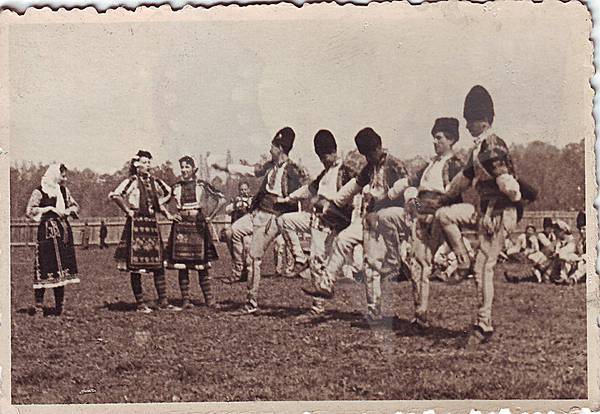
Folk dance in Dobrudzha
Unknown artist
- Dance:
- Folk/Country
- Rights:
- Not recorded. Do not assume this image is free to reuse — check the source record.
For historians of Balkan and Eastern European folk culture, this photograph is evidence of how traditional dress, communal gathering, and dance were still lived practice in the mid-20th century. For dancers and artists, it shows the costume, scale, and social texture of folk celebration in its regional context, beyond the choreographic moment alone.
What you are looking at
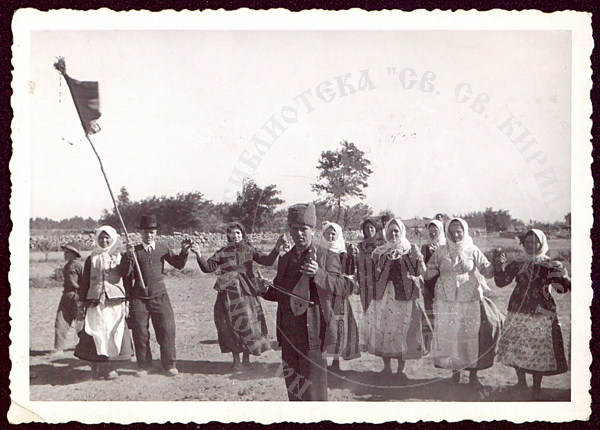
A group of approximately fifteen people stands in an open field under bright daylight, arranged in a loose, informal gathering. They wear traditional Eastern European folk dress: the women in long dark skirts, white aprons, and white headscarves or bonnets; the men in dark suits and hats. A flag—dark-colored, possibly red—is held aloft on the left side of the group. The figures are not in a tight formation but scattered across the frame in a way that suggests either a moment of assembly or dispersal rather than active dancing. The setting is entirely rural: flat open ground with sparse trees visible in the distance. The photograph's age is evident from its black-and-white stock, faded edges, and the formal documentary quality of the composition. A watermark reading "Smokvra '66, ??" crosses the image, suggesting an archival source or collection mark.
The dancing
The figures stand mostly upright and stationary rather than in active dance positions. A few appear to be holding hands or linked in pairs, but no clear closed hold, frame, or ballroom positioning is visible. Several women have their arms at their sides; at least two appear to hold hands across the group's width. The postures suggest a pause in movement—perhaps a moment between dances or during a celebration—rather than the captured instant of footwork or turn. The spacing is uneven and organic rather than arranged in lines or circles typical of structured choreography.
The dance depicted
This photograph documents a folk celebration or gathering in Dobrudzha (a region spanning Romania and Bulgaria) but does not capture an active dance performance. The formal attire, flag, and assembly suggest a communal occasion—possibly a celebration, festival opening, or official gathering—that includes or surrounds dance, but the moment frozen here shows the group assembled rather than dancing. The traditional clothing and regional context indicate this concerns Balkan or Romanian folk tradition, but without visible footwork, formation, or active movement, the specific dance style cannot be determined. The image is valuable as ethnographic documentation of folk costume and community practice rather than as a record of dance technique or choreography.
How it was made
This is a black-and-white photograph, likely a gelatin silver print, taken in natural daylight. The image shows the amateur or documentary conventions of mid-20th-century photography: slight softness of focus, careful composition to include all figures, and a viewpoint that maximizes legibility of dress and setting. The photograph's purpose appears to have been archival or ethnographic—to record the people, their costumes, and their gathering—rather than to capture a dramatic moment of performance. Its reproduction and watermark suggest it came from a collection or archive, possibly a folklorist or cultural documentation project.
About this work
This photograph documents a folk gathering in Dobrudzha, a border region with a distinctive Balkan heritage. The subjects wear traditional regional costume and have assembled in an open field, apparently for a communal celebration marked by a flag and formal grouping. Although the image is catalogued as folk dance, the photograph records the social context and dress of folk culture rather than dance in motion. It belongs in a gallery of dance in art because it represents how dance is embedded in community life and identity—the people, costume, and public occasion that frame the practice—even when the image itself does not show movement.
How to look at it
Look at the costumes first: the women's white headscarves, aprons, and dark long skirts, and the men's formal dark suits establish the regional and temporal context. Observe the spacing and posture of the figures—they are assembled but not actively dancing, suggesting this records the social frame of the celebration rather than its kinetic center. The flag and the formal composition indicate this is a public or official occasion. The photograph's value lies in what it shows about folk culture as lived community practice rather than as choreography on display.
The period
This photograph dates to the mid-20th century (the watermark '66 likely indicates 1966 or a collection code from that era), a period when European folklorists, anthropologists, and photographers undertook systematic documentation of traditional practices before modernization and migration altered them. In Dobrudzha, this moment came as the region was divided between Romania and Bulgaria, making such documentation politically and culturally significant. The photograph reflects the documentary photography movement that treated folk practice as heritage worthy of preservation.
Where it lives
The photograph comes from Europeana, a digital aggregator of cultural heritage collections across European institutions. The watermark 'Smokvra '66, ??,' indicates it is part of an identified collection, likely a folklorist or regional archive, but the full provenance and holding institution are not currently recorded in the available metadata.
Dance in this work
Questions about this work
Is this a staged photograph or a documentary record?
It appears to be documentary. The informal spacing, natural lighting, and composition suggest this was taken to record an actual gathering rather than to stage a folk performance for the camera. The watermark indicates it came from an archive or collection project.
Can you identify the specific dance from this photograph?
No. Although the image documents folk culture in Dobrudzha and the subjects wear regional costume, the photograph captures a moment of assembly rather than active dancing. Without visible footwork, formation, or movement, the specific dance style cannot be determined.
Why is this catalogued as folk dance if no one is dancing?
The image documents the social and material context of folk dance practice—the costume, community, and occasion—rather than the choreography itself. It is valuable as evidence of how dance exists within living culture, not only as a formal performance to be analyzed.
What is the flag?
The flag's identity is not recorded. It is held at the left edge of the group and appears to be dark-colored, possibly red. Its presence suggests an official or national occasion, but without additional context, its specific meaning cannot be stated.
More Folk/Country artwork