30 works in this view — arrow keys or swipe to move between them.
Dance in Art
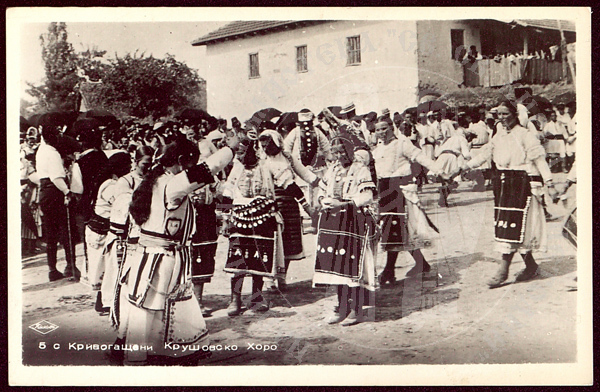
Folk dance in Krivogashtani
Unknown artist
- Dance:
- Folk/Country
- Rights:
- Not recorded. Do not assume this image is free to reuse — check the source record.
This photograph documents an endangered tradition at a moment when it was still primary community practice rather than reconstructed heritage. For Macedonian communities today, it serves as a historical record of their ancestors' actual dress and dance practices. For dance scholars, it is evidence of how Balkan folk dances functioned socially and physically in their home communities, not as staged performances but as participatory village occasions.
What you are looking at
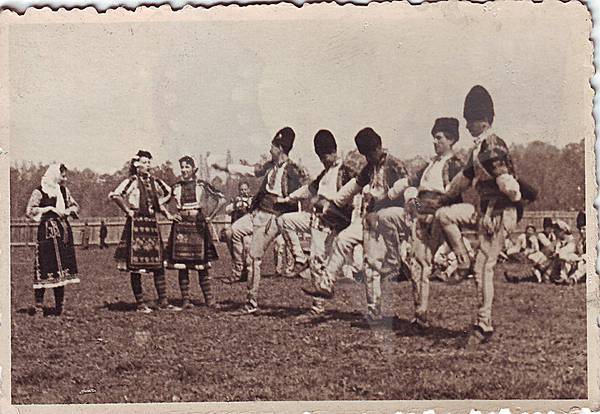
A large outdoor gathering in what appears to be a Balkan village courtyard, with a white-walled building with dark shutters visible in the background. The photograph captures a moment of active folk celebration, with dozens of participants arranged in loose groups across the dusty ground. The central focus is on dancers wearing traditional embroidered costumes—women in white chemises with bold geometric patterns in dark thread across the chest and hems, paired with dark wraparound skirts decorated with similar geometric designs. Men wear light-colored shirts with embroidered vests. The dancers are engaged in movement, some with arms raised or extended, others in profile showing the characteristic postures of Balkan circle or line dances. Spectators in lighter dress—possibly wearing Sunday clothes rather than traditional costume—form looser groups around the performers, suggesting this is a communal event where both dancers and observers participate in the social occasion. The photograph's composition captures the informal, energetic quality of village festivity rather than a staged performance.
The dancing
The dancers display the characteristic upright carriage and extended arm positions typical of Balkan folk dances, with several figures showing the side-stepping or forward-moving weight shift visible in line and circle dances of the region. The embroidered garments hang and move with the body, with skirts showing the kind of swing and lift that results from turning and lateral weight shifts. Several dancers have arms linked or held in the characteristic Balkan hold—extended to the sides or held at hip level—rather than in closed couple holds. The groupings suggest both organized formations (linear or circular) and more spontaneous gathering, typical of village celebrations where dances continue in waves throughout the event.
The dance depicted
This is almost certainly a Macedonian or broader South Slavic folk dance celebration, most likely photographed in the early-to-mid 20th century. The Cyrillic text visible on the original publication (reading 'S G Krivogazhtski Krushovski Koro' or similar) indicates this is from Krivogashtani, a town in North Macedonia known for its regional dance traditions. The costumes—particularly the women's white chemises with geometric embroidery in black thread—are consistent with Macedonian regional dress. The dance formations and arm positions suggest circle dances or line dances such as Oro, which remain central to Macedonian folk tradition. The scale of participation and the mix of performers and observers indicates this is a community celebration rather than a performance for outsiders, capturing how these dances functioned in village social life.
How it was made
This is a black-and-white photograph, likely from the 1920s–1940s based on the image quality, grain, and paper stock visible. The Europeana record indicates it is a historical documentation photograph rather than a studio portrait. The medium—a documentary photograph rather than an artistic rendering—means this captures an actual event and actual dress, though the photographer's choice of moment and framing inevitably shapes what is preserved. The outdoor daylight and the way the camera has captured the full scene suggests a portable camera and a photographer documenting village life, possibly as part of an ethnographic or regional documentation project. Such photographs are primary historical sources for understanding how dances were actually performed and dressed in their communities.
About this work
This is a documentary photograph of a folk dance celebration in Krivogashtani, a town in Macedonia, showing communal performance of regional circle or line dances in traditional dress. The image captures both the dancers—women in embroidered white chemises and patterned skirts, men in embroidered vests—and the social context in which these dances occurred: not as staged performances but as participatory village celebrations where the entire community gathered. The photograph documents a moment in the mid-20th century when these dances were still living practice in village life, performed in everyday settings rather than concert stages or tourist venues.
For dance historians, this photograph is valuable as documentary evidence of Macedonian folk dress, dance formations, and community participation in the early-to-mid 20th century. It shows the scale of communal celebration, the actual appearance of traditional costume in use, and the integration of dance into village social occasions—information that cannot always be recovered from written sources or later reconstructions.
How to look at it
Look first at the costumes: the women's chemises are entirely hand-embroidered with geometric patterns in black thread, and the precise placement of these patterns—concentrated at the chest, hem, and cuffs—reflects both aesthetic choice and the practical limits of hand embroidery labor. The dancers' posture—upright carriage, extended arms, side-stepping weight shifts—shows the physical vocabulary of circle and line dances adapted to the landscape and social space of a village courtyard. Note how the photographer has captured the event at a moment of active movement but without stopping it artificially; this is how the dance looked in practice, not a posed reconstruction. The mix of fully costumed dancers and more casually dressed spectators indicates the photograph documents an actual community celebration rather than a performance staged for documentation purposes.
The period
This photograph dates to the interwar or early post-war period in the Balkans, a time when regional folk traditions remained strong in village communities but were beginning to be documented and collected by folklorists and photographers. The Balkan states of this era (Yugoslavia, after 1918) were actively collecting and standardizing regional folk traditions as part of national cultural identity-building. Simultaneously, urbanization and modernization were beginning to shift how and where folk dances were performed. Photographs such as this one were often made as part of ethnographic documentation projects, capturing village life before rapid modernization transformed rural communities. The costumes visible here represent regional Macedonian dress that had been worn and embroidered by hand for generations; many of the specific patterns and techniques would be at risk within decades as commercial clothing and urban migration changed village life.
Where it lives
The photograph is held in the Europeana digital collection, which aggregates digitized cultural materials from European institutions. The Cyrillic text caption references Krivogashtani (a town in North Macedonia) and 'Krushovski Koro' (a regional dance or dance group), suggesting the photograph was originally documented with this regional context. The Europeana record does not specify the holding institution, the photographer, or the precise date, but the image quality and printing technique suggest an early-to-mid 20th-century documentary photograph.
Dance in this work
Questions about this work
What region is this dance from?
This is a Macedonian folk dance celebration from Krivogashtani, a town in what is now North Macedonia. The traditional embroidered costumes and the style of the dance formations are consistent with South Slavic (Macedonian) regional traditions. The Cyrillic caption on the original document confirms the location and regional identification.
What is the name of the dance being performed?
The caption mentions 'Krushovski Koro,' which suggests a circle dance (oro) specific to the Krusevo region or associated with Krusevo dancers. Without more detailed documentation, it is difficult to name the specific dance with certainty, but circle dances and line dances called oro remain central to Macedonian folk tradition. The formations visible in the photograph—loose circles and lines with linked or extended arms—are consistent with Macedonian circle dance practice.
When was this photograph taken?
The catalogue record does not provide a specific date. Based on the photographic technique, paper stock, and image quality, the photograph appears to date to the 1920s–1940s. The style of dress and the documentary nature of the image suggest it was taken during a period when village folk traditions were still strong and before major modernization transformed Macedonian communities.
Are the costumes shown here historically authentic?
Yes. This is a documentary photograph of an actual community celebration, not a staged reconstruction, so the costumes represent what Macedonian women and men actually wore for folk dance occasions in this era. The embroidery patterns, garment construction, and wear visible in the photograph are authentic to early-to-mid 20th-century Macedonian regional dress. However, these are village dress standards, and other regions or later eras may have had different patterns and styles.
More Folk/Country artwork