29 works in this view — arrow keys or swipe to move between them.
Dance in Art
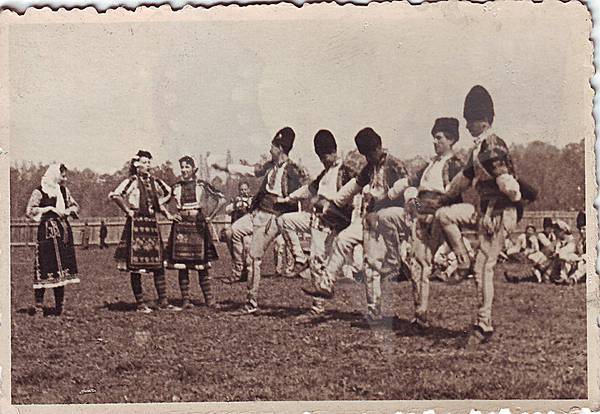
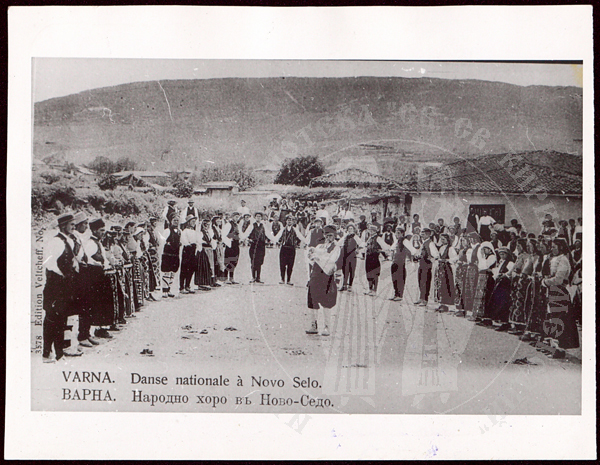
Folk dance in Novo selo
Unknown artist
- Dance:
- Folk/Country
- Rights:
- Not recorded. Do not assume this image is free to reuse — check the source record.
For dance historians, this image provides rare visual evidence of how Balkan folk dances were performed and celebrated in their original village context during the period when ethnographic documentation was beginning. The photograph also illustrates the tension between living folk practice and official or educational framing of that practice, showing how cultural institutions were beginning to stage, document, and standardize traditional dance in the early modern period.
What you are looking at
A large group of villagers, perhaps 60–80 people, stands in two loose facing lines across an open rural landscape, with low hills visible under a hazy sky. The ground is bare earth. The photograph captures what appears to be a moment of community gathering or demonstration. The figures are dressed in traditional Eastern European folk costume: women wear long skirts, some with embroidered detail, and many wear headscarves or kerchiefs; men wear dark trousers and jackets. In the centre of the two lines, several figures stand apart—one woman in a pale dress and a few men in dark suits—suggesting these may be officials, teachers, or documented participants. The composition suggests this is a public event or performance, staged for documentation or instruction rather than a private celebration.
The dancing
The villagers stand in two parallel lines facing inward, creating an alley or processional space. Most figures stand upright and relatively still, watching the centre rather than actively dancing. A few figures in the middle ground appear to be in motion or positioned as if stepping or turning. The overall posture is formal and observational rather than immersed; this reads as a gathered audience with selected performers rather than collective dancing. Arms are generally at the sides or held naturally; no couples are in closed or open holds typical of partner dances.
The dance depicted
This appears to document a folk dance gathering or instruction session in Novo Selo (now in North Macedonia or Bulgaria). The scale, the documentary framing, the rural setting, and the presence of what appear to be officials or teachers suggest this is a curated cultural event—possibly a folk dance celebration, a school or community performance, or an ethnographic documentation. The traditional Balkan costumes and open-air village setting support identification as South Slavic folk dance culture. However, no specific dance movements are clearly visible; the image captures the assembly and social context rather than the kinetic content of a particular dance form.
How it was made
This is a gelatin silver photograph, likely made in the early-to-mid 20th century based on the tonal quality, print condition, and documentary style. The image shows the characteristic grain, slight fading, and contrast range of early photographic reproduction. The wide-angle view, soft focus, and documentary cropping suggest this was made by a press photographer, ethnographer, or cultural official recording a public event. The photograph circulated via Europeana, indicating it was held in a public or institutional archive, possibly in Bulgaria or the former Yugoslavia.
About this work
This is a documentary photograph of a folk dance gathering in Novo Selo, capturing the social and sartorial context of Balkan village culture. The image preserves evidence of early-20th-century folk performance practices and the public celebration of regional dance traditions. As a photographic record of a community event rather than a moment of visible choreography, it documents the cultural infrastructure of folk dance—the gathering, the costume, the role of community witness—rather than the steps themselves.
How to look at it
Attend to the structure of the gathering: the double line, the cleared centre, the roles occupied by different figures. The photograph documents not a moment of performed movement but the social and spatial arrangement that enabled performance. Note the costume detail, which is rich and varied, suggesting regional variation and the importance of dress to folk identity. The soft focus and haze give the image an archival quality, as if preserving a vanishing moment.
The period
In the early 20th century, Balkan folk dance was being collected, documented, and increasingly institutionalized by newly formed nation-states seeking to define national identity. Photographs like this one were made as part of this archival and promotional effort, both by state ethnographers and by international anthropologists. The formal staging visible here—the ordered lines, the presence of officials, the documentary angle—reflects the influence of early folklore collection practices and the growing interest in 'authentic' folk culture as a marker of national heritage.
Where it lives
This photograph is held in the Europeana digital collection, a federated European cultural heritage platform aggregating items from partner institutions. The original holding institution is not specified in the available record.
Dance in this work
Questions about this work
Is anyone actually dancing in this photograph?
Not visibly. The photograph captures a gathering or assembly, with figures standing and watching. This may be the moment before a performance, a staged gathering for documentation, or an instructional event where specific movements have not yet begun. The composition suggests the photographer was interested in recording the event itself—the presence of the community, the costumes, the scale—rather than capturing dance in motion.
What is Novo Selo and where is it?
Novo Selo is a village in the Balkans; it is now located in North Macedonia, though the photograph dates to a period when the region's political boundaries and names were different. The name appears in both Cyrillic and Latin script on the photograph, reflecting the multilingual character of the region.
Why were these kinds of gatherings photographed?
In the early 20th century, folk culture was being systematically documented by state institutions, ethnographers, and educators seeking to preserve and standardize national traditions. Photographs served as visual records for archives, educational materials, and official cultural promotion. This image may have been made for a state folklore collection, a school or museum, or international ethnographic study.
More Folk/Country artwork