27 works in this view — arrow keys or swipe to move between them.
Dance in Art
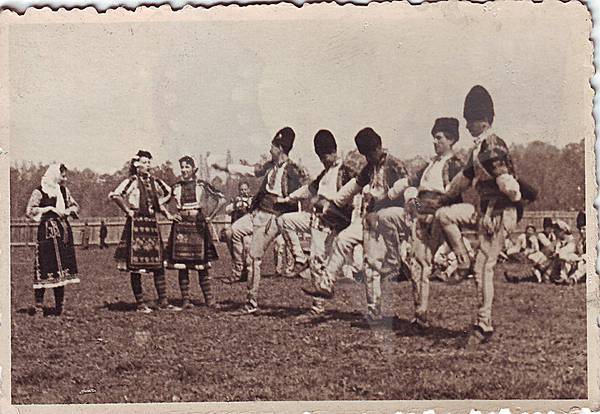
Folk dance in Sofia region
Unknown artist
- Dance:
- Folk/Country
- Rights:
- Not recorded. Do not assume this image is free to reuse — check the source record.
This photograph is valuable evidence of folk dance in its original social context before widespread choreographic standardization or theatrical presentation. The scale of the gathering and the informal documentation method suggest a moment of authentic cultural practice, offering historians and dancers insight into how these dances functioned within community life.
What you are looking at
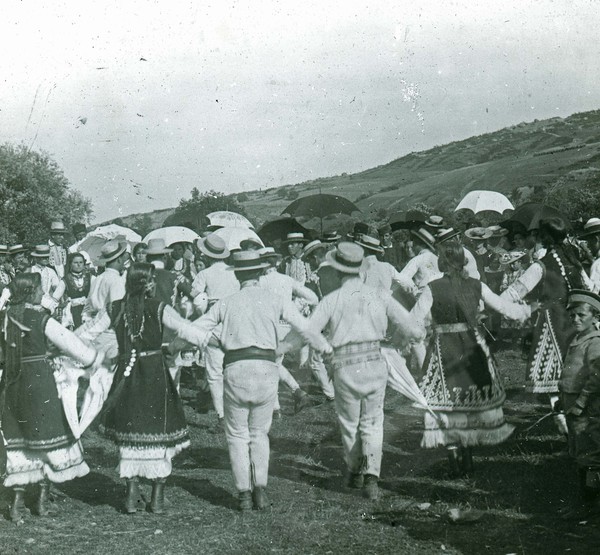
A large outdoor gathering of figures in traditional Eastern European folk dress, photographed in black and white. The scene appears to be a folk festival or celebration, with multiple participants wearing embroidered white shirts, dark vests, and traditional headdresses—some wearing white sun hats or caps. The dancers are arranged in loose groupings across a hillside or sloping field, with vegetation visible on the rising ground behind them. The photograph captures what appears to be an informal moment during a collective folk dance event, with figures in various poses of movement or preparation. The overcast sky and natural outdoor setting suggest this is documentary photography of living folk practice, likely from the early-to-mid 20th century based on the photographic quality and costume style.
The dancing
The dancers are arranged in small clusters and lines rather than a single unified formation. Several figures appear to be mid-movement or in transitional poses, with arms raised or extended in gestures consistent with group circle or line dancing. The posture is upright and grounded. The white embroidered shirts and vests suggest a cohesive costume tradition. Multiple figures are visible from full body or three-quarter view, allowing glimpses of leg position and weight distribution, though the photograph's distance and resolution prevent precise footwork analysis.
The dance depicted
This appears to be documentation of Bulgarian or broader South-Eastern European folk dance, consistent with the Sofia region attribution. The outdoor setting, the scale of the gathering, the traditional costume with embroidered white linen, and the loose group formations all point to a communal folk celebration or festival—possibly a village gathering, seasonal celebration, or organized folklore event. Without clearer detail of specific arm patterns, steps, or formations, the precise regional or named dance cannot be identified with confidence. The image documents folk dance as lived practice rather than theatrical performance.
How it was made
This is a black-and-white photograph, likely gelatin silver print or similar early 20th-century photographic process. The medium's capacity to capture documentary evidence of folk practice in daylight conditions, rather than relying on artistic interpretation, is significant. The distance of the camera and the inclusion of landscape context suggests this was shot by a documentarian or ethnographer rather than a portrait photographer, implying circulation among academic or folkloric institutions rather than as fine art.
About this work
This is a documentary photograph of a folk dance gathering in the Sofia region, capturing a moment of collective performance or festival celebration. The image preserves evidence of traditional dress, group formation, and the social context of folk dance as lived culture rather than staged performance. It belongs in a dance gallery as primary-source documentation of 20th-century folk practice—showing not a choreographed stage work but the actual conditions under which regional dance was performed and transmitted.
How to look at it
Observe the loose, flexible group formations rather than rigid lines—this tells you something about how folk dances organize space without military precision. Notice the mix of active dancers and spectators or participants in various states of engagement. The embroidery on the white shirts is visible enough to convey costume detail; look at how the photographer positioned the group to include landscape context, treating the dance as an event embedded in place rather than an isolated performance.
The period
This photograph likely dates to the mid-20th century, a period when European folklorists and photographers were actively documenting traditional culture in response to rapid modernization. In Bulgaria specifically, folk dance was undergoing both preservation and state-sponsored choreographic reformulation during the communist period. The informal, outdoor gathering style shown here contrasts with the more formally staged and technically refined folklore ensembles that emerged later in the same era.
Where it lives
The work is held in Europeana, the European digital library, which aggregates photographs and artifacts from cultural institutions across Europe. The original holding institution is not specified in the available record.
Dance in this work
Questions about this work
What region of Bulgaria is this from?
The catalogue identifies this as the Sofia region, but the photograph itself does not contain locating markers precise enough to confirm a narrower geography. Regional Bulgarian folk dances vary significantly by area; this image alone cannot determine which specific tradition is being performed.
Is this a staged performance or living folk practice?
The outdoor setting, the informal groupings, and the documentary photographic approach all suggest this documents an actual folk gathering or festival rather than a staged theatrical performance. However, the organized nature and scale of the gathering indicate it may be a semi-formal folkloric event rather than everyday social dancing.
Can you identify the specific dance?
The distance of the photograph and the quality of detail prevent confident identification of the named dance or its specific regional variant. The costume and formation are consistent with South-Eastern European folk traditions, but precision would require closer documentation of footwork, arm patterns, and music.
More Folk/Country artwork