26 works in this view — arrow keys or swipe to move between them.
Dance in Art
Folk dance in Varna region
Unknown artist
- Dance:
- Folk/Country
- Rights:
- Not recorded. Do not assume this image is free to reuse — check the source record.
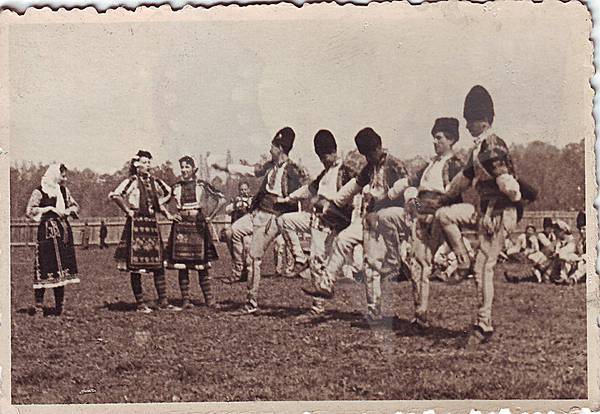
This photograph provides direct visual evidence of Bulgarian folk dance costume and regional identity at a moment when such traditions were being actively documented. For historians and dancers, it offers concrete detail about embroidery patterns, garment construction, and the presence of ritual objects or implements within folk practice. It represents the intersection of dance, material culture, and regional identity in the Balkans during a period of significant cultural change.
What you are looking at
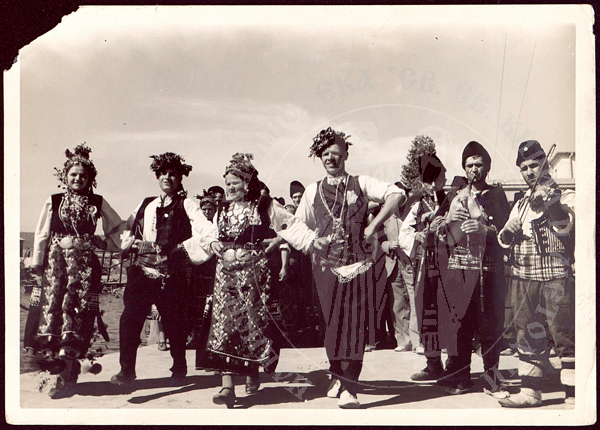
Seven figures in elaborately embroidered folk costumes stand in a loose line outdoors under bright sunlight. The photograph captures them in what appears to be a moment of pause or presentation rather than active movement. From left to right, the dancers wear richly decorated clothing: embroidered vests, patterned skirts, ornate headdresses including tall cylindrical caps and decorative headpieces. Several figures hold what appear to be ritual objects or implements. The setting is outdoor and sparse—flat ground visible behind them, suggesting a festival, fair, or documentation session. The image is a sepia-toned or black-and-white photograph showing the formal arrangement typical of early ethnographic or regional documentation photography. The costumes display the characteristic dense embroidery, multiple layers, and regional specificity of Bulgarian folk dress from the Varna region.
The dancing
The seven dancers stand upright in a relatively static formation, neither in motion nor in a closed partnered hold. Their posture is formal and presentational—chests forward, weight evenly distributed. One figure second from left appears to hold something in hand, possibly a ritual object. The stance and arrangement suggest these may be performers pausing for documentation or posed for a photograph, rather than captured mid-performance. There is no evidence of the dynamic weight shifts, turned-out positions, or interlocked holds typical of active social dancing.
The dance depicted
This is folk dance documentation from the Varna region, most likely representing Bulgarian regional folk dance traditions. The specific dance form cannot be determined with certainty from a static photograph, but the costume assemblage and regional attribution suggest this may relate to traditional circle dances (horo) or processional dances characteristic of Bulgarian celebrations, weddings, or festivals. The clothing displays markers of distinct regional identity rather than a single codified style, which is typical of Balkan folk dance regions. The formal posed arrangement suggests this is an ethnographic or regional documentation photograph rather than a performance photograph.
How it was made
This is a black-and-white photograph, likely silver gelatin or albumen print on the basis of the tonal range and aging patterns visible. The sepia cast and surface condition suggest early 20th-century photography, consistent with the era of systematic regional costume and dance documentation in Eastern Europe. The frontal, full-length framing and even outdoor light are typical of anthropological or regional documentation photography of the period, which prioritized clear visibility of costume detail over capturing movement. This type of image circulated in regional archives, ethnographic publications, and museum collections rather than as fine art.
About this work
This photograph documents folk dancers from the Varna region of Bulgaria, posed in their traditional ceremonial or festive costumes. The seven figures display the dense embroidery, layered garments, and regional headdresses characteristic of Bulgarian folk dress, arranged for formal documentation. The image belongs to the broader tradition of early 20th-century ethnographic and regional photography that systematically recorded folk dance traditions across Eastern Europe before modernization altered regional practice. It is a primary source for understanding Bulgarian regional costume and the contexts in which folk dances were performed and preserved.
How to look at it
Attend to the ornamental and structural detail of the costumes: the density and pattern of the embroidery, the construction of the headdresses, the layering of garments, and any ritual objects held by the dancers. These details tell the story of how folk identity was materially embodied and regionally specific. The static, frontal arrangement is typical of documentation photography and tells you more about the archive's purpose than about how the dance was actually performed in its original context. The formal presentation itself is informative—these dancers are being recorded as cultural representatives, not as performers in motion.
The period
This photograph dates to an era (likely early 20th century based on photographic technique) when European folk traditions were being systematically recorded by regional museums, ethnographic societies, and state cultural institutions. Bulgaria and other Balkan regions were sites of intense interest in folk culture as expressions of national identity and cultural preservation. The Varna region, on the Black Sea coast, was known for distinctive regional costume and dance practices. This photograph sits within a broader archive of regional documentation that served both scholarly and nationalist cultural projects.
Where it lives
The photograph comes from the Europeana digital collection, a pan-European aggregation of cultural heritage materials drawn from museums and archives across member countries. The original holding institution and accession number are not recorded in the available metadata.
Dance in this work
Questions about this work
What region of Bulgaria is this from and why does that matter?
The Varna region on the Black Sea coast has a distinctive folk culture marked by specific costume, embroidery, and dance traditions. Regional specificity was central to Bulgarian folk identity, and different regions maintained their own styles of celebration, ceremony, and dress. This photograph documents Varna region practice specifically rather than generic Bulgarian folk dance.
Why are they posed and not dancing?
This is ethnographic documentation photography, a common practice in early 20th-century regional cultural recording. The posed arrangement allowed full visibility of costume detail and allowed the photographer to gather multiple regional representatives in one frame for archival purposes. This tells us how the archive approached folk culture differently from how performance photographers worked.
What are the objects some of them are holding?
The photograph does not provide enough detail to identify these objects with certainty, but they may include ritual implements, processional objects, or ceremonial items associated with festive or wedding contexts. Such objects were integral to regional folk practice and merit closer examination of any higher-resolution versions.
More Folk/Country artwork