25 works in this view — arrow keys or swipe to move between them.
Dance in Art
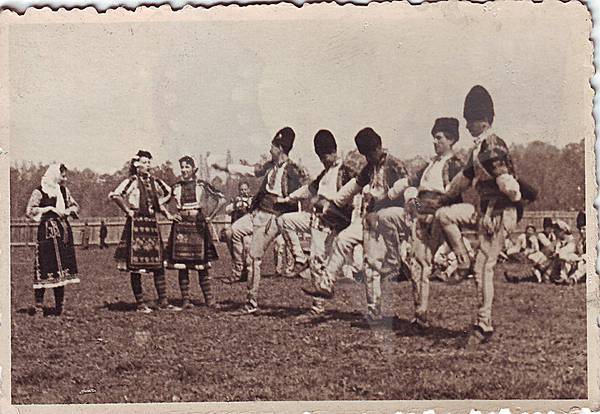
Karakachan folk dance
Unknown artist
- Dance:
- Folk/Country
- Rights:
- Not recorded. Do not assume this image is free to reuse — check the source record.
This image is rare documentation of Karakachan folk culture, a tradition that has been threatened by historical displacement and cultural assimilation across the Balkans. It shows folk dance not as a decontextualized performance but as embedded in community life, with the bagpiper as essential to the social function of gathering and celebration. For dancers and historians, it is evidence of how traditional music and dance operated as integrated practice rather than separate arts.
What you are looking at
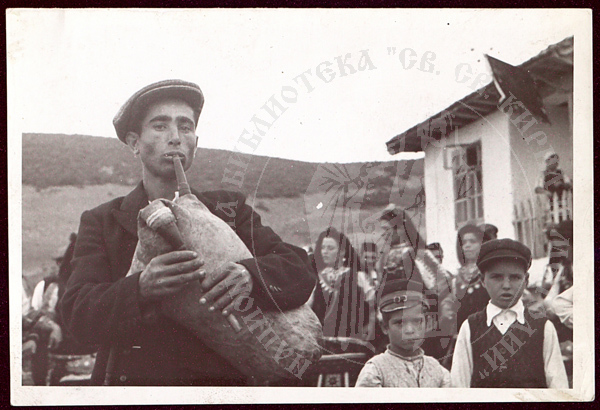
A man in dark work clothes and a flat cap stands in the foreground, holding a bagpipe to his mouth and playing. He faces left, captured mid-performance in what appears to be a village or rural setting. Behind him, a white-walled building with a dark roof is visible, and a crowd of villagers—men, women, and children in period dress—has gathered to watch. The photograph is grainy and overexposed in places, with watermarks visible, suggesting it is a historical document rather than a studio work. The moment captures an informal, communal gathering around a folk musician rather than a staged performance.
The dancing
The bagpiper stands alone as the focal point, his body angled to show the instrument clearly, his posture upright and engaged. His left hand is positioned on the chanter while his right supports the bag. The gathered crowd behind him is loosely arranged, with several figures visible but none actively dancing—they appear to be observers and listeners rather than participants in synchronized movement. The composition emphasizes the musician as the center of attention rather than depicting coordinated dancers.
The dance depicted
This photograph documents a Karakachan folk music and dance context rather than capturing active dance. The Karakachans are a Balkan shepherd people with a distinct musical and dance tradition. The bagpipe (likely a gaida, the traditional Balkan bagpipe) is fundamental to Karakachan folk music, which accompanies circle dances and celebratory gatherings. The image shows the musical infrastructure of folk dance rather than the dance itself—it captures the moment of musical invocation that would typically precede or accompany group movement. No actual dance steps or hold patterns are visible, but the gathering suggests this is part of a social occasion where such dancing would occur.
How it was made
This is a black-and-white photograph, likely from the early-to-mid 20th century based on the film stock, exposure characteristics, and printing quality. The image shows the deterioration and watermarking typical of archival photographs that have circulated through institutional collections. The photograph's documentary character—its grainy texture, natural lighting, and unposed quality—suggests it was taken as an ethnographic or journalistic record rather than as fine art. This mode of capture was common for European folk culture documentation in the interwar and postwar periods.
About this work
This photograph documents a Karakachan bagpiper performing for a gathered community, capturing the musical context in which folk dance traditionally occurs. The Karakachans are a Balkan pastoral people whose musical and dance traditions are closely linked to shepherding culture and seasonal celebrations. Rather than showing dancers in motion, the image preserves the moment of musical initiation—the bagpiper who would lead group dances—and the expectation of movement implicit in the assembled crowd.
The work belongs in a dance archive because it documents the living context and social function of folk dance, showing how music and community gathering frame movement. It is evidence of how folk performance operates: not as isolated display but as part of communal ritual where music, musician, and dancers form an integrated whole. The photograph preserves a moment of cultural practice that would otherwise be invisible—the quiet before the dance begins.
How to look at it
Attend to the relationship between the solitary musician and the gathered crowd—this composition shows the social structure of folk performance, where a single skilled player commands collective attention and generates the musical conditions for group movement. Notice the informal arrangement of observers: there is no stage, no formal viewing distance, no separation between performer and audience. The bagpiper's upright posture and direct engagement with the instrument show the physical commitment required of a folk musician who must project sound and energy without amplification. The moment captured is one of readiness—the music is being played, the crowd is present, and the dance is implicit but not yet visible.
The period
This photograph dates to an era when European folk cultures were being systematically documented, often as they were perceived to be disappearing. The early 20th century saw increased ethnographic and journalistic interest in traditional Balkan practices, partly as nationalist movements sought to claim folk heritage as evidence of distinct national identity. The Karakachans, as a mobile pastoral people without a recognized nation-state, had particular visibility in this documentary impulse. The photograph's style and archival status suggest it may be part of such systematic documentation efforts.
Where it lives
This photograph is held in the Europeana digital collection, a pan-European aggregator of cultural heritage materials from museums, archives, and libraries. The work's original holding institution is not specified in the available record.
Dance in this work
Questions about this work
Why is this a dance photograph if there are no dancers?
Folk dance cannot be understood in isolation from music and social context. This photograph documents the moment before or during which dance occurs—the musical invocation that structures group movement. It preserves evidence of how traditional dances functioned as communal acts rather than staged performances. For Karakachan culture, the bagpiper and the gathered community are inseparable from the dance itself.
What is a Karakachan and what do I need to know about their dance tradition?
The Karakachans are a Balkan people historically engaged in transhumant shepherding, with populations across Bulgaria, Greece, North Macedonia, and surrounding regions. Their musical and dance traditions are tied to pastoral life and seasonal gatherings. Karakachan dances typically include circle dances and couple dances performed to bagpipe and drum music. The tradition faces pressure from modern nation-state boundaries and cultural assimilation, making historical documentation particularly valuable.
Is this the only known photograph of Karakachan dance?
No, but systematic documentation of Karakachan culture remains sparse compared to other Balkan traditions. Karakachan communities' historical status as stateless pastoral peoples meant their practices received less institutional documentation than sedentary populations. This image is valuable as part of a small archive of such material.
What is a gaida and how does it relate to Balkan folk dance?
A gaida is the traditional Balkan bagpipe, fundamental to folk music across Bulgaria, Macedonia, Albania, and surrounding regions. It is the primary instrument for accompanying traditional dances, providing both the rhythmic and melodic structure that dancers follow. The gaida's sound carries across open spaces, making it ideal for outdoor communal gatherings. In Karakachan culture, the gaida player is essential to any gathering where dance would occur.
More Folk/Country artwork