49 works in this view — arrow keys or swipe to move between them.
Dance in Art
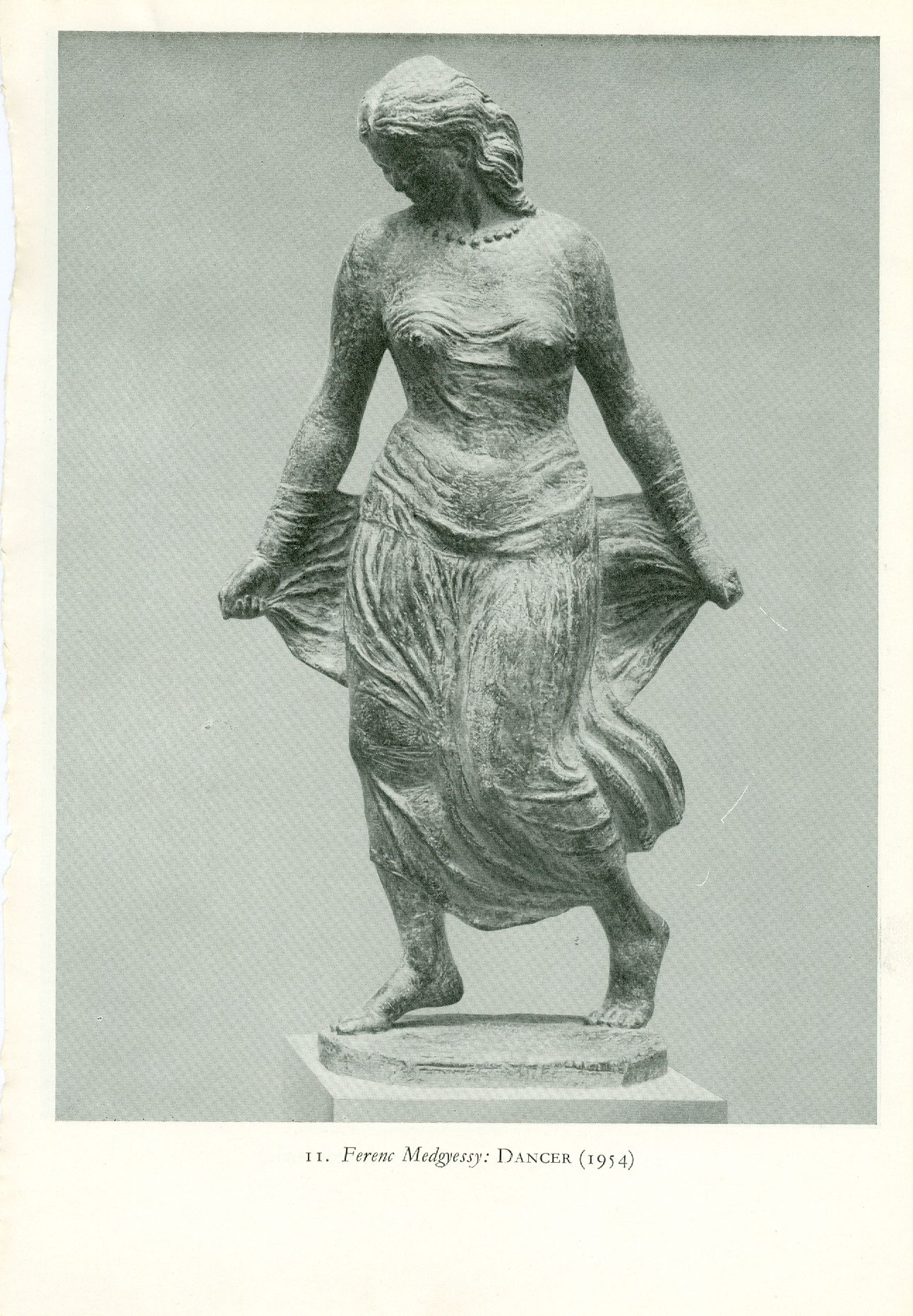
Medgyessy Ferenc Dancer
Unknown artist
- Rights:
- Not recorded. Do not assume this image is free to reuse — check the source record.
This work documents a specific moment in early 20th-century dance aesthetics—the shift from classical ballet toward modern, interpretive, and free dance forms that emphasized natural movement and emotional authenticity. For dancers and historians, it serves as three-dimensional evidence of how these ideas were understood and celebrated by visual artists of the period, and what qualities of movement the era valued most: fluidity, asymmetry, organic flow, and the expressive use of fabric.
What you are looking at
A single female figure dominates the composition, captured in a moment of movement against a neutral gray background. She stands in a contrapposto pose with her weight shifted, one leg bearing the load while the other extends in a graceful, fluid gesture. Her body twists gently at the waist, and her arms frame the movement—one raised and bent, the other extended lower, creating a sinuous line through the torso. She wears a draped garment that clings to her upper body and flows from the hips, with the fabric caught mid-motion, billowing around her legs in a way that suggests forward movement or a turning motion. Her hair is styled in waves typical of early 20th-century fashion, and she wears what appears to be a simple necklace. The sculpture has the soft, modeled surface quality of clay or plaster, with careful attention to the play of light and shadow across the figure's anatomy and drapery.
The dancing
The dancer's weight is clearly on her right leg in a soft knee, while the left leg gestures freely, suggesting a walking or traveling movement rather than a supported turn. Her torso leans subtly forward, creating a sense of momentum. The arms are positioned asymmetrically—the raised arm frames the head without tension, while the lower arm moves outward, contributing to a sense of flowing, continuous motion rather than a static pose. The overall frame is one of lyrical extension and natural, unforced grace; this is a dancer who understands weight transfer and the use of the body's center.
The dance depicted
This is almost certainly a theatrical dance figure—the costume, the attention to drapery, and the lyrical, unforced quality of the movement suggest modern dance or interpretive dance of the early 20th century rather than classical ballet. The pose recalls the aesthetics of Isadora Duncan's revolutionary approach to dance, with its emphasis on natural movement, flowing garments, and emotional expression through the body's organic motion. The figure's evident pleasure in movement, the asymmetrical arm placement, and the sense of walking or traveling rather than turning all point to early modern or free dance idioms that rejected the rigid formality of ballet.
How it was made
This is a sculptural work, almost certainly carved stone or cast from a mold. The soft modeling of form, the careful attention to volume and light-catching surfaces, and the way drapery is rendered suggest either direct stone carving or a bronze cast from a clay model. The technique allows for three-dimensional study of the figure from multiple angles—something impossible in a drawing or painting. The work shows the sculptor's understanding of how fabric behaves under gravity and movement, a skill that requires careful observation of actual dancers in motion.
About this work
This sculpture captures a moment of modern or interpretive dance from the early 20th century, likely created as a commemorative or celebratory work honoring a specific dancer or choreographic innovation. The work belongs to the tradition of dance-inspired sculpture that emerged in the late 1800s and early 1900s, when artists became fascinated by the human body in motion and the possibility of freezing a moment of dynamic gesture in permanent form. The piece is historically significant as evidence of how thoroughly modern dance had captured the artistic imagination by the 1950s—dance was no longer merely an entertainment to be represented in painting, but a worthy subject for serious sculptural treatment.
How to look at it
Notice how the sculptor has chosen not a moment of peak tension or dramatic extension, but a moment of transition—the dancer moving through space rather than striking a pose. Pay attention to how the weight sits in the standing leg and how the free leg trails or extends without effort. The drapery is not decorative but functional: it reveals the body's movement and tells you how the figure is traveling through space. The asymmetry of the arms, which would look awkward in classical ballet, here conveys natural, organic motion—this is how a body actually moves when it is not performing for the rules of a classical vocabulary.
The artist
Ferenc Medgyessy (1881–1955) was a Hungarian sculptor known for his figurative works and his particular interest in the human form in movement. His work often depicted dancers, athletes, and everyday figures caught in moments of natural, unstudied motion. He worked across multiple media—stone, bronze, and clay—and was part of the early 20th-century sculptural tradition that found in dance an ideal subject for exploring how form, drapery, and the body could convey grace and emotional content simultaneously.
The period
This work was created in 1954, late in Medgyessy's career and near the end of the sculptural modernism that had celebrated the dancing body since Rodin. By the 1950s, modern dance—once revolutionary—had become established as a serious art form, and sculptors could treat it as worthy of monumental treatment without irony. The aesthetic here reflects decades of artistic engagement with Isadora Duncan's innovations and the subsequent development of Central European and Eastern European modern dance traditions, of which Hungary was an important center.
Where it lives
The work is recorded in Europeana, a digital aggregator of European cultural heritage. It is identified as a sculpture from 1954 by Ferenc Medgyessy with the title 'Dancer,' but the current holding collection and location are not specified in the available catalogue record.
Dance in this work
Questions about this work
Is this classical ballet?
No. The pose, the costume, and especially the asymmetrical arm placement all suggest modern or interpretive dance from the early 20th-century tradition. Classical ballet would emphasize turned-out positions, formal port de bras, and symmetry. This figure moves naturally and organically, in the manner of post-Duncan modern dance.
What technique did the sculptor use?
This appears to be either direct stone carving or a work cast in bronze from a clay model. The soft modeling and the way light plays across the surface suggest careful attention to form and volume. The three-dimensionality allows viewers to understand the figure's movement from multiple viewpoints, something unique to sculpture.
What is the significance of the flowing drapery?
The drapery is not merely decorative. It responds to the figure's movement and gravity, revealing the body beneath and showing the direction and quality of motion. In early modern dance, especially the Isadora Duncan tradition, flowing fabric was integral to the aesthetic and to how the body's movement was understood and celebrated.
Who was Medgyessy?
Ferenc Medgyessy was a Hungarian sculptor (1881–1955) who frequently depicted the human figure in motion, particularly dancers. He worked in stone, bronze, and clay, and was part of the early-to-mid 20th-century sculptural tradition that found in dance an ideal subject for exploring form, grace, and the expressive possibilities of the human body.
More dance artwork