49 works in this view — arrow keys or swipe to move between them.
Dance in Art
Niwaka dancer
Unknown artist
- Rights:
- Not recorded. Do not assume this image is free to reuse — check the source record.
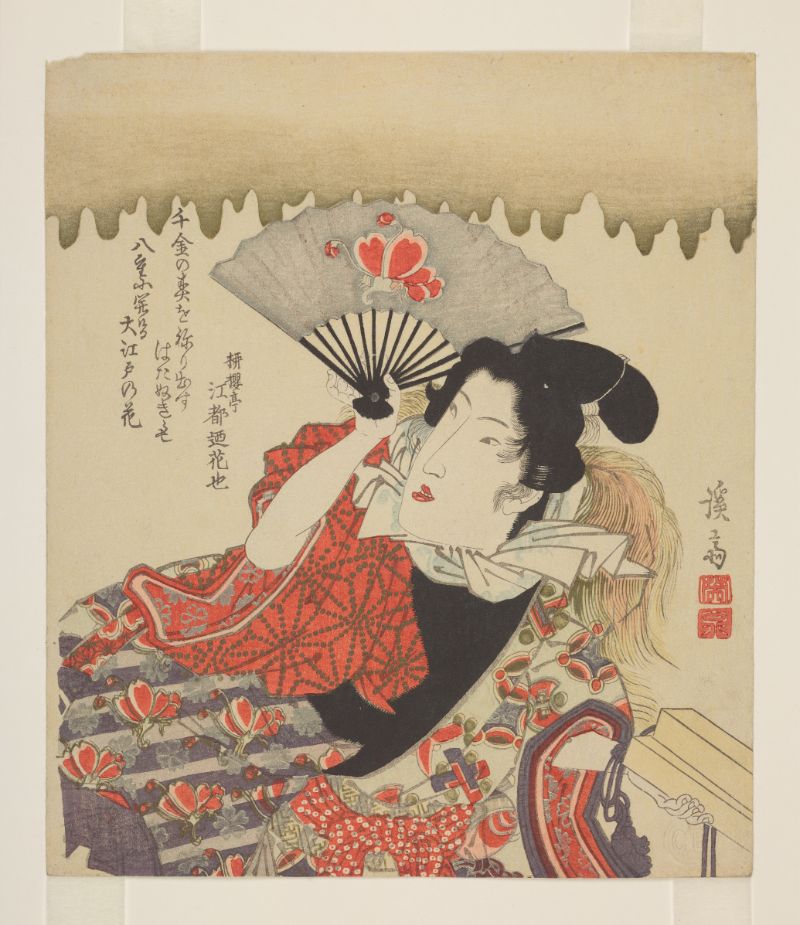
This print documents *niwaka*—a form of participatory street performance that has left few visual records despite its enormous popularity and social significance in Edo Japan. For historians of vernacular dance and amateur performance, it is rare evidence of how ordinary urban people danced, dressed, and entertained themselves. The image shows that *niwaka* was not crude or formless, but deliberately stylized, costume-heavy, and visually sophisticated—evidence that amateur performance culture operated with its own aesthetic conventions.
What you are looking at
A single figure dominates this woodblock print: a woman in elegant dress, shown in three-quarter view, holding a fan before her face. She wears a brilliant red patterned robe with geometric and floral motifs, layered over darker garments with contrasting fabrics in purple and cream. Her black hair is arranged in the traditional style of the Edo period, adorned with ornamental pins. The fan she holds displays red flowers against a pale ground. Behind her head floats a decorative fan—another example of the elegant accessories that frame the composition. The background is the pale cream typical of woodblock printing, with darker drips or streaks at the very top suggesting a hanging or border element. The overall effect is one of refined leisure and display: a woman pausing mid-gesture, perhaps in the middle of a social gathering or entertainment. Japanese characters appear to the left and right of the figure, identifying both the print and potentially the subject.
The dancing
The woman's posture is upright but relaxed, weight settled on one leg with the other slightly bent, creating a gentle S-curve through the body. Her right arm is raised to hold the fan near her face in a gesture of modest display or flirtation—a pose calculated to present the figure and dress to advantage. Her gaze is directed downward and to the side, adding to the sense of studied elegance rather than direct engagement. The raised arm and angled torso create an impression of momentary pause or transition, a body poised between stillness and movement.
The dance depicted
The print depicts a *niwaka* dancer—a participant in the impromptu street performances that flourished in Edo Japan, particularly during festival season. *Niwaka* (literally 'suddenly' or 'on the spot') involved amateur performers, often from the merchant and working classes, who would spontaneously assemble to sing, dance, and perform comic skits in public spaces. This image shows the costumed glamour and deliberate pose of such performance: the elaborate dress, the fan as both costume prop and social signifier, and the refined gesture are all elements of *niwaka* spectacle. The pose suggests a moment of display or transition within a performance—the kind of stylized pause that punctuates improvised entertainment. Unlike the structured dance forms of *Kabuki* or courtly *Buyō*, *niwaka* was democratic, temporary, and often satirical in nature.
How it was made
This is a Japanese woodblock print (*ukiyo-e*), executed in the multi-block color technique that emerged in the mid-18th century. The artist has used separate blocks for each color layer—red, purple, pale gray, black, and the natural cream of the paper—allowing for precise registration and brilliant color saturation. The technique enabled mass production and affordable distribution to a broad urban audience, particularly in the entertainment districts of cities like Edo. The visible registration of colors (and the occasional slight misalignment visible in close inspection) is characteristic of the process. This format—a single-figure study in bold color and refined line work—was a staple of *ukiyo-e* print production, aimed at the same audiences who attended *niwaka* performances.
About this work
This woodblock print documents the culture of *niwaka* street performance in Edo Japan, capturing both the visual spectacle and the social context of improvised urban entertainment. The figure is presented with the refinement and glamour that characterized *niwaka* costume and display, yet the form itself—a print for popular consumption—reflects the democratic, accessible nature of the practice. *Niwaka* occupied a distinct cultural space: more structured than pure improvisation, yet far less formalized than *Kabuki* or classical *Buyō*. It was entertainment by and for ordinary townspeople, and prints like this one circulated among the same urban audiences who participated in or attended these performances.
The work belongs in a dance history precisely because it captures a moment when performance culture was being democratized and commercialized in early modern Japan. Unlike the court dances or temple rituals documented in other visual records, *niwaka* represents vernacular, amateur performance—the kind of social dance and costume play that ordinary people engaged in for pleasure and social bonding. The print preserves not just an image but evidence of a practice that shaped urban culture and left traces in later, more formalized theatrical traditions.
How to look at it
Attend first to the posture and the pause: this is not a moment of active movement, but a calculated display, the body held in a pose designed to show off both costume and elegance. The fan held near the face is not merely a functional accessory but a prop of the performance—it frames and focuses attention. The downward gaze is equally deliberate, a convention of modest display that paradoxically draws the viewer's eye by withholding direct meeting of gazes. Notice too the abundance of pattern and color in the costume: the print demonstrates that *niwaka* was visually maximalist, using brilliant reds, contrasting fabrics, and dense geometric patterns to create spectacle. The figure occupies the entire composition, centered and dominating the frame, reflecting the solo or featured position this performer held in the entertainment.
The period
*Niwaka* emerged as a popular phenomenon in the late 18th and early 19th centuries in Edo and other major cities, reaching its peak during the 1820s–1840s. It coincided with rapid urbanization, the growth of a merchant class with disposable income and leisure time, and a surge in popular visual and performative culture. Woodblock prints of *niwaka* performers were produced in large numbers during this period, serving as both souvenirs and advertisements for the performances themselves. The form eventually attracted official scrutiny and was periodically banned by the shogunate, which viewed the improvised satire and social mixing as potentially subversive. By the late Edo period, *niwaka* had begun to formalize into semi-professional theatrical practice, and it influenced later dramatic and musical forms. This print sits within a broader moment of urban, popular culture flourishing in early 19th-century Japan, before the social upheavals of the Meiji Restoration.
Where it lives
The work is held in Europeana, a pan-European digital aggregator of cultural heritage collections. The original location and holding institution are not specified in the catalogue record provided.
Dance in this work
Questions about this work
What is *niwaka*?
*Niwaka* was an improvised street performance tradition that flourished in Edo and other Japanese cities from the late 18th century onward. Participants—often amateurs from merchant and working-class backgrounds—would spontaneously form groups to sing, dance, and perform comic skits, particularly during festival seasons. The name means 'sudden' or 'on the spot,' reflecting its improvisational nature. Unlike the highly formalized *Kabuki* or classical *Buyō* traditions, *niwaka* was participatory, affordable, and often satirical.
Who performed *niwaka*?
Participants were primarily drawn from urban merchant and working-class populations—the very audiences who purchased and consumed woodblock prints. Both men and women participated, and performances involved considerable cross-dressing and role-play. Unlike professional actors, *niwaka* performers were amateurs engaging in entertainment for pleasure and social bonding, though some later became semi-professional.
Why did the authorities restrict *niwaka*?
The shogunate periodically banned or restricted *niwaka* performances because of their improvisational, satirical content and the social mixing they encouraged. Performances could include political commentary and social satire, and the participatory nature meant they were harder to control than formal theater. The form's association with urban pleasure districts and its lack of clear hierarchy made it appear potentially subversive.
How does this print help us understand *niwaka*?
Woodblock prints of *niwaka* performers provide rare visual documentation of a practice that left few other records. This image shows that *niwaka* was visually sophisticated and costume-heavy, with deliberate poses and refined aesthetics. The circulation of such prints in large numbers demonstrates both the popularity of the form and the commercial market for images of urban entertainment.
More dance artwork