49 works in this view — arrow keys or swipe to move between them.
Dance in Art
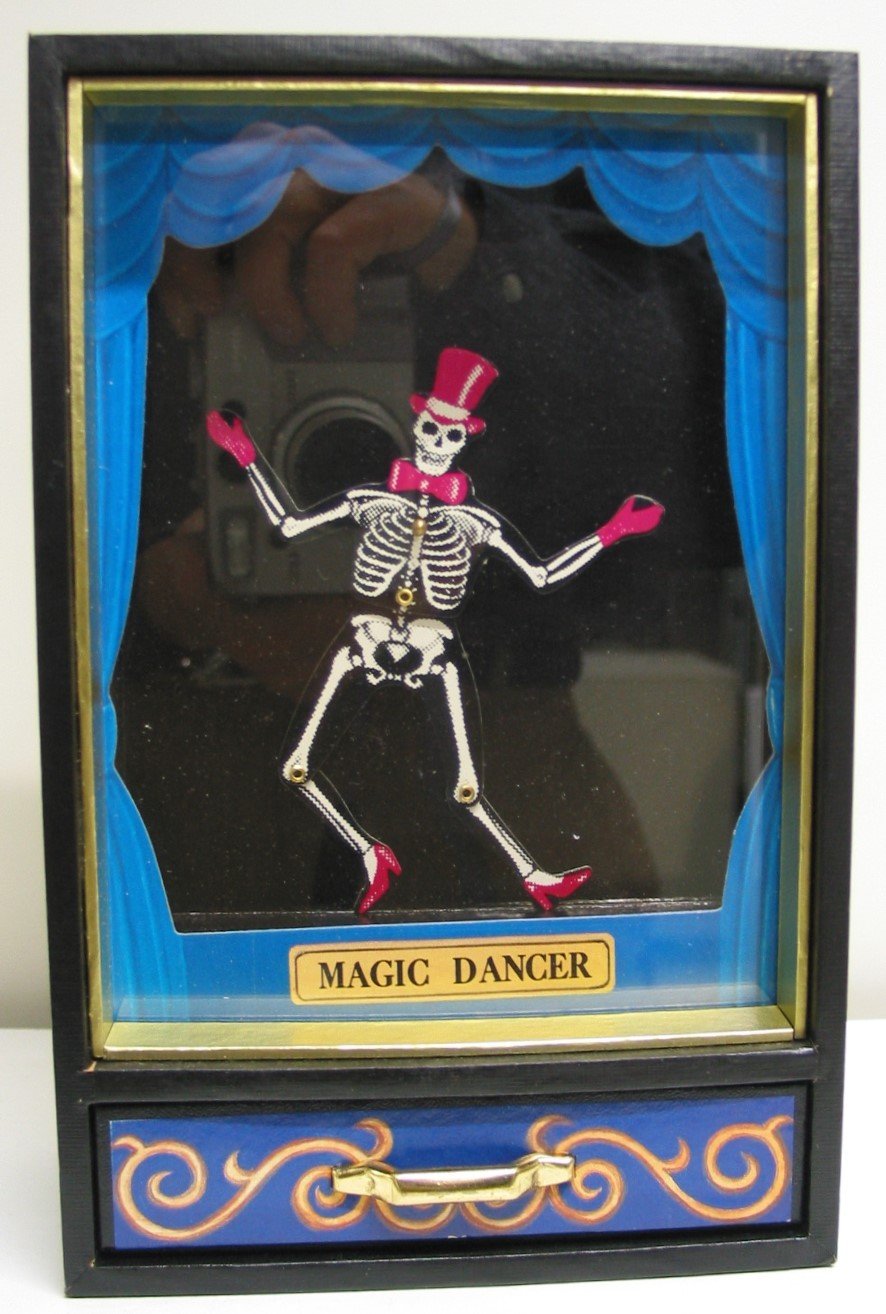
Spieluhr Magic Dancer
Unknown artist
- Rights:
- Not recorded. Do not assume this image is free to reuse — check the source record.
This object documents how dance—even as pure theatrical spectacle—was mechanized and made collectible in the 19th century, revealing the era's hunger for both motion and the uncanny. The skeleton dancer also stands as an ancestor to later cabaret, carnival, and theatrical uses of skeletal or death imagery in performance art. For historians of dance and automata alike, it demonstrates how the moving body became a commodity and a puzzle to be replicated.
What you are looking at
A skeletal figure in formal attire performs a solo dance within an ornate theatrical frame. The skeleton wears a vivid magenta top hat and bow tie, with matching gloves or paws at the ends of outstretched arms, and scarlet shoes. The pose is one of uninhibited exuberance: legs splayed in a wide stance, one arm raised high and the other extended outward, suggesting energetic movement or celebration. The backdrop is a deep black void, creating stark contrast with the white articulated bones rendered in fine detail. Elaborate blue velvet curtains with swags frame the scene on either side, establishing a proscenium arch—the theatrical setting unmistakable. At the base runs a decorative gold band bearing the title *MAGIC DANCER*, and below it an ornamental gold scroll pattern on a blue ground.
The dancing
The skeleton is rendered as a complete anatomical structure with distinct ribs, spine, pelvis, and limbs. The posture is one of complete abandon: weight appears equally distributed or lightly sprung on both feet, the torso upright and proud, both arms in wide lateral or raised positions as if mid-pirouette or mid-leap. The gesture conveys exuberance rather than any codified dance position—this is uninhibited movement, not formal technique. The single figure dominates the entire frame, scaled to fill the theatrical space.
The dance depicted
This is a music-box automaton or mechanical toy depicting a skeleton performing a theatrical solo dance. The object title *Magic Dancer* and the proscenium-stage setting are consistent with 19th-century mechanical toys and automata, which often featured skeletal or fantastical figures performing scripted movements to music. The dance itself appears to be a general theatrical or cabaret entertainment—energetic, playful, and designed to delight rather than to conform to any specific dance genre. The exuberant posture and the macabre subject matter suggest an element of the grotesque-comic, perhaps a memento mori or carnival entertainment.
How it was made
This is a Spieluhr (music box) mechanism with a painted or enameled lid, rendered as a three-dimensional object photograph or museum documentation image. The skeleton is hand-painted in white and black with fine detail work on a dark background; the theatrical frame, curtains, and ornamental elements suggest either hand-painting or lithographic decoration applied to the music box housing. The gold leaf or gilt detailing and the vivid magenta and scarlet pigments indicate a high-quality decorative object, likely from the 19th or early 20th century. The photographic or studio lighting and the frontal, squared composition suggest this is a museum documentation image rather than contemporary artwork.
About this work
This is a music-box automaton depicting a skeletal figure in formal attire performing a joyful, uninhibited dance on a theatrical stage. The work belongs to the tradition of mechanical curiosities and decorated music boxes that flourished in Europe from the 18th century onward—objects designed to amuse and unsettle in equal measure. The skeleton—rendered in anatomical detail yet dressed in festive finery and striking a pose of pure exuberance—embodies the Romantic and Gothic fascination with death, performance, and the grotesque. It is simultaneously a functional music-making device, a work of decorative craft, and a philosophical conceit: the danse macabre translated into a music box that plays a solo performer's eternal, mechanical joy.
How to look at it
Notice first the tension between the skeleton's anatomical detail and its festive costume—the effect is both morbid and celebratory. The pose is the key: the artist has chosen a moment of maximum exuberance, with limbs fully extended and weight dynamic, suggesting continuous motion frozen in a single frame. The proscenium curtains insist on artifice: we are watching a performance, not a natural event. Finally, observe how the magenta and scarlet pigments sing against the black void—this is a dance of pure color and gesture, emptied of naturalism.
The artist
The artist is not recorded. The object is catalogued as a Spieluhr (German music box) of unknown origin and date, held in a Europeana digital collection. The level of craftsmanship—the gilt, the enameling, the anatomical precision—suggests a professional European maker, likely from the 19th century, when such objects were produced by specialized artisans in Germany, France, and Switzerland.
The period
This object emerges from the 19th-century fascination with mechanical reproduction and entertainment, an era when music boxes and automata were luxury collectibles for affluent households. Simultaneously, the skeleton as a theatrical figure connects to the Romantic movement's engagement with death, the macabre, and the grotesque—evident in contemporary literature, visual art, and entertainment. The formal theatrical setting and the skeleton's joyful pose reflect both the high culture of 19th-century European theater and the popular entertainments of sideshows, cabarets, and optical toys. Dance, in this context, was not only a living practice but a subject for mechanical replication and wonder.
Where it lives
This object is held in a Europeana digital collection, a federated resource for European cultural heritage. It is catalogued as a Spieluhr (music box) of unknown date, maker, and current holding institution. The digital record provides only the title and source information; the physical object's provenance, dimensions, and material composition are not recorded in the available catalogue.
Dance in this work
Questions about this work
Is this a real dance or a choreographed sequence?
Neither. This is a music box automaton—a mechanical toy that plays a preset sequence of movements synchronized to music from a wound spring and pin-cylinder mechanism. The skeleton's pose was designed once by the maker and repeats identically with each playing. It is theatrical spectacle reduced to mechanical performance.
What was the skeleton supposed to represent?
Likely a memento mori or danse macabre figure—a reminder of death dressed in the trappings of joy and celebration. The juxtaposition of skeletal anatomy with formal attire and exuberant gesture was a common motif in 19th-century entertainment and decorative arts, reflecting both Romantic fascination with the grotesque and older European traditions of skull symbolism.
How did music boxes like this work?
A wound spring drove a brass cylinder studded with pins. As the cylinder rotated, the pins plucked tuned metal prongs or teeth, producing music. A cam or linkage mechanism could be attached to drive a small puppet or figure through a set sequence of motions synchronized to the music. The dancer's movements would repeat as long as the spring had tension.
When and where were these made?
Music boxes and automata were manufactured across Europe from the 18th century onward, with major production centers in Switzerland, France, and Germany. This particular object is not dated in the available record, but the style suggests the 19th century. Similar objects are documented in museum collections worldwide.
More dance artwork