25 works in this view — arrow keys or swipe to move between them.
Dance in Art
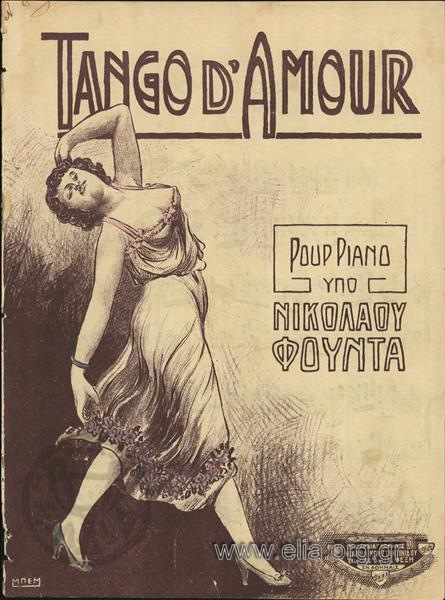
Tango d amour
Unknown artist
- Dance:
- Tango
- Rights:
- Not recorded. Do not assume this image is free to reuse — check the source record.
This image captures how tango was marketed and mythologized in the early 20th century—not as a social dance but as pure emotion made visible. It shows the gap between the actual technique of the dance and its theatrical representation, a gap that shaped how the dance was taught, performed, and understood in ballrooms and concert halls across Europe.
What you are looking at
A woman in a flowing, diaphanous gown leans dramatically backward in a pose of romantic abandon. Her body is arched, one arm extended upward, the fabric of her dress caught mid-movement and billowing around her legs. The composition emphasizes her elongated form against the pale background, creating a sense of weightlessness and surrender. The sketch is rendered in a spare but elegant line, with cross-hatching in the woman's dark hair and clothing to suggest volume and movement. The pose suggests a moment of emotional intensity—a swoon, a surrender to passion—typical of early 20th-century theatrical imagery.
The dancing
A single female dancer occupies the frame, her body weight shifted onto one leg while the other extends behind or to the side. Her spine curves in a pronounced arch, the neck thrown back and the face upturned. One arm reaches upward in an expressive line; the other appears to rest at her torso. The overall line of the body from knee to fingertip creates a single, unbroken curve of surrender. This is not a ballroom frame but a theatrical solo moment, close to a swoon or a dramatic fall into an imagined partner's arms.
The dance depicted
The pose and title 'Tango d'Amour' (Tango of Love) identify this as Argentine tango imagery, the most sensual and passionate of the early 20th-century social dances. However, the composition does not depict partner work; instead it shows a woman alone in a moment of emotional climax—the kind of theatrical exaggeration of tango's emotional intensity that appeared in concert performances, operetta, and music-hall entertainment rather than social dancing. The arched back and thrown-back head are iconic markers of tango's portrayal in theatrical and commercial contexts, where the dance's eroticism was amplified for effect.
How it was made
This is a pen or ink drawing, likely lithographically printed for commercial distribution. The signature mark 'MUG' appears in the lower left, possibly the artist's mark. The technique is economical—broad areas of white paper, selective hatching for shadow and form, and flowing line work that captures movement with minimal mark-making. This approach suggests a work produced for mass circulation, likely a theatrical poster, sheet-music cover, or popular entertainment advertisement of the Belle Époque or early 1920s.
About this work
This is a marketing or promotional image for tango, one of the most commercially successful dances of the early 20th century. The work trades in the visual language of tango's theatrical reception—the arched body, the ecstatic emotion, the sensual abandon—rather than documenting actual social dance technique. The image belongs to a broader visual culture in which tango was sold to European and North American audiences as the embodiment of passion and modernity, a racy import from Buenos Aires that violated ballroom convention and excited both desire and moral anxiety. Such images appeared on sheet music, theater programs, and postcards, shaping how people imagined the dance before they experienced it.
How to look at it
Observe the artist's choice of the moment of maximum emotional intensity—not a held position in a dance frame, but a moment of apparent collapse or surrender. The arched back is the key formal element; it breaks the vertical line of ballroom propriety and suggests a body overcome by feeling. The selective use of line and hatching creates movement and emotion with economy, allowing the viewer's eye to complete the figure. This is theatrical tango, where the image's purpose is not documentary but seductive—to sell the idea of tango as a experience of overwhelming passion.
The artist
The artist is not identified in the catalogue record. The signature or mark 'MUG' may indicate the creator's name or studio mark. The work's commercial purpose—as a poster or printed advertisement—suggests it was produced by a commercial artist or atelier rather than a fine artist. The style and printing technique are consistent with early 20th-century theatrical and music-hall publicity, a large and now largely anonymous field of production.
The period
Tango arrived in Europe around 1910 and became a sensation within a few years, spreading from Paris and London to ballrooms across the continent. Initially, the dance was controversial—seen as sexually explicit, lower-class in origin, and a threat to ballroom decorum. Rather than dampen interest, this moral anxiety intensified the dance's appeal among the young and fashionable. By the 1910s and 1920s, tango was packaged as theatrical entertainment, performed in concerts and music halls, and heavily advertised through sheet music, postcards, and theater programs. Marketing imagery exaggerated the dance's emotional intensity and sexual charge, emphasizing arched backs, ecstatic faces, and intimate partner positioning. This image belongs to that commercial visual culture.
Where it lives
The work is held in the Europeana digital collection, a European aggregator of cultural heritage objects from museums, libraries, and archives. It is presented without attribution, date, or institutional holding, suggesting it may be a deaccessioned or uncatalogued item, or one whose provenance was not recorded at digitization.
Dance in this work
Questions about this work
Is this an actual tango dancer, or a made-up image?
This is a theatrical interpretation of tango, designed to convey emotion and passion rather than to document actual dance technique. The pose—a woman alone, arched backward in apparent ecstasy—is typical of how tango was portrayed in concert performances, operetta, and advertising rather than how it was danced socially. The image was created to sell tango to audiences, not to teach them how to dance it.
Why is she alone if tango is a partner dance?
Early 20th-century marketing imagery often isolated one figure, usually a woman, to emphasize emotional intensity and sexual charge. This composition focuses the viewer's attention on the drama of her body and expression, suggesting surrender and passion. In actual social tango, this pose would occur briefly within a larger partner sequence, but theatrical imagery froze such moments and presented them as the essence of the dance.
When was this made?
The catalogue record does not provide a date. Based on the style, printing technique, and tango's popularity, it was likely produced between 1910 and 1930, when tango was at the height of its fashion in Europe and such promotional imagery was widespread. More precise dating would require research into the printing technique, the mark 'MUG', and the original publication context.
What is the title in Greek?
The visible title is 'TANGO D'AMOUR' in Latin letters. The Greek text below reads 'POUR PIANO / ΓΝΟ / ΝΙΚΟΛΑΟΥ / ΦΟΥΛΤΑ' (For Piano by Nikolaou Foulta), indicating this may have been the cover for a sheet-music publication. Foulta appears to have been a composer, likely Greek, writing tango arrangements for piano.
More Tango artwork
![[Les noces de trottoir, par les compagnies Tango Sumo et Vendaval. Chalon dans la rue. 2007 / photographies de Joël Verhoustraeten] by Verhoustraeten, Joël (1954-2019). Photographe](https://gallica.bnf.fr/iiif/ark:/12148/bc6p058zgkc/f1/full/800,/0/native.jpg)