49 works in this view — arrow keys or swipe to move between them.
Dance in Art
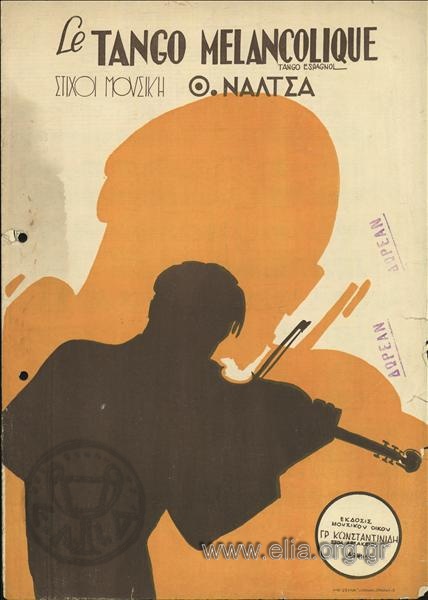
Tango melancolique le
Unknown artist
- Rights:
- Not recorded. Do not assume this image is free to reuse — check the source record.
This image documents the moment when tango entered European modernism—when the dance was no longer simply a social phenomenon but had become a motif for expressing psychological intensity, sophistication, and the allure of the exotic. The solitary figure and the emphasis on the musician reveal how European artists understood tango not as a partner dance but as an expression of individual emotional depth. For historians of tango, it shows the dance's transformation in the European context; for art historians, it exemplifies how dance became a vehicle for modernist aesthetics.
What you are looking at
A stylized silhouette composition of a solo male dancer dominates the frame, rendered in solid black against a warm ochre-orange background. The figure is captured in a moment of passionate movement, body angled sharply, one arm raised with what appears to be a violin or similar stringed instrument held aloft. The dancer's posture conveys intensity and melancholy—the title *Tango melancolique* (Melancholic Tango) is inscribed in art deco typography at the top of the composition. The background figure's silhouette is larger and softer-edged, almost a shadow, suggesting either emotional depth or the echo of another presence. The overall aesthetic is that of a 1920s–1930s modernist poster or print, with bold graphic simplification and a psychological rather than naturalistic approach to the subject.
The dancing
A single male dancer occupies the composition, rendered as a complete silhouette. His body is sharply angled forward and to the right, weight appearing to be on his back leg while his torso twists. His raised arm holds an instrument (likely a violin), and the opposite arm is positioned against his body. The posture suggests a moment of both restrained control and emotional release—the kind of held tension characteristic of tango, where the body may seem still but carries enormous internal pressure. The silhouette technique eliminates anatomical detail, so footwork and precise frame cannot be assessed, but the overall stance is compatible with a tango's characteristic forward-leaning, collected quality.
The dance depicted
This is clearly Argentine tango, identified by the title, the melancholic mood, and the formal dress silhouette. The presence of the violin is significant: tango's relationship to live instrumental music (especially string instruments) is central to the genre's identity and emotional expression. The image captures tango at a moment of cultural transition in Europe—the dance had emigrated from Buenos Aires to Paris and beyond in the 1910s–1920s, often presented in modernist avant-garde contexts, sometimes with high-art associations that moved it away from its working-class origins. The figure's solitary posture and the psychological tone suggest the introspective, passionate character that European audiences associated with tango during this period.
How it was made
This appears to be a color lithograph or pochoir (stencil-colored print), characteristic of 1920s–1930s European avant-garde graphic design. The flat color fields, bold outlines, and high-contrast silhouette are consistent with lithographic technique, while the precise registration of warm orange against the pale background suggests either skilled registration or hand-coloring. The visual economy—maximum emotional impact through minimal representational means—is typical of modernist poster art. This technique allowed rapid reproduction for theatrical or commercial promotion while maintaining the handmade aesthetic valued by the avant-garde.
About this work
This is a European modernist poster or art print celebrating tango as a dance of passion and melancholy. The work likely dates to the 1920s–1930s, a period when tango was being absorbed into avant-garde art practice and positioned as an emblem of sophisticated, psychologically complex entertainment. The silhouette technique and stark color palette reflect the design language of European modernism—Constructivism, Art Deco, and Expressionism all converge here. The artist remains unidentified, but the work's formal sophistication and the presence of credits or production marks suggest it was created for a specific theatrical, cabaret, or commercial context, possibly promoting a performance or establishment in Paris or another European cultural capital. The image bridges dance history and design history, showing how a working-class Argentine social dance became a subject for avant-garde visual culture.
How to look at it
Attend to the artist's choice to show the dancer alone and in silhouette: this removes all naturalistic detail and forces the viewer to read emotion from posture and line alone. The raised violin is not incidental; it identifies the subject as tango and signals the dance's dependence on live music and on the musician's emotional interpretation. The backward tilt of the body and the forward-leaning stance together suggest the tango's characteristic tension between restraint and passion—a body held in collected control but emotionally exposed. The warm orange background, rather than a cool or neutral tone, actively conveys the heat and intensity of the emotion the title names.
The period
Tango arrived in Europe around 1910 and became a sensation by the 1920s, adopted by avant-garde artists and high society alike. By the time this print was made, tango was no longer scandalous but had become a symbol of modernity, passion, and psychological complexity—a way for artists to evoke the sophisticated, transgressive energies of the Jazz Age and the post-war avant-garde. Simultaneously, the visual language of European modernism—flattened forms, high-contrast silhouettes, bold typography—was being applied to dance subjects as artists sought to capture movement through abstraction rather than narrative realism. The figure of the solo, melancholic dancer reflected Romantic and Expressionist preoccupations with inner emotional states.
Where it lives
The work is recorded in Europeana, a digital aggregator of European cultural heritage, and carries Greek text alongside the French title, suggesting it may have circulated in Mediterranean European contexts. No current holding institution or accession information is recorded; the source is the Europeana platform itself.
Dance in this work
Questions about this work
Why is the dancer shown alone if tango is a partner dance?
European modernist interpretations of tango often emphasized the dance as an expression of individual psychological states rather than social interaction. The solitary figure allowed artists to present tango as a vehicle for conveying emotion—melancholy, passion, intensity—and aligned the dance with avant-garde aesthetics that valued introspection and abstraction over narrative or social realism.
What does the violin signify?
The violin is essential to tango's identity and emotional character. In Buenos Aires, tango orchestras featured strings prominently, and the instrument became inseparable from the genre. For European audiences, the violin also carried Romantic associations with passion and soulfulness, reinforcing tango's appeal as a sophisticated, emotionally expressive art form.
When did tango reach Europe?
Tango began to arrive in Paris and other European cities around 1910–1912, becoming fashionable in high society and music halls by the 1920s. By the 1920s–1930s (when this print was likely made), tango had become fully absorbed into modernist culture and was celebrated as both a dance form and a symbol of modernity and psychological depth.
More dance artwork