26 works in this view — arrow keys or swipe to move between them.
Dance in Art
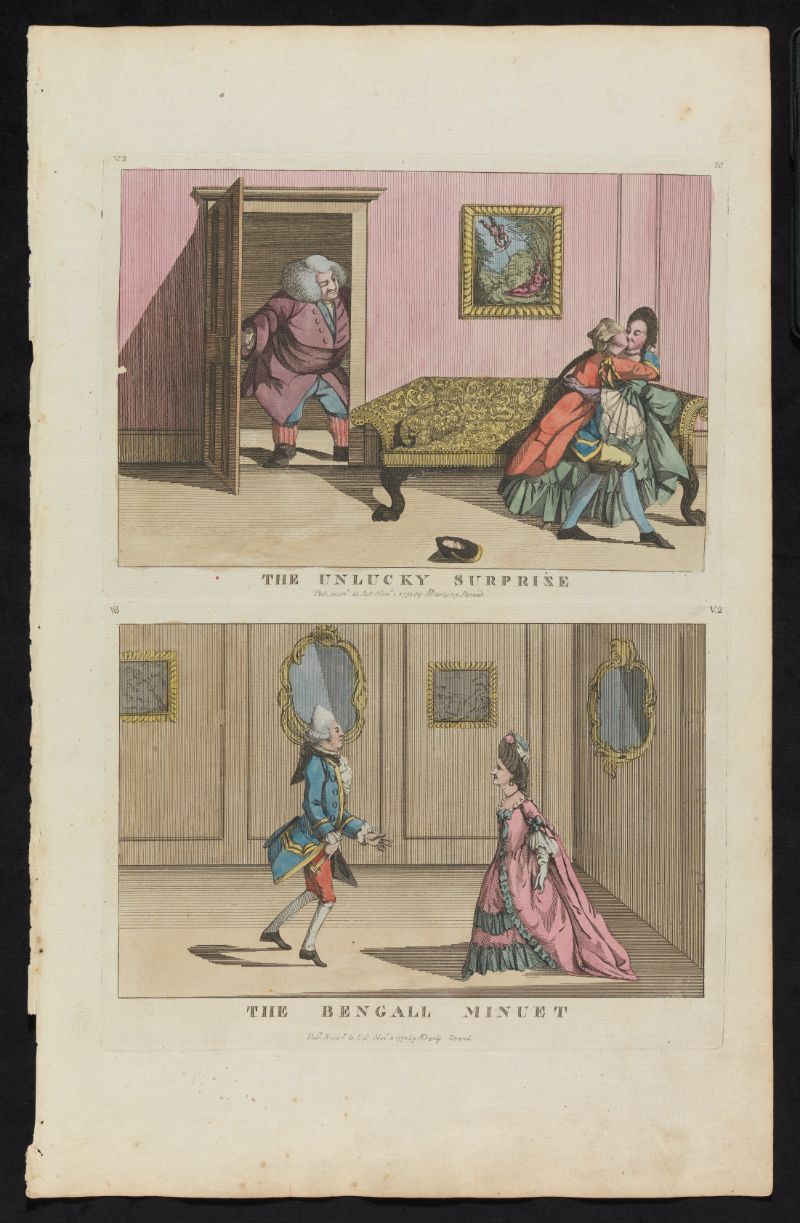
The unlucky surprise plate 1 The bengall minuet plate 2
Unknown artist
- Dance:
- Minuet
- Rights:
- Not recorded. Do not assume this image is free to reuse — check the source record.
The minuet was the dominant social dance of the aristocratic 18th century, and knowing how it was performed—how far apart the partners stood, how the woman held her skirts, the quality of the man's bow—is essential to understanding both dance history and the social order it embodied. This image is a primary source for minuet technique and deportment, made by someone who observed the dance in actual performance. The satirical framing also reveals what 18th-century commentators found notable or comic about the dance: its formality, its separateness of the sexes, its rigid control of the body.
What you are looking at
This is a hand-coloured engraving presenting two separate court dance scenes, stacked vertically. The upper scene, titled "The Unlucky Surprise," depicts an interior with pink damask walls and a gilt-framed landscape painting. An older man in pink coat and white wig emerges from a doorway on the left, startled, while two figures—a woman in a green and orange dress and a man in darker clothing—occupy a gilt sofa on the right, in an intimate embrace. The lower scene, "The Bengal Minuet," shows a formal interior with vertical striped wallpaper and multiple gilt-framed mirrors. A young man in blue coat and breeches stands in an exaggerated pose facing a woman in pink silk with a train, who holds her skirts. Both figures are positioned as if mid-minuet, with the man's body inclined toward his partner in a courtly bow or declaration.
The dancing
In the upper scene, the dancers are caught in social proximity rather than formal hold—the couple on the sofa are entwined without the structured posture of a dance frame. The emerging man's body language reads as surprise, with arms slightly raised. In the lower scene, the minuet dancers maintain the characteristic separated, upright positions of formal court dance: the man bends forward in a courtly inclination while the woman stands with weight centered, both figures aligned along the picture plane rather than in direct embrace. The woman's skirts are held away from her body with one hand, a signature minuet gesture.
The dance depicted
The lower plate is explicitly a minuet, as stated in the title. This is the formal court dance that dominated European aristocratic life in the 18th century. The artist has captured the characteristic pose vocabulary: the gentleman's forward-leaning bow or révérence, the lady's upright carriage, the separated distance maintained between partners, and the woman's manipulation of her skirt. The minuet was danced in strict geometric patterns with prescribed steps and significant weight shifts on alternate feet. The upper scene, titled a 'surprise,' appears to depict an interruption of social intimacy—possibly a satirical commentary on what happens when formal restraint breaks down, or a narrative of courtship in progress.
How it was made
Both scenes are hand-coloured engravings, a common format for satirical or narrative prints in 18th-century Europe. Engraving allowed fine detail in the faces, clothing, and architectural elements, while the hand-applied colour—pink walls, gilt frames, the woman's silk—provides the social and economic markers of court life. The technique is well-suited to narrative printmaking: the two scenes can be read sequentially, the clear lines define the figures and setting precisely, and the work was designed for circulation as a print that could be hand-coloured on demand. This format suggests a market in prints for a literate, affluent audience interested in satirical commentary on courtship and social propriety.
About this work
These two engravings form a narrative pair about courtship and dance manners in 18th-century aristocratic life. The titled scenes play on the contrast between the formal restraint required by the minuet—one of the period's most codified dances—and the physical and emotional intimacy that lay beneath courtship rituals. The minuet image serves as a visual reference for the 'correct' posture and distance between partners; the bedroom scene above it implies what happens when those proprieties collapse. Together, they form a satirical comment on the gap between social performance and private desire, using dance as the measure of propriety.
How to look at it
Pay attention to the precise positioning of the minuet dancers: the distance between them, the angle of the man's body, the woman's arm and skirt placement. This is what the 18th century called 'proper' deportment. Then compare it to the sofa scene above, where that distance collapses and the bodies entwine. The artist is arguing through the body itself—the minuet's form is the thesis, its violation the punchline. Notice too the woman's face in both scenes: composed and formal in the minuet, engaged and animated on the sofa.
The artist
The artist is not recorded. The style and technique are consistent with 18th-century English or French satirical printmaking—the hand-colouring, the interior settings, the narrative pairing, and the focus on courtship comedy all suggest this was a commercial print, possibly from a series. The quality of observation and the sophistication of the social satire suggest an artist with access to court circles or at least to the prints and paintings that circulated among the gentry.
The period
The minuet was at its social zenith in the mid-to-late 18th century, taught to all children of rank and danced at every formal assembly. It was increasingly seen by critics and satirists as stiff, old-fashioned, and sexually repressive—a perfect target for prints that juxtaposed its rigid decorum with the desires it supposedly contained. At the same time, satirical prints about courtship, seduction, and social manners were hugely popular among the literate classes, particularly in England. The double scene format allowed artists to present a moral or comic argument through visual contrast.
Where it lives
The work is listed in Europeana as part of a digital collection, but the specific holding institution is not named. The object is a hand-coloured engraving, likely from a bound series of satirical or instructional prints about manners and dance.
Dance in this work
Questions about this work
What is a minuet and how does this image show how it was danced?
The minuet was the most formal and prestigious social dance of the 18th-century European aristocracy. Partners maintained a separated stance, as shown here: the man inclines forward in a bow while the woman stands upright, and they do not embrace. The woman holds her skirts away from her body, a characteristic gesture both to show the fabric and to allow freedom of movement. The dance consisted of prescribed steps executed in geometric patterns, and this image captures the characteristic postures between steps.
Why are there two scenes on one plate?
The pairing creates a narrative argument through visual contrast. The lower scene shows the minuet's formal decorum—distance, upright posture, structured gesture. The upper scene shows what happens when that propriety breaks down: the couple retreat indoors and embrace on the sofa, surprised by an intruder. The title 'The Unlucky Surprise' suggests this intimacy was meant to be hidden. Together, the scenes mock the minuet as a dance so rigid that passion erupts elsewhere.
How do we know this is an 18th-century work?
The dress, architecture, and furniture all date to the 18th century: the man's coat, waistcoat, and breeches; the woman's silk gown and coiffure; the damask walls and gilt-framed mirrors; the sofa style. The engraving technique and hand-colouring are also consistent with 18th-century print production. The subject matter—satirical commentary on courtship and minuet etiquette—is typical of that period's popular prints.
Is this a how-to guide or a joke?
It is primarily satire, but it functions as both. The minuet image documents actual technique and posture, so it has instructional value. But the title and the narrative setup suggest the artist is mocking the dance's stiffness and the gap between its formal pretense and the actual desires of young people. This was a common target of 18th-century satirists: the minuet as a symbol of artificial restraint.
More Minuet artwork