49 works in this view — arrow keys or swipe to move between them.
Dance in Art
America - Valse
Unknown artist
- Rights:
- Not recorded. Do not assume this image is free to reuse — check the source record.
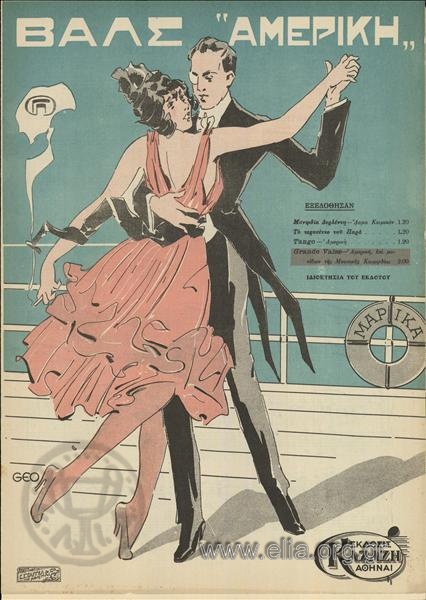
The image documents the moment when ballroom dance transitioned from exclusive social practice to mass-market entertainment and visual spectacle. It shows how a European social form was repackaged and rebranded as 'American' and theatrical, and it illustrates the crucial role chromolithographic posters played in circulating images of dance to audiences far beyond the theatre or ballroom.
What you are looking at
A man in black evening dress and a woman in a coral-pink gown are shown mid-waltz against a turquoise background. The woman's body is extended and animated, her voluminous skirt swirling up and outward as she leans back in an exaggerated arch, her right arm raised high. The man holds her firmly, his body upright and controlled, creating a sharp contrast with her fluid, weightless pose. The setting appears to be a ship's deck or ballroom, suggested by the curved railing visible in the lower right and the geometric architectural elements in the background. Art Deco styling dominates the composition: clean lines, simplified forms, and bold color fields. A small illustration of a man's head in profile appears in the lower left corner, signed with what appears to be a monogram. Greek text runs across the top of the image, and a publisher's mark is visible in the lower right.
The dancing
The couple is shown in a closed ballroom frame, though the woman's upper body is dramatically arched backward while the man remains vertical. Her weight appears to be supported entirely by his lead; her left leg extends into the frame while her right foot trails, suggesting forward motion. His right arm wraps around her waist; her left arm reaches upward and away. The extreme curvature of her spine and the buoyancy suggested by her lifted skirt convey a sense of weightlessness and momentum characteristic of the waltz's rise-and-fall action, though the pose is more theatrical than anatomically typical of authentic ballroom technique.
The dance depicted
This depicts the waltz, one of the defining dances of the early 20th century, shown here in a theatrical or exhibition style rather than social ballroom form. The exaggerated arch and the woman's weightless pose suggest the influence of theatrical dance aesthetics of the 1920s–1930s, when ballroom dance began to be portrayed in popular visual culture with increased expressivity and drama. The Greek title 'Βάλε Αμερικη' (likely *Valse Americana* or *American Waltz*) suggests this may represent a stylised or 'American' interpretation of the European waltz, reflecting the transatlantic dance fashions of the era. The image captures the dance as spectacle rather than social practice.
How it was made
This is a chromolithograph or colour lithographic print, evident from the bold flat areas of colour, the simplified forms, and the registration of multiple colour layers typical of the medium. The technique allowed for rapid reproduction and distribution as a theatrical or commercial poster, likely advertising a dance performance, musical revue, or film. The Art Deco graphic style and the integration of Greek text suggest a European origin, possibly Greek or Eastern European. Lithography's accessibility made this kind of image a primary vehicle for disseminating images of modern dance and ballroom culture to a broad, non-specialist audience.
About this work
This is a chromolithographic poster depicting a couple performing an exaggerated, theatrical waltz in the Art Deco style of the 1920s–1930s. The image captures the moment when ballroom dance—traditionally a social and participatory form—began to be reimagined as theatrical spectacle, with expressive, dramatised bodies replacing the restrained technique of the ballroom. The 'American' waltz referenced in the title reflects the period's fascination with transatlantic styles and the popularisation of ballroom dance through cinema, stage performance, and commercial imagery. It belongs in a dance gallery both as evidence of how dance was visualised and marketed in the early 20th century, and as a record of the aesthetic values—elegance, height, weightlessness, controlled abandon—that defined the era's ideal of the modern dancing body.
How to look at it
Attend to the asymmetry of the composition: the man's stillness against the woman's extreme extension. This contrast—between lead and follow, control and surrender, verticality and curve—was central to how early 20th-century ballroom was understood. Notice also how the artist has captured motion not through blur or multiple positions, but through the distortion of the body itself: the arched spine, the lifted skirt, the trailing foot all suggest the continuous spiral and rise-and-fall of the waltz without showing any multiple frames. The choice to freeze this particular moment—the woman at the apex of an arch—reveals what the artist and the culture valued in the dancing body: grace, weightlessness, and a kind of surrendered elegance.
The artist
The artist is not recorded in the available catalogue information. The monogram in the lower left corner may be legible under magnification, but without further research it cannot be attributed. The style and technique are consistent with Art Deco commercial graphic design and theatrical poster production of the 1920s–1930s.
The period
The 1920s and 1930s saw a dramatic shift in how ballroom dance was perceived and presented. What had been an intimate social practice became subject matter for avant-garde visual art and commercial spectacle. Simultaneously, European ballroom technique was being Americanised through Hollywood and Broadway, and competitive ballroom dancing was beginning to formalise into a recognised sport. The rise of chromolithography and colour printing enabled the mass production of dance imagery, making iconic representations of the dancing body available to consumers across Europe and beyond. Art Deco, with its celebration of modernity, streamlining, and geometric abstraction, became the dominant visual language for representing fashionable dance.
Where it lives
The work is held in the Europeana digital collection, a pan-European aggregator of cultural heritage objects. It is a chromolithographic print, likely a theatrical or commercial poster from the 1920s–1930s. The specific holding institution and accession number are not recorded in the available metadata.
Dance in this work
Questions about this work
Was the American waltz different from the European waltz?
In the 1920s–1930s, the term 'American' or 'American style' ballroom dancing began to denote a more theatrical, expressive approach to European ballroom forms, with greater use of rotation, sway, and dramatic body shapes. The distinction was partly marketing and partly genuine stylistic evolution, as American dancers and choreographers adapted European forms for stage and film. This poster likely advertises a performance or film that presented the waltz in this more theatrical idiom.
Is this an accurate representation of how the waltz was actually danced?
No. The extreme arch and the woman's weightless pose are theatrical exaggerations. In authentic ballroom waltz, both partners maintain an upright frame and move with controlled rise-and-fall, not dramatic spinal flexion. This poster prioritises visual drama and elegance over technical accuracy, reflecting the influence of theatrical dance and cinema on how ballroom was represented to the public.
What was chromolithography and why was it used for dance posters?
Chromolithography is a colour printing technique that uses separate stone or metal plates for each colour layer, allowing bold, flat areas of bright colour and sharp edges. It was fast, affordable, and could produce hundreds of copies, making it the standard medium for theatrical and commercial posters in the early 20th century. The technique's bold graphic qualities suited the Art Deco style and made dance imagery instantly recognisable and eye-catching.
More dance artwork