49 works in this view — arrow keys or swipe to move between them.
Dance in Art
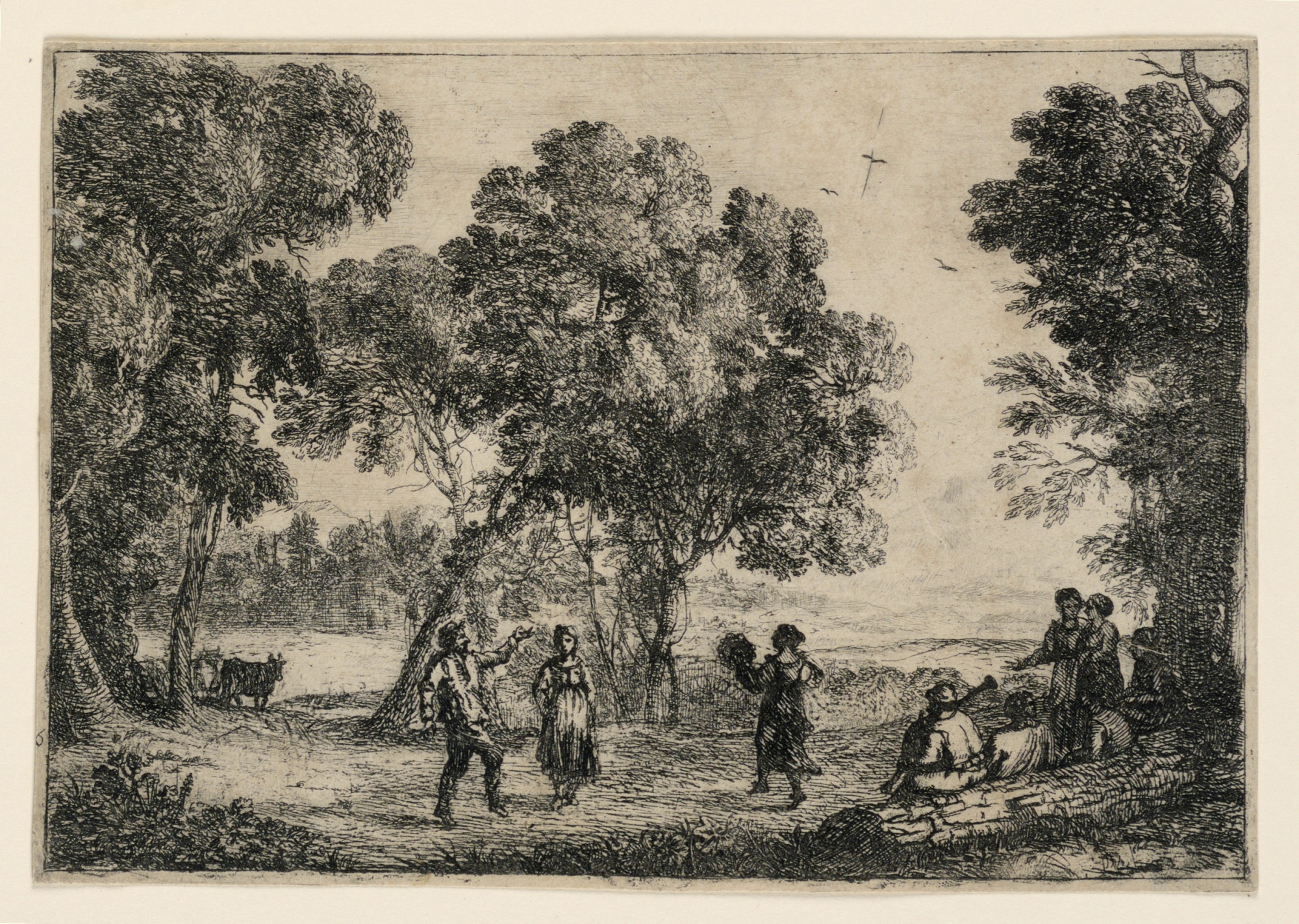
The Country Dance ld1-164339
Unknown artist
- Rights:
- Not recorded. Do not assume this image is free to reuse — check the source record.
Country dances are the ancestor of American contra and square dance, and this print is direct testimony to the form as it existed in the 18th century—not a description or a manual, but a visual record of the social dance in motion. For anyone tracing the lineage of set dances in English and American culture, this image shows the original context and aesthetic.
What you are looking at
A pastoral landscape engraving depicting a country dance in progress, set beneath towering trees in a clearing that opens toward distant hills. The composition is framed by dark, heavily detailed foliage on both sides—dense trees rendered in the characteristic fine cross-hatching of the medium—which creates a natural proscenium. In the middle distance, figures in 18th-century dress move across open ground. The dancers wear long skirts and fitted coats typical of the period; the women's gowns have full skirts, the men wear breeches and coats. To the right, a group of standing figures watch or await their turn. To the left, a dog rests near the trees. The light is even and clear, with no dramatic shadows; the atmosphere is one of leisure and social gathering rather than performance or formality. Birds fly in the pale sky above.
The dancing
The dancers occupy an open formation across the clearing, neither tightly grouped nor widely dispersed. The visible pairs and individuals show relaxed posture consistent with social dancing rather than balletic technique; bodies are upright but not rigid. The women's full skirts dominate the silhouette and suggest movement, though no single figure is caught mid-leap. Several figures appear to be in conversation or transitioning between dances. The hold and spacing suggest the kind of set or group dance in which partners rotate or advance and retreat, not the close ballroom hold of later Regency dances.
The dance depicted
This is a country dance, the English social form that dominated rural and village entertainment in the 17th and 18th centuries. The open formation, the pastoral setting, and the mixed group of dancing and waiting figures all align with the documented practice of country dances, which were typically danced in sets of couples arranged in longways or square formations, with a caller or musician directing the figures. The dress and style suggest the 18th century, when these dances had become increasingly codified and were also performed in courtly settings. The print documents not the dance itself but the social occasion—the dancing, the spectating, the mingling.
How it was made
This is an engraving, recognisable by the fine parallel lines (hatching and cross-hatching) used to create tone and texture, the sharp linear clarity of the composition, and the even, controlled line weight throughout. The technique allowed the artist to render intricate foliage and fine details of costume and gesture while maintaining the graphic clarity needed for reproduction and wide circulation. Engravings of this subject were produced in quantity for popular consumption, suggesting this work was intended for a broad audience interested in fashionable rural leisure, not collectors of fine art.
About this work
This is an 18th-century engraving of a country dance, the foundational English social dance form. It documents the aesthetic of country dancing as both physical practice and social ritual—the mixture of movement, costume, landscape, and spectation that made these dances central to village and courtly life. The print belongs to a large body of visual and literary material recording country dances and the ideals of rural English life they embodied. For dancers and historians, it is valuable evidence of how country dances were actually assembled and presented, and how the genre itself was marketed and understood in the period of its widest popularity.
How to look at it
Notice the balance between movement and stillness in the composition: some figures are actively dancing while others stand at the margins, reinforcing that country dances were communal, not continuous. The women's skirts catch light and suggest turning and stepping, but the image is not frozen at a moment of extreme extension or suspension—the artist has chosen a calm, readable moment. Observe the role of the landscape: the trees, the open ground, the distant prospect all situate the dance in a specific kind of place, not a ballroom or stage but a clearing in the countryside. This was ideologically important in the 18th century.
The period
Country dances emerged in England in the 16th century and reached their peak popularity in the 17th and 18th centuries, when they were performed at every social level from farmhouse to royal court. By the 18th century, dancing masters had begun to publish instructions for country dances, codifying their forms and steps. Visual culture of the period—paintings, engravings, and tapestries—frequently depicted country dances as emblems of English national identity and rural virtue. This print sits within that commercial and cultural production.
Where it lives
The work is held in the Smithsonian Institution and is listed as coming from an unknown era and unknown artist, suggesting it is part of a larger collection of popular prints acquired without full documentation.
Dance in this work
Questions about this work
What is a country dance?
A country dance is a social form for groups of dancers, usually in longways or square sets, with figures directed by a caller or musician. Dancers advance, retreat, and rotate partners according to set patterns. They originated in England in the 16th century and became the dominant social dance across Europe and colonial America. Many modern contra and square dances descend directly from country dances.
How can you tell this is an engraving and not a painting?
Engravings are made by incising lines into a metal plate; the resulting print shows very fine, parallel lines (hatching) to build tone and shadow. This image shows that characteristic linear technique throughout, especially in the rendering of foliage and fabric. Paintings, by contrast, use brushwork and blending. Engravings also have a particular graphic clarity and high contrast.
Why is the setting rural rather than in a ballroom?
Country dances were performed everywhere—in farmhouses, village greens, and also in aristocratic homes—but the rural or pastoral setting was symbolically important in the 18th century, when country dances were marketed as expressions of English national character and rural virtue. Even court dances included country dance figures. This image emphasizes that association.
More dance artwork