25 works in this view — arrow keys or swipe to move between them.
Dance in Art
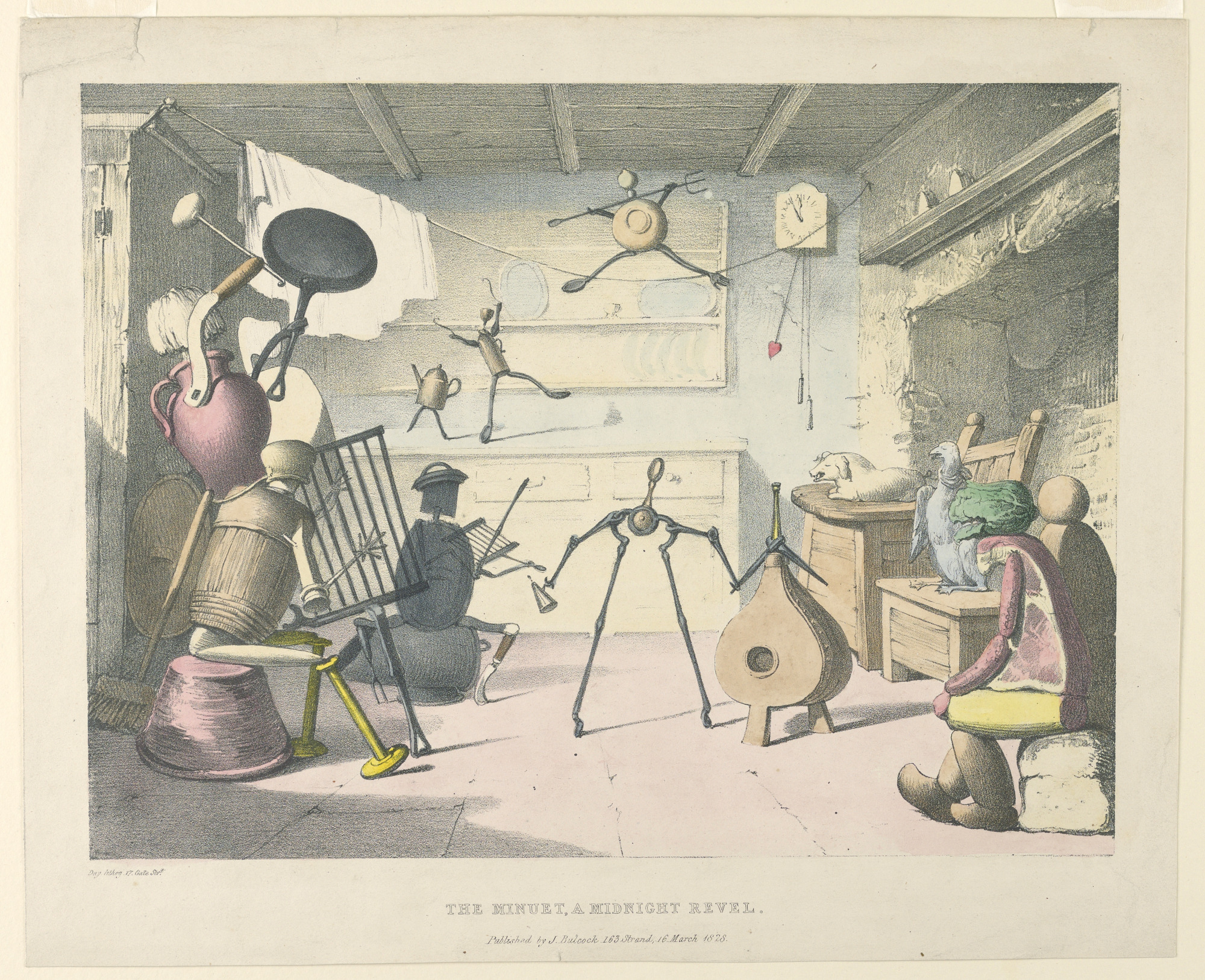
The Minuet a Midnight Revel ld1-164339
Unknown artist
- Dance:
- Minuet
- Rights:
- Not recorded. Do not assume this image is free to reuse — check the source record.
This print documents the minuet not as a dance form in itself, but as a cultural symbol—something formalized enough that its visual codes (the closed hold, the upright frame, the paired positioning) could be instantly recognized and lampooned. For historians, it reveals how 19th-century audiences understood ballroom dance: as a mechanized, almost inhuman performance of prescribed steps. For dancers, it is a humorous critique of the rigidity that formal technique can impose.
What you are looking at
A fantastical nocturnal interior where anthropomorphic kitchen implements and household objects have come to life to dance and make music. The scene depicts an impossible parlor or kitchen transformed into a ballroom, with thin-limbed figures constructed from pots, pans, ladles, and utensils arranged as if in a formal dance assembly. In the foreground, a figure with a large black frying pan for a head strikes a dramatic pose; nearby, a kettle-bodied dancer performs; in the center, figures hold each other in what resembles ballroom holds. At the right, two human observers—a woman in pink and a figure in green—watch from beside a table and window. A clock on the wall shows midnight. The ceiling is coffered wood; the walls are rendered in warm cream and grey wash. Moonlight appears to stream through a window, creating an atmosphere of whimsical nightmare or dream. The composition suggests a moment of lively revelry frozen mid-dance.
The dancing
The anthropomorphic figures adopt recognizable ballroom positions: several pairs appear to hold one another in closed position, with the characteristic upright frame of formal couples' dances. One central figure stands with arms extended in an exaggerated, theatrical pose suggesting either preparation for movement or a moment of display. The limbs of all figures are spindly and wire-like, emphasizing the grotesque quality of animate household goods. At least six to eight dancing figures occupy the central space, while the two human observers maintain static, witnessing poses at the periphery. The human woman wears a full skirt and appears to gesture toward the scene.
The dance depicted
The work depicts a minuet or formal ballroom dance, as confirmed by the title and by the closed-position partnering and upright posture visible in several figure pairs. The minuet was the most formal and codified of European court dances during the 18th and 19th centuries, characterized by precise steps, controlled arm carriage, and emphasis on grace and symmetry. This image inverts the minuet's association with refinement by staging it among inanimate objects—a satirical commentary on the rigidity, artificiality, or absurdity of formal dance convention. The 'midnight' setting and the dream-like impossibility of the scene suggest this is a fantastical or allegorical interpretation rather than a record of actual practice.
How it was made
This is a hand-colored engraving or aquatint, rendered in gray-green and cream tones with selective color applied by hand—pink, red, and yellow accents appear on the figures and furnishings. The technique of engraving allowed for fine linear detail in the figures' construction and the interior architecture, while tonal washes establish atmosphere and depth. The combination of engraving with hand-coloring was common in satirical and humorous prints of the 18th and 19th centuries, allowing for both precision and expressive color. Such prints were relatively affordable and circulated widely among educated and merchant-class audiences, making them effective vehicles for social and artistic satire.
About this work
This is a satirical engraving depicting a midnight dance of anthropomorphic household objects executing a formal minuet. The work dates to the 19th century (the publication line reads 'Published by Falk, Strand 153, March 4th 183[?]'), and uses the dream-logic and grotesque humor characteristic of the era's print culture. It belongs in a dance gallery because it comments directly on the minuet as a social and formal practice—by staging it among impossible figures, the artist raises questions about the artificiality and mechanical nature of courtly dance etiquette. The image preserves a record of how the minuet was perceived in popular culture: as a stiff, rule-governed spectacle worthy of mockery.
How to look at it
Look first at the poses of the central figures: notice the closed holds, the upright posture, and the mirrored positioning that signal the formality of ballroom dance. Then observe the grotesque incongruity—the figures are made of kitchen equipment, with spindly wire limbs and hollow bodies. The two human observers at right frame the scene as a spectacle or dream; the midnight clock and the impossible interior (with both domestic and ballroom furnishings) signal that this is a fantasy. The engraver has captured the minuet at the moment of its greatest formality and artifice, making it ripe for satirical transformation.
The period
The minuet dominated European aristocratic and court culture from the 17th through the late 18th century, by the time of this print it had become associated with the old regime and formality. The 19th century saw both nostalgia for and mockery of the minuet as a symbol of ancien régime etiquette; printing technologies and the expansion of a commercial print market created an audience for satirical images of social convention. Grotesque anthropomorphism—the animation of everyday objects—was a popular motif in European satirical art of the period, reflecting anxieties about industrialization, mechanization, and the loss of human agency.
Where it lives
This work comes from the Smithsonian Institution. The publication line indicates it was published by a London printer (Falk, Strand 153) on 4 March of an 183- year (the final digit is unclear from the image). It is a hand-colored engraving, a type of work that circulated widely and affordably in 19th-century Britain.
Dance in this work
Questions about this work
Is this meant to be a real dance?
No. The minuet is real, but the scene is a fantastical satire—the figures are made of household objects animated as if in a dream. The artist is using the minuet's formal codes (the holds, the partnering, the upright frame) to comment on its rigidity and artificiality, not to document an actual dance or performance.
Why was the minuet being mocked?
By the 19th century, the minuet was associated with the formal, hierarchical etiquette of the old European aristocracy. As societies modernized and new dances emerged, the minuet became a symbol of stiffness and outmoded convention—an easy target for satirists. This print reflects a cultural moment when formality itself had become ridiculous.
What does the title 'A Midnight Revel' suggest?
A 'revel' is a wild, unrestrained celebration or dance. But here, the minuet is the opposite—hyper-controlled and formal. By calling it a 'midnight revel,' the artist deepens the paradox: this is as far from wild revelry as imaginable. The midnight setting also signals a dream or supernatural event, heightening the sense of the absurd.
How was this made?
It is an engraved print (a type of intaglio printmaking) that was hand-colored after printing. This technique allowed for both fine, precise detail in the figures and furnishings and expressive color. Such prints were popular, affordable, and widely distributed in 19th-century Britain, making them effective tools for satire and social commentary.
More Minuet artwork