32 works in this view — arrow keys or swipe to move between them.
Dance in Art
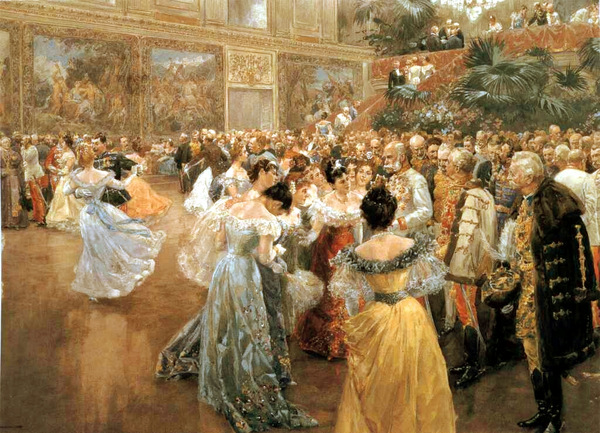
Hofball in Wien (Court Ball in Vienna)
Wilhelm Gause
- Era:
- 1900-1920 (Ragtime/Early Jazz)
- Rights:
- By Wilhelm Gause. In the public domain in the United States.
- Recorded as:
- public_domain
This is one of the most direct and detailed visual records of Viennese waltz culture in its native context—the imperial court—and shows how the dance functioned as a language of status, courtship, and social order rather than as entertainment or display. For dancers and dance historians, it documents the authentic posture, frame, and spacing of historical ballroom dancing and reveals the waltz not as a romantic solo moment but as a crowded, social, carefully regulated collective practice.
What you are looking at
A grand ballroom scene depicts dozens of elegantly dressed figures in a palatial interior adorned with frescoed walls, gilt decorations, and potted palms. The composition is crowded and energetic, with dancers and spectators distributed across a polished floor. The figures wear formal evening dress: women in white, pale blue, yellow, and jewel-toned gowns with long trains and bare shoulders; men in dark tailcoats with white shirts and medals or decorations. The lighting is warm and diffuse, suggesting either candlelight or early electric illumination, casting soft shadows across the scene. The moment captures the height of the ball—a throng of couples mid-waltz or in conversation, their postures relaxed and social rather than formally posed, suggesting a candid record of an actual court occasion or a skilled imaginative recreation of one.
The dancing
Couples are held in closed ballroom position throughout the composition—the man's right hand at the woman's back, her left hand on his shoulder, their right and left hands clasped at shoulder height. The characteristic frame is upright and formal, with bodies held at a controlled distance. The dancers' weight is centered and their stepping is small and controlled, appropriate to the crowded floor. The women's long trained skirts trail behind them in arcs, their movement suggested by the angle of their bodies and the flow of fabric. Posture is upright and dignified, with the formal reserve expected of imperial court etiquette.
The dance depicted
This is a waltz—the dominant ballroom dance of the Habsburg court and European aristocracy from the late 18th century onward. The closed position, the paired couples, the upright frame, and the formal setting all confirm it. The Vienna court ball (Hofball) was the supreme occasion for waltzing in the 19th and early 20th centuries, and waltzing remained the most prestigious and formally codified of ballroom dances during the Gilded Age and into the early 20th century. The image shows social waltzing rather than competitive display—the primary function of the dance at such occasions was courtship, social bonding, and the affirmation of aristocratic status through refined movement.
How it was made
The work appears to be a painting executed in oils or tempera, likely a large-scale commissioned work based on its scale, finish, and the detail lavished on the crowd and setting. The artist has employed a high viewpoint and aerial perspective to encompass the full ballroom and make space for dozens of figures without crowding the composition illegibly. The soft, warm palette and the play of light across fabrics and polished floors suggests training in salon painting and an interest in depicting luxury and elegance. The scale and formal nature of the work indicate it was created for public exhibition or private patronage, not as a sketch or study.
About this work
This is a formal record of an elite court ball in Vienna, rendered as a painting that celebrates the splendor and refinement of Habsburg court culture at the height of its power. The work documents the waltz as the primary dance of aristocratic Vienna—no longer a novelty, as it had been in the 1780s, but the established language of courtship and social hierarchy among the imperial elite. The painting captures not a single dramatic moment but the ambient life of the ball: the constant circulation of couples, the formal dress code, the palatial setting, and the absolute dominance of the closed-position waltz as the only acceptable form of couple dance. For historians of dance and dress, the work is valuable as a visual archive of how the waltz was actually danced, held, and integrated into court ritual in Vienna's final decades as a major European power.
How to look at it
Attend to the density and repetition of the closed-position frame across the canvas—every couple holds the same position, suggesting its absolute codification and the conformity demanded by court etiquette. Notice the angle of the women's bodies as they turn, the trail of their skirts, and the upright posture of the men, which together suggest the three-beat rotational motion of the waltz without depicting any single frozen moment of it. The palatial setting—the frescoes, the gilt, the potted palms, the crystal light—is not incidental; it is the waltz's proper context, the stage on which aristocratic identity is performed. Finally, observe that there is no spectacle, no showiness, no individual variation; the beauty lies in uniformity, in the collective grace of the crowd.
The artist
Wilhelm Gause (1853–1916) was an Austrian painter and illustrator specializing in scenes of Viennese high society, court life, and grand public occasions. He was known for his ability to compose complex multi-figure scenes with elegance and narrative clarity, and his work was widely reproduced in illustrated periodicals and exhibited at the Vienna Salon. His paintings of court balls and society events were popular with the Austro-Hungarian aristocracy and are now important documentary sources for the visual culture of the period.
The period
The painting dates to the Gilded Age / Belle Époque, a period of unprecedented wealth and cultural confidence among European aristocracies. The waltz had by this time been the dominant ballroom dance for over a century and was codified in strict rules of frame, posture, and rotation. The late 19th and early 20th centuries saw the rise of competitive ballroom dancing as a separate activity, but the court ball remained the highest social occasion and the waltz its central ritual. At the same time, new dances—the Tango, the Foxtrot, the One-Step—were arriving from the Americas and would soon displace the waltz from popular culture. This painting thus captures the waltz at a moment of cultural triumph and imminent decline.
Where it lives
It is catalogued as from the 1900–1920 period, though the image itself suggests it may date from the 1880s–1900s on stylistic grounds.
Dance in this work
Questions about this work
Is this a documentary record or an imagined scene?
It is almost certainly imagined or stylized rather than a direct record of a single ball. However, Gause was a careful observer of Viennese court culture and based his compositions on close study of contemporary court etiquette, dress, and architecture. The painting should be read as a faithful reconstruction of type rather than of a specific occasion—it shows how court balls looked and functioned, not a particular evening.
Why do all the couples look the same?
They do not—there is variation in the women's gown colors, fabrics, and trim, and in the men's decorations and insignia. But they all hold the same closed position and maintain the same formal posture because court etiquette required it. Variation in dress was permitted and even expected as a display of status; variation in the dance itself was not.
What is the difference between a court ball and other waltz venues?
The court ball was the supreme occasion, attended only by the aristocracy and the highest nobility, and governed by rigid rules of dress, behavior, and dance. The waltz was also danced in salons, at private parties, and in public dance halls, but always with less formal restriction. This painting shows the waltz at its most formal and socially exclusive.
When did the waltz stop being the main ballroom dance?
The waltz began to yield ground to newer dances—the Foxtrot, the Tango, the Quickstep—in the 1910s and 1920s. However, it remained (and remains) a core ballroom dance, and court balls continued to open with a waltz well into the 20th century.
More dance artwork