31 works in this view — arrow keys or swipe to move between them.
Dance in Art
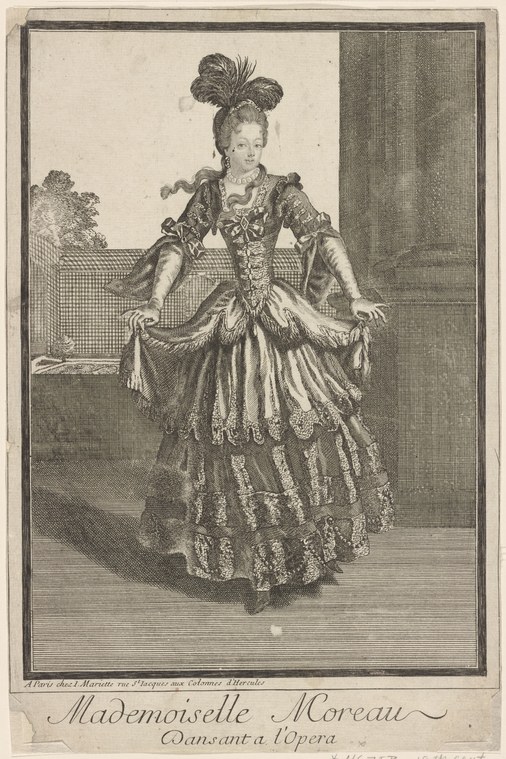
Mademoiselle Moreau dansant a L'Opéra
Unknown artist
- Collection:
- Prints depicting dance
- Source:
- New York Public Library
- Rights:
- Public domain — free to use, share and adapt.
- Recorded as:
- Public Domain
This image is one of the few surviving records of how baroque theatrical dance appeared in the late 17th century, before choreographic notation became standard. It documents both the physical technique (upright posture, controlled arms, evidence of trained footwork) and the crucial role of costume and textile in the choreography itself, showing how the dancer's skill lay partly in manipulating her elaborate skirts as part of the movement vocabulary. For historians and dancers, it provides concrete evidence of the aesthetic priorities and technical demands of French court ballet at the Opéra.
What you are looking at
A solo female dancer occupies the center of this engraving, posed in a moment of suspended elegance. She wears an elaborate late 17th-century court costume: a richly patterned brocaded bodice with short puffed sleeves, and a voluminous skirt composed of multiple tiers of deep pleats or flounces that fall to the floor, creating dramatic vertical lines. The skirt appears to be caught mid-motion, suggesting active dancing rather than a static portrait. She wears her hair piled high and adorned with feathers. Her left arm extends gracefully to the side, holding the fabric of her skirt, while her right arm hangs at rest. Her posture is upright and controlled, weight appearing to rest lightly on her feet. The figure stands on a simple wooden stage floor rendered in linear perspective, with a checkered balustrade or railing visible to the left background and neutral drapery to the right, establishing a theater interior. The engraving employs fine parallel hatching to create shadow and volume, particularly in the rendering of the fabric and the neutral ground.
The dancing
The dancer is presented in profile-frontal view, allowing the viewer to see the full silhouette of her costume while observing her frontal bearing. Her upper body remains poised and vertical; her head is held high. The extended left arm and gathered skirt suggest a moment in a gliding or turning movement typical of baroque court dances, where the management of fabric was as essential to the choreography as footwork. Her stance implies lightness—the legs are not splayed or weighted heavily, suggesting the quick, precise footwork of baroque dance rather than the grounded, flat-footed stance of folk dancing.
The dance depicted
This is a theatrical court dance of the late 17th century, most likely a theatrical version of the minuet or a related baroque court form performed at the Paris Opéra. The inscription identifies the figure as Mademoiselle Moreau dancing at the Opéra (likely the Académie Royale de Musique). The costume, theatrical setting, and style of presentation indicate this is theatrical dance—ballet de cour or operatic ballet—rather than social dancing. The dancer's management of her elaborate skirts and the controlled, upright posture are characteristic of the aesthetics of Lully-era French ballet, where dancers were trained in the five positions and worked to create an impression of effortless elevation and grace despite the technical demands of the movement.
How it was made
This is a copper-plate engraving, identifiable by the fine parallel hatching lines, the precision of the linear perspective, and the tonal gradations achieved through varied line density. The technique allows for detailed rendering of textile pattern and surface, which is lavished on the dancer's brocaded bodice and pleated skirt. Engravings of this period were widely circulated as prints and served as records of celebrated dancers and theatrical performances; this example likely served both documentary and promotional functions, circulating among courtiers and the theatrical public. The inscription in script below the figure is characteristic of such prints, serving as a caption that anchored the image to a specific performer and venue.
About this work
This engraving documents a celebrated dancer of the late 17th-century Parisian Opéra, capturing a moment of baroque theatrical dance. Mademoiselle Moreau is presented in a formal pose that conveys both the technical control and the courtly elegance demanded by the ballet of the period. The work belongs to a tradition of dance prints that made performances visible to audiences beyond the theater itself, circulating knowledge of celebrated dancers and the aesthetic standards of French court dance at the height of its formal refinement. The engraving demonstrates how the management of costume—particularly the pleated skirt—was integral to the visual and choreographic language of baroque ballet.
How to look at it
Observe the relationship between the dancer's body and her costume: her extended arm is not merely posed, but actively managing the fabric of her skirt, suggesting that this moment represents an actual movement within choreography rather than a static portrait. Notice how the pleated skirt creates strong vertical lines that frame the lower body, a silhouette that would have been essential to baroque dance aesthetics. The upright carriage of the torso and the controlled, light quality suggested by her stance and proportions reflect the training methods of the period. The engraving's fine detail makes visible the elaborate brocade of the bodice—a textile that would have been expensive and would have announced the dancer's status as a professional performer at the royal Opéra.
The period
This engraving dates to the era when Jean-Baptiste Lully dominated French theatrical dance and music, establishing the vocabulary and techniques of ballet de cour. The Académie Royale de Musique (the Paris Opéra) was the premier venue for such performances, and celebrated dancers like Mademoiselle Moreau achieved celebrity status through their roles in operatic ballets. The late 17th century saw the codification of the five positions and the development of a professional ballet technique distinct from social dancing. Theatrical dance was increasingly documented in prints, which served as both records and promotional tools, helping to disseminate knowledge of celebrated performers across Europe. The technical sophistication visible in this image—the controlled posture, the precise handling of fabric, the theatrical setting—reflects the growing professionalization of dance as an art form separate from courtly social practice.
Where it lives
This engraving is held in the New York Public Library's print collection on dance. It is one of many similar prints documenting celebrated performers and theatrical moments from the baroque opera house, and it exemplifies the practice of circulating images of famous dancers through the print market.
Dance in this work
Questions about this work
Who was Mademoiselle Moreau?
Mademoiselle Moreau was a celebrated dancer at the Paris Opéra in the late 17th century. Beyond what is recorded in prints like this one, little biographical information survives. Such prints were how dancers achieved and maintained their celebrity, and this image is likely one of the few records of her performance.
What is she dancing?
The specific choreography cannot be determined from the image alone, but the costume, setting, and her posture indicate this is a theatrical ballet from the Lully era, likely a minuet or a related court form performed as part of an operatic ballet. The dance would have been performed to instrumental music and would have employed the five positions and the controlled, rising aesthetic of baroque technique.
Why is her skirt so elaborate?
The pleated skirt was not merely decorative: it was integral to baroque choreography. Dancers trained extensively in managing their skirts, and the silhouette created by the pleats was central to the visual language of the dance. The fabric also signaled the dancer's status and the prestige of the Opéra.
Is this a photograph or a drawing?
This is an engraving, a printmaking technique that uses a metal plate incised with fine lines to create an image. Engravings allowed for precise detail and wide circulation through printing, making them ideal for documenting and promoting theatrical performances before photography existed.
More dance artwork





