38 works in this view — arrow keys or swipe to move between them.
Dance in Art
Roland
Unknown artist
- Collection:
- Prints depicting dance
- Source:
- New York Public Library
- Rights:
- Public domain — free to use, share and adapt.
- Recorded as:
- Public Domain
This image preserves visual evidence of how court ballet was staged and experienced in the early 18th century—not as a display of virtuosity but as a theatrical and architectural experience that merged dance, costume, and fantasy setting. For historians of theatrical dance, the work documents the aesthetic priorities of the period: the body in motion was subordinate to the grandeur of the space and the formality of social order. For readers of court culture, it demonstrates how ballet functioned as a vehicle for displaying wealth, taste, and command of both artistic and architectural spectacle.
What you are looking at
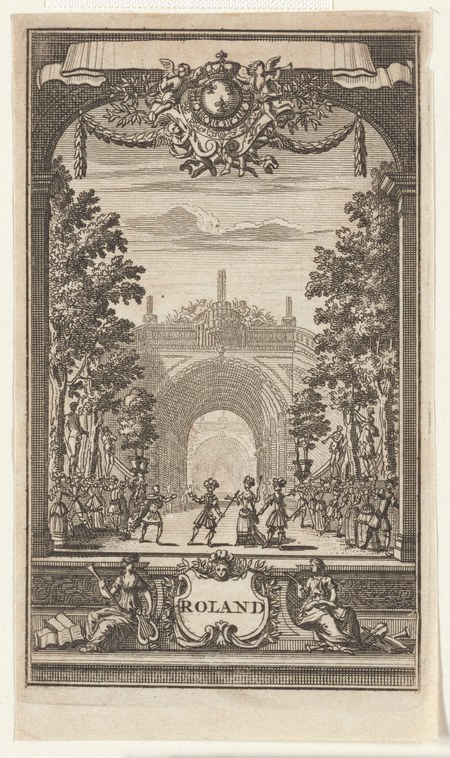
This is an engraved theatrical scene framed by a classical proscenium arch, showing a grand formal garden or palace courtyard viewed through an arched colonnade. The composition is deeply recessed, with a paved pathway leading toward an ornate building with domes and spires in the distance, flanked by tall trees on either side. The foreground features several figures in period dress—appearing to be early 18th-century clothing—arranged in small groups on the paved floor. The figures are positioned across the width of the stage space, some standing, some in conversation or interaction. Above the arch is an ornate cartouche with a coat of arms and two ribbon banners, with the word "ROLAND" inscribed in the lower section beneath the scene. The engraving is executed in fine parallel lines typical of classical printmaking, creating a theatrical architectural setting that dominates the composition while the human figures remain relatively small and subordinate to the grandeur of the setting.
The dancing
The figures are distributed across the stage floor in loose groups rather than in a coordinated line or formation. They wear the silhouettes of early 18th-century costume—women in full-skirted gowns, men in coats and breeches—suggesting formal court dress of the period. The poses are relatively upright and stately; no figures appear to be executing dynamic movement or leaps. The groupings suggest social interaction and promenade rather than partnered or massed choreography. The figures are quite small relative to the architectural setting, indicating that the visual emphasis is on the theatrical space itself rather than on the bodies of the dancers.
The dance depicted
This appears to be a scene from a theatrical ballet or court entertainment, most likely a ballet de cour or an opera-ballet of the early 18th century. The title "Roland" suggests it may relate to the Arthurian or medieval romance tradition that was popular in French court entertainment of this era. The formal garden setting and courtly dress align with how such entertainments depicted aristocratic social dancing or processional movement. The placement of figures in dispersed groups rather than in tight choreographic formation, and the emphasis on the architectural setting, suggests this depicts the processional or social dances that typically concluded acts in court ballets—the kind of stately, promenading movement that filled theatrical space rather than concentrated footwork.
How it was made
This is an engraving, executed with the fine hatching and parallel line technique characteristic of 17th- and early 18th-century print production. The use of engraving—a technique requiring skilled hand-work and multiple printing passes—indicates this was a luxury item, likely circulated among aristocratic or educated audiences familiar with court entertainments and opera-ballet. The architectural precision and linear perspective suggest this was designed for a wider educated public rather than a specialized theatrical context; such prints served as souvenirs of celebrated performances or as illustrations in published librettos and accounts of court spectacles.
About this work
This engraving documents a scene from what is likely a court ballet or theatrical entertainment titled "Roland," probably from the early 18th century. The work combines theatrical architectural fantasy—a palatial garden colonnade receding into impossible distance—with a dispersed grouping of courtly figures in period dress. The emphasis on setting over choreography, and on the formal social arrangement of bodies rather than virtuosic movement, tells us much about how theatrical dance functioned in the aristocratic court: as processional, stately, and deeply bound to the social world represented by the costume and architecture. The engraving's fine detail and technical skill suggest it was a high-status object, circulated among those who patronized or attended such spectacles.
How to look at it
Observe how the engraver has made the architectural setting—the colonnade, the receding garden, the palatial structure—far more elaborate and spatially complex than the figures occupying it. This is not incidental: the choice tells us that the theatrical experience was about environmental spectacle. Notice the dispersed placement of the figures: they are not in a line, not in a tight formation, but spread across the floor in small conversational groups. This suggests the 'dance' here is closer to formal procession and social arrangement than to what we might now expect of stage dancing. The engraving technique itself—visible hatching, the precision of the perspective lines—speaks to this as a technical and luxury object, documenting a specific production for a specific educated audience.
The period
In the early 18th century, court ballet and opera-ballet were major entertainments of European aristocracy, particularly in France. These were not primarily vehicles for virtuosic dance display; rather, they were multimedia spectacles combining music, theatrical machinery, elaborate costume, and formal social dancing. The tradition inherited from Louis XIV's court ballet saw dance integrated into longer dramatic and musical works, often retelling classical or medieval narratives. The emphasis was on the courtier's ability to execute noble, restrained movement—the foundation of the ballet vocabulary that was codifying into the system later known as classical ballet. Such works were documented in prints and engraved illustrations, which circulated as expensive luxury objects among aristocratic patrons and the educated public.
Where it lives
This engraving is held in the New York Public Library's collection of prints depicting dance. The work is catalogued by its title alone; artist, date, and medium are not recorded in the catalogue.
Dance in this work
Questions about this work
What is 'Roland' referring to?
The title likely refers to a work from the Arthurian or medieval romance tradition—stories of the knight Roland were popular in European culture and frequently adapted for court entertainments and opera-ballets. Without additional documentation, the specific work cannot be identified with certainty, but the formal garden setting and courtly context suggest a romantic or chivalric narrative.
Is this a ballet in the modern sense?
No. This depicts what was called a ballet de cour or a scene from an opera-ballet of the early 18th century, which is very different from ballet as it developed later. These were primarily social and processional entertainments, not technical displays. The dancers were courtiers or professional singers and actors trained in courtly deportment, not the virtuosic dancers we associate with 19th-century ballet.
Why is so much of the image devoted to the setting?
The theatrical appeal of such productions lay in the combination of music, spectacle, elaborate costume, and architectural fantasy. The engraver's choice to depict the grand colonnade and receding garden reflects what actually drew audiences: the opportunity to see costly, ingenious stage machinery and scenery that created impossible worlds. The dancing was part of this total effect, not its center.
What do the dispersed groupings of figures suggest about how the dance was performed?
The loose, spread arrangement suggests movement that was restrained, stately, and social rather than concentrated. This was likely a promenade or processional finale, in which courtiers displayed their noble bearing and formal deportment—the foundation of what became classical ballet technique. The movement would have been relatively symmetrical and orderly, not involving rapid footwork or spectacular jumps.
More dance artwork





