49 works in this view — arrow keys or swipe to move between them.
Dance in Art
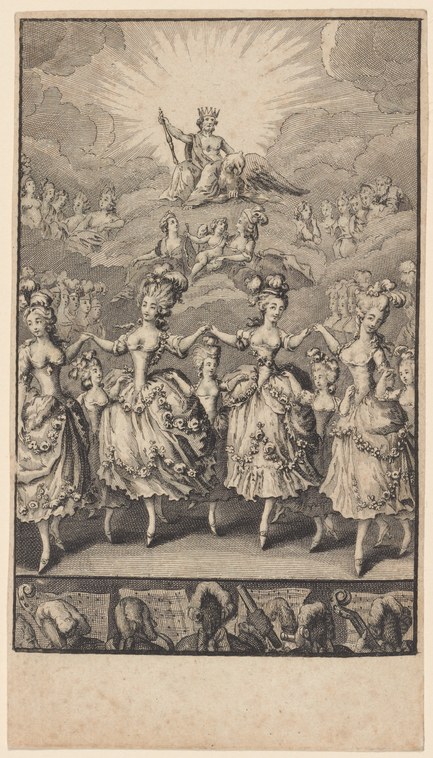
Psyché, a scene from the ballet
Unknown artist
- Collection:
- Prints depicting dance
- Source:
- New York Public Library
- Rights:
- Public domain — free to use, share and adapt.
- Recorded as:
- Public Domain
This engraving is a primary record of court ballet aesthetics and the visual language of 17th-18th century court spectacle at a moment when dance was a central art form of court display and political expression. The work demonstrates how dance imagery functioned in the pre-photographic era: as designs for performance, as records of ephemeral events, and as allegorical representations of courtly values and political order. Understanding this visual tradition is essential to grasping how professional theatrical ballet evolved from court entertainment and how the representation of dance changed across media and historical periods.
What you are looking at
A celestial vision of classical mythology rendered as allegorical dance theater. At the top of the composition, a radiant crowned figure (Psyché or divine Love) sits enthroned on clouds, surrounded by radiating light and seated figures in adoration. Below, an ensemble of eight to ten women in draped classical costume stand in a formal, nearly symmetrical arrangement on a stage platform. They wear diaphanous gowns with decorative borders and jeweled ornaments, and most hold or gesture toward attributes—some carry what appear to be palms, wreaths, or ceremonial objects. Their poses are formally composed rather than naturalistic: several stand with weight evenly distributed or in slight contrapposto, arms extended in gestures of reverence or offering toward the heavenly vision above. The lower register contains a thin frieze of secondary figures. The entire composition is rendered in fine engraved line on pale ground, creating an effect of theatrical design or festival spectacle rather than documentary record.
The dancing
The ensemble dancers occupy a shallow stage space in a unified front-facing arrangement, arranged as if for a formal procession or ceremonial presentation rather than a social dance. Their bodies are largely vertical and upright; there is no partnering, no closed holds, no turning. The raised arms and gestures toward the divine figure above read as devotional rather than balletic—palms turned outward or upward in offering. The spacing and symmetry suggest a masque or court spectacle in which the dancers function as a chorus or attendant group rather than as virtuosic performers. The rendering of the bodies is idealized and somewhat stiff, without the anatomical specificity or dynamic weight that would appear in later Romantic or Classical ballet imagery.
The dance depicted
This represents a court masque or allegorical ballet of the 17th or early 18th century, most likely depicting a scene from a pastoral or mythological ballet d'action. The title 'Psyché' invokes the classical narrative of Psyche and Cupid, a popular subject for court entertainment and theatrical spectacle across this period. The dancers appear to be female members of the court or professional performers enacting allegorical or mythological roles—likely attendants, nymphs, or personifications of virtues surrounding the divine or heroic central figure. The composition and costume align with the court ballet tradition (ballet de cour), where such works combined poetry, music, dance, elaborate costume, and scenic machinery to create a unified spectacle. The formal, processional quality and the absence of technical virtuosity suggests this is documentary or commemorative imagery of court entertainment rather than a record of professional theatrical dance.
How it was made
This is a finely executed engraving, identifiable by the controlled parallel line work, cross-hatching for tone, and the characteristic bite and precision of the engraving needle. The technique allowed for mass reproduction and distribution of designs for festivals, court entertainments, and theatrical spectacles—this is almost certainly an engraved print after a design by a court artist, circulated among the nobility and educated classes. The fineness of the line and the idealized rendering suggest skilled execution by a professional engraver, probably working from a drawing or design by a painter associated with court theaters. Engravings served as records of ephemeral spectacles and as designs or commemorations of important court events; they reached a wider audience than the performances themselves and helped establish the visual conventions of court ballet across Europe.
About this work
This engraving documents or commemorates a scene from a court ballet on the subject of Psyché, presenting an allegorical vision of divine or celestial love presiding over an ensemble of female dancers in classical dress. The work belongs to the tradition of court spectacle (ballet de cour) and masque entertainment of the 17th or early 18th century, in which aristocratic or professional dancers performed in elaborately costumed, dramatically staged presentations combining music, poetry, and visual design. The engraved format indicates this is a print made for circulation among the court and educated public—not a record of a single performance, but a design or commemorative image establishing the visual and narrative content of the spectacle.
For a viewer accustomed to Romantic or Classical ballet imagery, this work offers a valuable window into the formal, hieratic, and courtly aesthetic that preceded the development of technical virtuosity and narrative drama in theater dance. The dancers are presented as dignified, symmetrically arranged figures in service to an allegorical idea rather than as individuated performers. This reflects the courtly values of order, hierarchy, and the submission of human will to divine or heroic principle that structured court ballet at its height.
How to look at it
Attend to the formal symmetry and stillness of the composition: there is no moment of dynamic movement frozen here, but rather a hieratic arrangement designed to communicate order, allegiance, and the subordination of human figures to a divine or allegorical center. Note how the radiance above and the formal forward-facing arrangement of the dancers below create a visual hierarchy in which the celestial vision commands attention and the dancers function as a responding chorus. The engraver's precision in rendering costume details—the borders, jewels, and attributes—indicates that the visual spectacle and symbolic meaning of dress were central to the work's purpose. This is not a snapshot of dance but a composed, emblematic image in which dance serves as part of a larger court ceremonial.
The period
This work belongs to the era of the court ballet (ballet de cour), which flourished in France and across European courts from the early 16th century through the 18th century. Court ballet combined dance with spectacle, machinery, music, and elaborate costume in service of courtly ideology and often to commemorate dynastic events or celebrate political power. The Psyche myth was a favored subject for such entertainments, as it offered opportunities for elaborate visual allegory, celestial machinery, and the display of both male and female courtly dancers. By the period this engraving appears to date from—likely early 18th century—the court ballet was beginning to give way to the professional ballet d'action and the development of Romantic ballet, but the formal, processional, hieratic aesthetic seen here remained influential in court and court-derived theatrical traditions. The engraved print format was the standard means of recording and circulating designs for such spectacles, establishing their visual conventions across the European court system.
Where it lives
This engraving is held in the New York Public Library's Prints collection, which focuses on pictorial and graphic works across historical periods. The sparse cataloguing (title, no identified artist, no dated attribution) reflects the challenge of establishing provenance for prints that circulated widely and often anonymously, especially from the court entertainment tradition.
Dance in this work
Questions about this work
What is a court ballet (ballet de cour)?
A court ballet was a spectacular theatrical entertainment performed at royal courts, combining dance with music, poetry, elaborate costumes, and stage machinery. Popular from the 16th through 18th centuries, these works celebrated dynastic power, allegorical virtues, or mythological narratives. They involved members of the court nobility as well as professional musicians and dancers, and were often recorded in engraved prints that circulated among the European aristocracy.
Why would a court ballet about Psyche have been performed?
The Psyche myth offered rich material for court allegory: the story of Psyche's trials and ultimate union with divine love could be read as a meditation on virtue, divine favor, and the transcendence of mortal weakness. Such narratives allowed courts to celebrate their own power and refinement while engaging audiences in a visual and narrative spectacle that combined courtly display with classical learning.
How does this differ from later ballet imagery?
Unlike Romantic or Classical ballet imagery, which emphasizes the technical virtuosity, dynamic poses, and emotional expression of individual dancers, this court ballet image presents dancers as a formal, symmetrical ensemble in service to an allegorical idea. There are no pointed feet, no turned-out legs, no dynamic movement—only dignified stillness and ceremonial arrangement. This reflects the courtly aesthetic that valued order and hierarchy over technical display.
What was the purpose of printing engravings of court spectacles?
Engravings allowed courts to circulate images of their spectacles beyond the single performance, spreading knowledge of their artistic patronage and cultural sophistication. These prints served as designs for future performances, commemorations of important events, and gifts to allied courts and dignitaries. They also helped establish and standardize the visual conventions of court entertainment across Europe.
More dance artwork





