49 works in this view — arrow keys or swipe to move between them.
Dance in Art
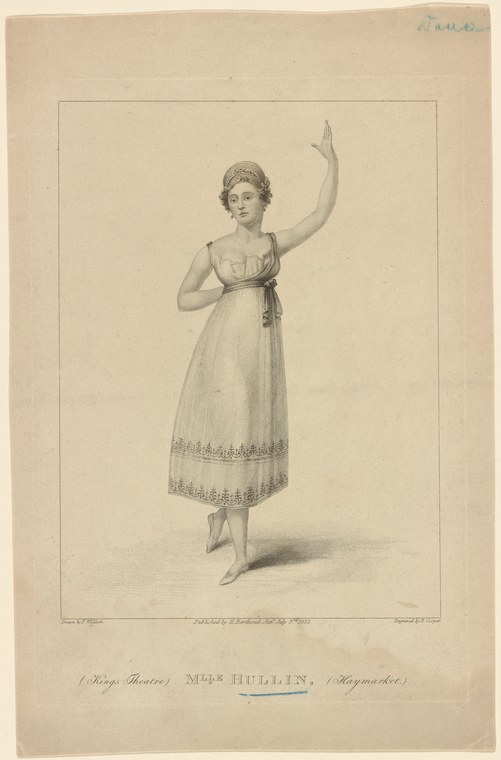
(Kings Theatre) Mlle. Hullin, (Haymarket)
Unknown artist
- Collection:
- Prints depicting dance
- Source:
- New York Public Library
- Rights:
- Public domain — free to use, share and adapt.
- Recorded as:
- Public Domain
This print documents a crucial moment of transition in British dance history: the arrival of Romantic ballet aesthetics in London theatres during the 1820s–1830s, when the language of the body was shifting from the 18th-century emphasis on lower-body articulation (footwork, jumping) toward the 19th-century focus on upper-body line and ethereal presence. The print also preserves evidence of the professional female dancer as a commodity and celebrity in the London market, and of the visual culture through which theatrical performance was circulated to the non-theatre public.
What you are looking at
A young woman stands alone against a plain background in a pose that suggests performance or demonstration. She wears a high-waisted white muslin dress with a decorative embroidered or patterned border at the hem, characteristic of Regency-era fashion. Her hair is arranged in a classical style with a headpiece or ornament. Her right arm is raised in an elegant arc above her head, palm open, while her left arm rests at her side. Her weight appears to be on one leg, with the other slightly extended. The figure is rendered in fine detail using what appears to be hand-colored engraving or aquatint, with careful attention to the fall of fabric and the modeling of the body. The pose is formal and controlled, suggesting a trained performer captured mid-movement.
The dancing
A single female dancer stands in a classical contrapposto position with her weight shifted to one leg. Her raised right arm follows a long, elegant line from shoulder to fingertips, characteristic of early 19th-century theatrical deportment. The arm position and the slight extension of the opposite leg suggest a moment of elegant elevation or transition between steps. Her torso is upright and her frame composed; the gesture conveys grace and formal training rather than vigorous action.
The dance depicted
This is a theatrical dance figure of the Regency era, most likely a scene from a contemporary pantomime or dance entertainment at the King's Theatre or Haymarket Theatre, as indicated by the caption. The pose and costume are consistent with the Romantic ballet vocabulary that was emerging in the 1820s–1830s, though the emphasis on upper-body line and the elevated arm position also suggest influence from earlier classical dance training. The isolated figure and formal presentation indicate this is a demonstration of a particular pose or moment of choreography, possibly documenting a famous performer's signature movement or role.
How it was made
This is a hand-colored engraving or aquatint, a reproductive print technique widely used in the early 19th century for theatrical documentation and entertainment prints. The fine linear work establishes form and drapery, while subtle tonal gradation creates volume in the body and shadows beneath the figure. The technique allowed for wide circulation and affordable reproduction, making theatrical imagery accessible to the London public. Such prints were commonly collected as records of celebrated performers and specific roles.
About this work
This is a theatrical portrait engraving documenting a moment of early Romantic-era dance from a London stage. The print records a performer identified as Mlle. Hullin, likely a French or foreign dancer working in London's West End theatres during the 1820s–1830s. The image captures both the technical vocabulary of the period—the lifted torso, the extended line of the arm, the balanced stance—and the aesthetic ideals of early 19th-century theatrical dance, which valued elegance, refinement, and a sense of effortless grace. Such prints are valuable witnesses to how dance was performed and valued before photography, and they reveal the Anglophone theatre public's appetite for images of celebrated performers.
How to look at it
Notice the raised arm and the long, unbroken line it creates from shoulder to fingertip—this is the emerging aesthetic of Romantic ballet, in which the upper body was used to suggest grace, lightness, and emotional quality. Observe also the slight inclination of the torso and the extension of the weight-bearing leg, which creates a sense of elegant balance and poise. The plain background and formal frontality of the pose indicate that this is a kind of visual document or dance notation, freezing a particular moment that the artist or publisher considered worth preserving as an image of a celebrated performer's technique and style.
The artist
The artist is not recorded. The engraving is a professional theatrical print, likely produced by a London print publisher or theatrical print-maker working in the 1820s–1830s. The quality and finish suggest a skilled hand trained in the conventions of theatrical portraiture and figure engraving.
The period
The 1820s–1830s were a period of profound change in European dance. The Romantic ballet was emerging in Paris (La Sylphide, 1832) and spreading rapidly to London, bringing with it new aesthetic values: weightlessness, emotional interiority, pointe work, and a focus on the female dancer as a creature of imagination rather than virtuosity. Simultaneously, London's West End theatres (King's Theatre, Haymarket Theatre) were centers of fashionable entertainment, and the public appetite for theatrical prints and celebrity images was intense. The print market was booming, fed by lithography and hand-colored engraving, which made images of celebrated performers widely available and affordable.
Where it lives
The print is held by the New York Public Library in their collection of prints depicting dance. It was likely produced in London in the 1820s–1830s and circulated as a theatrical print or souvenir of the performance.
Dance in this work
Questions about this work
Who was Mlle. Hullin?
The catalogue record identifies her only as a performer at London's King's Theatre or Haymarket Theatre. She was likely a professional dancer working in the London theatres during the Regency era, possibly a French or foreign performer (the French title 'Mlle.' suggests continental training). Without additional sources, her biography is not fully documented here, but her presence in theatrical prints indicates she was a celebrated enough performer to warrant documentation in this visual medium.
What dance or role is being shown?
The print does not identify a specific dance, role, or theatrical work. It appears to be a formal study or demonstration of a particular pose or moment that would have been recognizable to contemporary audiences. The isolated figure and formal presentation suggest this may have been a signature pose or a famous moment within a theatrical work, but the specific context is not documented in the available records.
How was this print made and distributed?
This is a hand-colored engraving, a reproductive print technique that allowed a single design to be multiplied many times and sold individually. Such prints were published by London print-sellers and distributed through theatrical venues, print shops, and private collectors. They served as commemorative images and fan souvenirs, allowing theatre-goers to bring home images of celebrated performers.
What does the pose tell us about dance at this time?
The raised arm, elongated line, upright torso, and sense of poised balance all reflect the emerging Romantic ballet vocabulary of the 1820s–1830s, which valued elegance and ethereal quality over technical display. The formal, composed presentation suggests dance was understood as a refined art form worthy of serious documentation, distinct from earlier carnival or street entertainment.
More dance artwork





