49 works in this view — arrow keys or swipe to move between them.
Dance in Art
Madame Auriol as Columbine
Unknown artist
- Collection:
- Prints depicting dance
- Source:
- New York Public Library
- Rights:
- Public domain — free to use, share and adapt.
- Recorded as:
- Public Domain
Columbine prints like this one preserve the visual memory of theatrical dance outside the ballet establishment—the acrobatic, gestural performance tradition that entertained urban audiences and that influenced how dancers moved on stage. The image is evidence that 19th-century theatre embraced multiple movement vocabularies: formal ballet techniques coexisted with the more improvisational, character-driven movement of commedia dell'arte and pantomime. For dancers and historians, this print is a window into the entertainment that preceded and paralleled ballet's rise to dominance.
What you are looking at
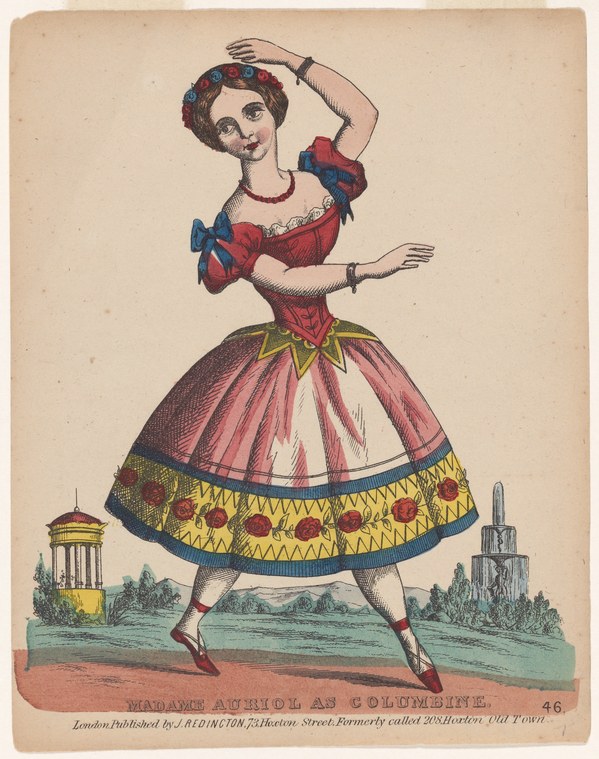
A young woman in theatrical costume strikes an exuberant pose against a landscape background. She wears a red silk bodice with blue ribbon trim and puffed sleeves, paired with a voluminous skirt of pink and white striped silk bordered with a deep band of yellow embroidered with red rosettes and edged in blue ribbon. Her dark hair is styled in ringlets with a decorative headpiece, and she wears a necklace and bracelets. Her body is twisted in a dynamic attitude: one arm raised to her head with fingers played, the other extended outward, her torso arched and one leg lifted. Behind her, a theatrical backdrop suggests a garden or pastoral setting with stylized trees and a small classical pavilion. The overall composition emphasizes theatrical spectacle and the virtuosity of the dancer's moment of peak movement.
The dancing
A single female figure dominates the composition, captured in a moment of pronounced contrapposto and extension. Her weight appears to shift toward one leg while the other lifts, creating a diagonal line through her torso. Both arms are raised and extended in the vocabulary of early 19th-century theatrical gesture—expressive rather than balletic, with fingers extended and wrists articulated. The pose suggests neither formal classical ballet position nor folk movement, but rather the gestural idiom of popular theatrical performance of the period.
The dance depicted
The image appears to depict a character from the commedia dell'arte tradition—specifically Columbine (Colombina), the clever, flirtatious soubrette. The title confirms this. Columbine was danced as a character role in pantomime and theatrical spectacle rather than as classical ballet proper, though theatrical dancers of the 19th century performed such roles with considerable agility. The costume, pose, and performative energy all suggest the lighthearted, acrobatic style of popular theatre rather than the formality of ballet de cour or Romantic ballet. The pose—dynamic, asymmetrical, and oriented toward an imagined audience—captures the character's vivacity and comedic spirit.
How it was made
This is a hand-colored engraving or lithograph of the mid-to-late 19th century, a reproductive medium that allowed wide circulation of theatrical images. The precise line work, the carefully articulated drapery folds, and the refined hand-coloring suggest a commercial print made for a popular audience—likely sold as a souvenir of a specific performance or performer. The technique was capable of capturing fine details of costume and gesture, which made it ideal for documenting stage dress and the dancer's characteristic pose. The flatness and frontal orientation are characteristic of theatrical prints, designed to be readable and reproducible.
About this work
This is a portrait print documenting a 19th-century theatrical dancer in the role of Columbine, a stock character from commedia dell'arte tradition who remained popular in pantomime and spectacular entertainment throughout the 1800s. The print records not only the costume and makeup of the character but also the kinetic, gestural style of performance: dynamic, asymmetrical, and pitched toward immediate audience engagement rather than the controlled refinement of classical ballet. The hand-colored engraving is a document of popular dance culture and commercial theatre during an era when theatrical prints were mass-produced souvenirs of celebrated performers and memorable roles.
How to look at it
The artist has frozen the dancer at a moment of maximum extension and energy, capturing not a step or a held position but an attitude—a pose that displays the character's vivacity and the dancer's virtuosity. Notice the twist through the spine, the raised arm, and the lifted leg: this is not a moment of repose or balance, but of dynamic motion suspended. The frontal orientation and the character's direct, engaging gaze suggest that the performance was directed outward toward the audience, with emphasis on projection and personality rather than on the intricacy of footwork or the geometric precision of classical ballet. The ornate costume and theatrical backdrop reinforce that this is a documented moment from a specific performance tradition.
The artist
The artist is not recorded in the catalogue. The print was published by J. Rouquette, a London print publisher based on Bishopsgate Street (the address is visible at bottom). Rouquette was active in mid-19th-century theatrical print publishing, producing affordable hand-colored engravings and lithographs of popular performers and characters. The work is typical of the commercial theatrical portrait trade.
The period
This print dates to an era when theatre and dance were tightly intertwined with commercial print culture. The mid-19th century saw the rise of the 'star system' in theatre, and famous performers became subjects for mass-produced portraits sold to fans. Simultaneously, Romantic ballet (the pointe-work, ethereal aesthetic associated with dancers like Marie Taglioni) was establishing itself as the prestige form of theatrical dance. Yet popular theatre—pantomime, melodrama, and spectacle—remained the dominant form of dance entertainment for most urban audiences. Commedia dell'arte characters like Columbine persisted in these popular forms, even as the classical ballet repertory expanded. This print captures a moment when theatrical dance encompassed both the refined technique of ballet and the broad gestural vocabulary of popular entertainment.
Where it lives
This hand-colored engraving is held in the New York Public Library's collection of prints depicting dance. It was published by J. Rouquette of London and is part of the broader 19th-century documentary record of theatrical performance through commercial print.
Dance in this work
Questions about this work
Who was Madame Auriol?
The title indicates this is a portrait of a performer known as Madame Auriol in the role of Columbine. The identity of the performer and the date and location of the specific performance are not recorded in the catalogue. She was likely a popular theatrical dancer of the mid-19th century whose performance was commercially documented through this print.
What is commedia dell'arte and why does it matter for dance history?
Commedia dell'arte was an improvisational theatre tradition with roots in Renaissance Italy, built around stock characters (Harlequin, Columbine, Pantalone) and their comic interactions. The tradition was performed across Europe for centuries and remained embedded in pantomime and popular theatre well into the 19th and 20th centuries. For dance, commedia matters because the character roles required physical virtuosity, acrobatic skill, and expressive gesture—a parallel movement vocabulary to ballet, maintained in popular entertainment.
Why is this print valuable as historical evidence?
The print documents the costume, pose, and gestural style of a theatrical character role as it was actually performed. Unlike written descriptions, it preserves visual detail: the exact cut and trimming of the dress, the pose and arm position characteristic of the performer, and the overall aesthetic of the theatrical moment. For dance historians, such prints are primary documents of movement practice outside the ballet establishment.
More dance artwork





