49 works in this view — arrow keys or swipe to move between them.
Dance in Art
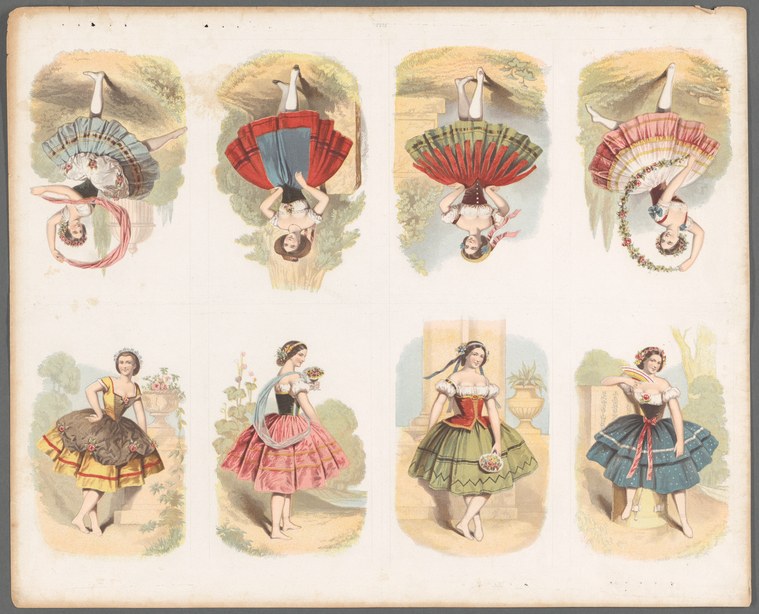
Eight ballerinas in folk costumes
Unknown artist
- Collection:
- Prints depicting dance
- Source:
- New York Public Library
- Rights:
- Public domain — free to use, share and adapt.
- Recorded as:
- Public Domain
This print is essential evidence of 19th-century theatrical dance culture and the commercialization of folk forms for urban mass entertainment. It shows how professional dancers and entrepreneurs synthesized acrobatic training, ballet technique, and costume exoticism to create a new category of stage spectacle that had little to do with authentic regional dance practices but tremendous appeal to paying audiences. Understanding this imagery is crucial for historians tracing the origins of fusion performance, the commodification of cultural otherness, and the path from theatrical entertainment to modern commercial and fusion dance forms.
What you are looking at
This is a chromolithographic print showing eight young female dancers arranged in two rows against soft, impressionistic backgrounds of foliage and architectural settings. The upper row presents four figures in mid-leap or inverted poses, each holding a decorative fan—striped, solid red, red-and-green patterned, and ornate respectively—their bodies arched backward with legs extended upward in dynamic, acrobatic positions. The lower row shows four standing figures in folk or national costumes: the first wears a yellow skirt with dark patterned overskirt, the second a pink tulle skirt, the third a green skirt with embroidered hem and red waistband, and the fourth a dark blue skirt with ruffled petticoat. Each figure strikes a posed, presentational stance with arms held expressively. The color palette is soft and delicate, with pale yellows, pinks, greens, and blues dominating the composition. The overall effect is of a theatrical or entertainment spectacle, possibly from a mid-19th-century popular or commercial dance production.
The dancing
All eight figures are young women or girls depicted in balletic or theatrical poses. The upper four are captured in extreme back-bends or inverted positions—an acrobatic rather than classical ballet frame—with legs raised high and bodies folded dramatically backward. Their arms reach upward or outward to support or balance the fans they hold. The lower four stand in more conventional theatrical poses with varied arm positions: some with hands on hips, others with arms gesturing outward. The postures are uniformly elongated and graceful, with pointed feet and an emphasis on elevation and extension rather than grounded folk movement. There is no closed partnership or couple work visible; each dancer is presented as an individual performer within a line or group.
The dance depicted
This appears to depict theatrical dance entertainment from approximately the mid-19th century, likely a professional or semi-professional stage production marketed as exotic or folk spectacle rather than classical ballet proper. The acrobatic fan-work in the upper register—where the fans appear to be the central prop and the body contortions are extreme—suggests a fusion form combining acrobatics, pantomime, and folk costuming for popular consumption. This was common in 19th-century traveling shows, music halls, and commercial theaters, where 'national' or 'folk' costumes were worn by trained ballet dancers performing stylized, acrobatic movements rather than authentic regional dance. The image does not document genuine folk dance but rather theatrical appropriation and commercialization of folk costume for urban entertainment.
How it was made
This is a chromolithograph—a color printing process that became dominant for theatrical and commercial illustration in the mid-19th century. The soft edges, delicate color gradation, and subtle use of tonal washes to suggest landscape backgrounds are characteristic of the medium. Chromolithography allowed for mass production of theatrical imagery at affordable prices, making this a circulation object for a popular audience rather than an elite or archival item. The technique's capacity for bright, varied color was especially suited to marketing entertainment spectacles and attracting viewers to performances. The softness of the printed lines and the absence of sharp contours suggest this was made from stone rather than metal plates.
About this work
This chromolithographic print documents a theatrical entertainment form from the 19th century that merged classical ballet training, acrobatic display, and exoticized folk costuming for commercial popular performance. Eight young female dancers are presented in two distinct registers: above, acrobatic figures performing fan-work in extreme back-bends; below, presentational poses in folk-inspired national dress. The work is neither authentic documentation of folk dance nor classical ballet, but rather a commercial spectacle that capitalized on European fascination with 'otherness' and technical display. It belongs in a gallery of dance imagery because it reveals how dance was commodified, staged, and marketed to popular audiences, and how folk forms were appropriated and transformed through the lens of theatrical convention.
How to look at it
Observe the stark contrast between the upper and lower registers: above, the dancers are inverted, acrobatic, and prop-dependent; below, they are upright, presentational, and costumed. Notice how the fans in the upper half appear to be the primary focus, with the dancers' bodies contorted around them rather than the reverse—this prioritization of visual spectacle over dance logic is characteristic of commercial entertainment. Look at the uniformity of body type, the pointed feet, and the balletic training evident even in the acrobatic positions: this is not folk dance but trained performers in folk costume. The soft, dreamlike background and the presentation of each figure as an isolated icon rather than part of a narrative or group dynamic emphasizes the print's function as a collection of images for visual consumption rather than documentation of a performed event.
The period
This print dates to the era when chromolithography was revolutionizing theatrical marketing and popular visual culture (approximately 1840s–1880s). In this period, European and American theaters were saturated with spectacles marketed as 'national ballet,' 'folk entertainment,' or 'exotic' performance—productions that trained ballet dancers in acrobatic and pantomimic styles and dressed them in costume assemblages loosely inspired by regional dress. This was also the height of Romantic ballet's influence, but its techniques were being democratized and commercialized for popular venues. The mid-19th century saw intense European fascination with non-European and 'folk' cultures, which was reflected in entertainment through costume and marketing rather than ethnographic accuracy. Chromolithographic prints like this were primary marketing and souvenir materials for these productions, circulating widely among middle-class and working-class audiences.
Where it lives
This print is held in the New York Public Library's collection of prints depicting dance, a broad holding that documents theatrical, popular, and social dance imagery across media and periods. The work is catalogued simply as a chromolithograph of eight dancers in folk costume, without attribution to a specific artist, publisher, or performance.
Dance in this work
Questions about this work
Are these real folk dances?
No. These are theatrical interpretations—trained ballet dancers wearing costume assemblages inspired by folk dress and performing acrobatic, balletic movements for commercial entertainment. They represent 19th-century popular theater's approach to exoticizing and commodifying cultural difference, not documentation of authentic regional dance practice. The extreme acrobatics, the use of props like fans, and the stylization are all marks of stage spectacle rather than tradition.
What were these performances for?
These were commercial entertainments staged in music halls, traveling shows, and urban theaters for paying audiences. The chromolithograph itself was a marketing tool—a souvenir or advertisement to promote the performance and attract viewers. This kind of spectacle was immensely popular in the 19th century and occupied a space between circus acrobatics, ballet, and pantomime.
How do I identify the specific 'folk' costumes?
You cannot do so with confidence from this image alone. The costumes appear to be theatrical approximations or assemblages rather than ethnographically accurate representations. The print's catalog title refers to them generically as 'folk costumes,' but the specific regions or traditions they purport to represent are not labeled. This ambiguity is itself historically significant—it suggests the costumes were intended to evoke 'otherness' and exoticism to a European audience without claims to precision.
Who were the performers?
The print does not identify them. They were likely professional ballet dancers or acrobats employed by a theater company or traveling show, trained in the hybrid style this entertainment form required. Women performers dominated these spectacles, which were marketed partly through the display of the female body in costume and motion.
More dance artwork





