49 works in this view — arrow keys or swipe to move between them.
Dance in Art
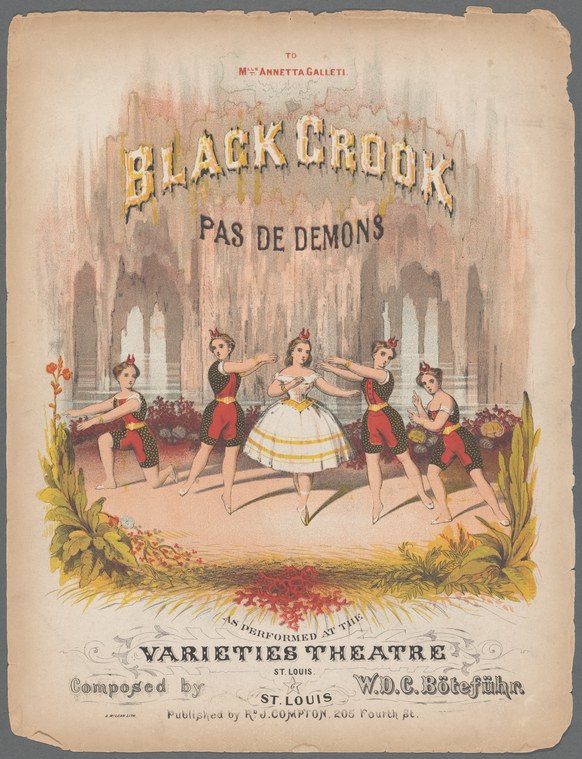
Black crook. Pas de demons: as performed at the Varieties Theatre, St. Louis
Unknown artist
- Collection:
- Prints depicting dance
- Source:
- New York Public Library
- Rights:
- Public domain — free to use, share and adapt.
- Recorded as:
- Public Domain
The Black Crook established the template for theatrical dance spectacle in America for decades to come, and this scene epitomizes its hybrid nature: classical ballet training meets acrobatic performance, and the female dancer becomes the organizing presence around which male performers enact chaos and fantasy. Understanding how this work was visualized and sold reveals what audiences wanted from dance and what impresarios believed would draw crowds.
What you are looking at
This is a chromolithographic theatrical poster for a pantomime or extravaganza, printed in the decorative style of mid-19th-century American theatre advertising. The composition depicts five figures in elaborate costume arranged in a stage tableau within an ornamental architectural frame—a grand interior space with columns and arches rendered in warm beige and terra-cotta tones. At center stands a ballerina in a classical white tutu with yellow trim, arms outstretched in a welcoming gesture. Surrounding her are four demonic or fantastical figures in red tights and darker costumes, positioned in exaggerated attitudes of movement and play. The demons appear to be leaping, gesticulating, and engaging the central female dancer in a choreographed ensemble. The stage floor is suggested by a band of ornamental foliage—golden plant forms and red flowers—which grounds the scene. The overall effect is one of theatrical spectacle and supernatural encounter, with the classical ballerina as the focal point amid the fantastic company.
The dancing
The central dancer stands with legs in a neutral stance and both arms raised and extended outward at shoulder height, a pose suggesting welcome, amazement, or orchestration of the surrounding chaos. The four surrounding figures adopt dynamic, acrobatic poses: one leans backward with an arched spine, others are caught mid-leap or mid-gesture with bent knees and reaching arms. None display the formal closed partnering holds of ballroom dance; instead they occupy and activate the stage space as a chaotic ensemble, their poses exaggerated and carnivalesque. The ballerina's classical tutu and pointe-ready stance establish her as the anchor of the composition, while the demons' bent postures and splayed limbs create visual rhythm and movement energy around her.
The dance depicted
This depicts the 'Pas de Démons' ('Dance of Demons') from The Black Crook, a supernatural pantomime-ballet-spectacular that premiered in New York in 1866 and became one of the most celebrated theatrical productions of its era. The Black Crook synthesized classical ballet, acrobatics, and theatrical spectacle into a new form of commercial entertainment. The demons here represent one of its famous divertissements—a inserted dance number designed to showcase athleticism, comedy, and the fantastic rather than narrative advancement. The pose of the central ballerina and the demonic figures' exaggerated physicality suggest a blend of classical training (visible in the tutus and stance) with the acrobatic and comedic conventions of pantomime and music-hall performance.
How it was made
This is a chromolithograph, a color printing technique using multiple stone plates (one per color) that allowed for bold, saturated hues and broad flat areas of color typical of theatrical posters from the 1860s–1880s. The technique was ideal for theatrical marketing: images could be reproduced at scale, the colors were eye-catching and durable, and distribution was cheap and rapid. The hand-drawn quality visible in the figures' outlines and the ornamental border indicates this was drawn by an artist (likely a theater's staff lithographer or a specialist poster house) and then transferred to stone. The printing credit line acknowledges the printer's location and production role, typical of the period.
About this work
The Black Crook was a transformative moment in American theatrical dance history—it married classical ballet vocabulary with the extravaganza and pantomime traditions, creating a new genre of popular entertainment that would dominate stages into the early 20th century. This poster advertises a single divertissement from that production: a scene in which a classical ballerina is surrounded by acrobatic demon performers. The image captures the theatrical grammar of the 1860s: classical ballet as the civilized center, with fantasy and acrobatics arranged around it. The poster itself is a document of how dance and dance spectacle were marketed to the public—as visual sensation, as a gathering of skills, and as a promised escape into the supernatural and impossible.
How to look at it
Attend to the composition's symmetry and hierarchy: the ballerina in white at the exact center, the demons in red arrayed around her in dynamic asymmetry. Note the contrast between her stillness and extension (arms open, body upright) and the demons' explosive poses (bent spines, splayed limbs, mid-air leaps). The artist chose a moment of theatrical intensity—a peak moment in the choreography where energy radiates from the center outward. Observe also the ornamental frame and architectural setting, which was a convention of theatrical lithography: it transforms the stage moment into an iconic image fit for framing and preservation, elevating popular entertainment into art-world terms.
The artist
The artist is not recorded. The poster was printed by H. C. Compton of St. Louis and composed by W. D. C. Boeuffieu (also of St. Louis), as noted in the credit line. This suggests a regional theater or a touring production stopping in St. Louis. The work represents the labor of specialist theatrical lithographers and poster houses, whose names often appeared on prints while the artists who drew them remain anonymous. These prints were produced in volume and intended for rapid circulation and short-term display.
The period
The Black Crook premiered at Niblo's Garden in New York in September 1866 and ran for an astonishing 475 performances—a record at the time. It arrived at a cultural moment when American theatre was embracing spectacular visual effects, imported European ballet stars (the cast included the Italian dancer Marie Bonfanti), and a new fusion of genres. The 1860s saw the rise of theatrical lithography as a mass medium, with chromolithographic posters becoming the primary advertisement for theatrical productions. This democratized theatrical imagery; what had been elite court entertainment could now be visualized and circulated to a broad urban audience. The demons in this particular scene reflect both the supernatural fantastic that Gothic and Romantic traditions had made popular on stage, and the acrobatic traditions of pantomime and circus performance that were increasingly intertwined with theatrical dance.
Where it lives
This is a theatrical poster advertising a performance at the Varieties Theatre in St. Louis. It was acquired or held by the New York Public Library's collection of prints depicting dance, making it part of a curatorial tradition of collecting visual records of performance rather than treating such prints purely as ephemeral advertisements.
Dance in this work
Questions about this work
Was The Black Crook ballet?
No, though it featured ballet dancers and ballet technique. It was an extravaganza—a spectacular theatrical form that blended classical ballet with pantomime, acrobatics, music-hall comedy, and visual spectacle. The Black Crook is historically important because it created a new category of entertainment that took ballet out of the concert hall and into popular theatre, making it commercially successful for the first time in America.
Who was the ballerina in the center?
The poster does not identify her. The cast of The Black Crook included European ballet stars like Marie Bonfanti, but without documentation specific to this St. Louis production, we cannot know which dancer performed this scene or when this performance took place.
What is the 'Pas de Démons'?
A 'pas de' is a dance number in classical ballet terminology. The 'Pas de Démons' (Dance of Demons) was a divertissement—an inserted spectacular number designed to showcase fantasy and acrobatic skill rather than advance the plot. These demonic figures would have performed rapid, exaggerated movements, likely incorporating cartwheels, backbends, and other circus-derived acrobatics while the ballerina occupied the center stage as a point of focus.
Why is this poster important?
It documents how American theatrical dance was marketed in the 1860s–1870s, what audiences expected to see, and how classical ballet was being presented to mass audiences as part of popular entertainment. It also captures the visual conventions of theatrical lithography at a moment when printed images were becoming the primary way people encountered information about performance.
More dance artwork





