49 works in this view — arrow keys or swipe to move between them.
Dance in Art
Spanish suite
Unknown artist
- Collection:
- Prints depicting dance
- Source:
- New York Public Library
- Rights:
- Public domain — free to use, share and adapt.
- Recorded as:
- Public Domain
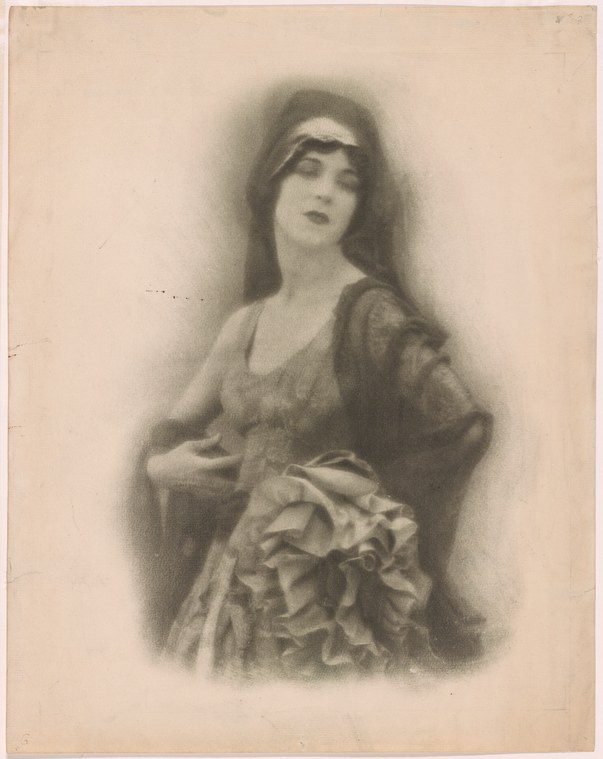
This work exemplifies the crucial but often overlooked role of photographic reproduction in early 20th-century dance culture: these prints were not documentary but promotional, creating and circulating an image of the dancer that shaped public expectation and memory. The soft focus and theatrical pose reveal how early photographers understood dance not as movement to be captured but as a figure to be composed—a distinction that would sharpen only later as film and faster plates allowed true action photography.
What you are looking at
A solitary female figure is posed in three-quarter view against a soft, atmospheric background that fades from darker tones at the edges to pale cream at the center. The woman wears a long, draped garment with puffed sleeves characteristic of early 20th-century theatrical costume; the fabric appears to be richly textured, possibly brocaded or embroidered, with decorative detail visible at the bodice and hem. Her pose is contemplative and languid: she gazes upward and to the side, her body held in a gentle contrapposto, weight on one leg, one arm relaxed at her side and the other positioned near her torso. The overall effect is one of dramatic reverie or melancholy—the kind of pose associated with Romantic-era theatrical portraiture. The technique is a soft-focus photogravure or similar reproductive print, which lends the figure an almost ethereal quality, as if catching a moment of introspection or yearning.
The dancing
The dancer's frame is upright but not rigid, the shoulders squared and slightly back, suggesting ease and refinement rather than tension. The weight appears settled into one supporting leg, while the other remains relaxed; the feet are not clearly visible. The head is tilted, the gaze elevated and dreamlike. The arms frame the body without a closed balletic position—this is a portrait pose, not a mid-movement capture, though the relaxation of the frame and the gentle turn of the torso suggest a trained dancer at rest.
The dance depicted
The title *Spanish suite* and the theatrical costume suggest this is a portrait documenting a performer, likely a dancer, in character dress for a Spanish-themed theatrical production or recital popular in the early 20th century. The soft, romantic pose and the upward gaze indicate a Romantic aesthetic rather than the sharp articulation of Spanish folk dance; this appears to be a theatrical or salon interpretation of Spanish idiom, not an ethnographic document. The loose arm position and contemplative bearing are more aligned with early 20th-century theatrical dance—lyrical, interpretive, influenced by the reform movements of Duncan and her contemporaries—than with traditional flamenco technique.
How it was made
This is a photogravure, photolithograph, or similar reproductive print process, likely early 20th century. The soft focus, tonal gradation, and halo effect around the figure are characteristic of these media; the technique allows for painterly effects and atmospheric mood while working from a photograph or similar source. Such prints were inexpensive and widely circulated—suitable for theatrical promotion, souvenir sale, or publication in journals and newspapers. The reproductive process flattens the figure slightly and eliminates sharp detail, enhancing the romantic, otherworldly effect.
About this work
This is a theatrical portrait of a dancer in Spanish-themed costume, most likely a promotional or documentary photograph issued as a print. The work belongs to the early 20th-century tradition of theatrical dance photography and illustrates the fashion for Spanish and Oriental exotica in European and American theater during the period—a trend driven by impresarios like Diaghilev and fed by the international tours of dancers like Pavlova and the Spanish dancers who found eager audiences in Paris, London, and New York. The image documents not a specific historical dance but rather the *aesthetic* of theatrical Romantic dance as filtered through a Spanish costume: the languid pose, the soft focus, the emphasis on beauty and mood over technical display. It is evidence of how theatrical dance photography functioned as a tool of promotion and a vehicle for the dancer's own fashioning of identity.
How to look at it
Attend to the pose itself: this is not a moment of action but of emotional stillness, chosen to convey sentiment rather than to display technique. The upward gaze and the relaxation of the frame are conventions of early 20th-century theatrical photography, used to suggest the dancer's interiority and to invite audience sympathy. The costume—richly draped and detailed—is equally important to the pose; costume and body together create the character. Note also the soft focus and tonal subtlety of the reproductive print, which was itself a deliberate aesthetic choice, not a limitation of the camera.
The period
The print dates to the early 20th century, an era of intense theatrical innovation and international cultural exchange. Spanish dance was fashionable in European theaters during this period, spurred partly by the success of dancers like Antonia Mercé ('La Argentina') and by the association of Spanish style with exoticism and passion. Photography had emerged as a primary tool for promoting and documenting theatrical performance; unlike painting, it offered apparent fidelity to the dancer's actual appearance while allowing manipulation of tone and focus to achieve romantic effect. The soft-focus photographic portrait became a standard form of theatrical promotion during this era.
Where it lives
The work is held in the New York Public Library's collection of prints depicting dance. It is catalogued only as 'Spanish suite' with unknown artist and date, suggesting it may be a theatrical souvenir or a page cut from a larger publication.
Dance in this work
Questions about this work
Is this Spanish dance (flamenco)?
No. The pose and soft-focus aesthetic are purely theatrical and Romantic. The costume and title indicate the *subject matter* is Spanish, but the *style* is early 20th-century theatrical dance—lyrical, introspective, interpretive. This is a European theater's idea of Spain, not Spanish folk practice.
Who is the dancer?
Unknown. The catalogue record does not identify the dancer or photographer. Without further research, we cannot determine whether this is a famous performer or a lesser-known salon dancer.
When was this made?
The style of dress, the soft-focus photographic technique, and the aesthetic conventions place this in the early 20th century, roughly 1900–1920. The exact date is not recorded.
Why is the figure so soft and dreamy?
This is the deliberate choice of the photographer and printer. Soft focus was used to enhance beauty and mood, to suggest emotion, and to create a romantic atmosphere. It was a standard technique in theatrical photography of this era, quite different from modern documentary photography.
More dance artwork





