49 works in this view — arrow keys or swipe to move between them.
Dance in Art
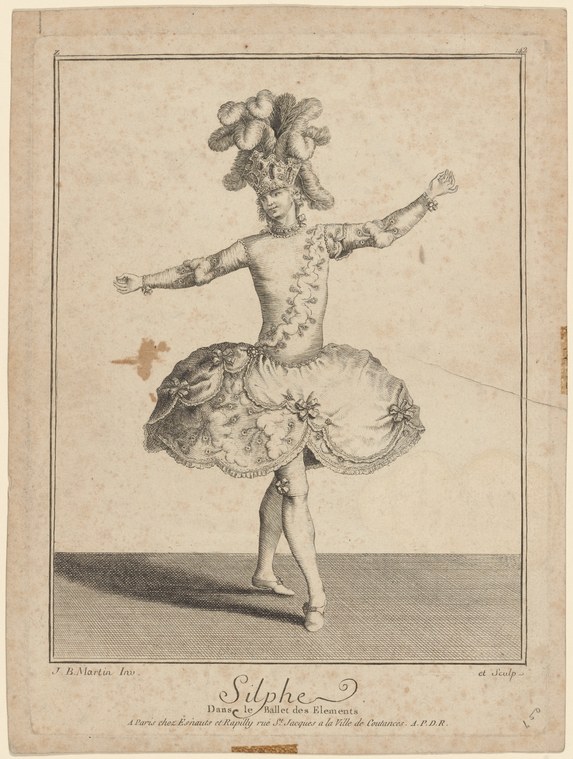
Silphe dans le Ballet des elements
Unknown artist
- Collection:
- Prints depicting dance
- Source:
- New York Public Library
- Rights:
- Public domain — free to use, share and adapt.
- Recorded as:
- Public Domain
The ballet de cour was the ancestor of modern ballet, and this image shows the formality and allegorical richness of early court dance. For historians it documents the collaboration between dance, costume design, and engraved record—how dance spectacle was circulated and remembered before photography. For dancers it demonstrates the courtly stance and bearing that underwrites all subsequent European theatrical dance.
What you are looking at
A single dancer is posed in contrapposto stance against a plain background, her weight on the back leg and her arms extended in a graceful, asymmetrical frame. She wears an elaborate costume: a fitted bodice adorned with ornamental embroidery or jeweling, a voluminous skirt constructed in layered swags and scalloped edges that suggest rich fabric gathered and pinned, and what appears to be a corseted torso. Most strikingly, her headdress is a towering arrangement of rounded forms—possibly meant to represent clouds or botanical elements—that rises well above her head. The engraving technique renders fine detail in the costume and figure; the plain ground and simple rectangular border frame her as a solitary performer. There is no narrative action, no ensemble, no scenery: this is a costume study of a dancer in character, likely intended for theatrical record or circulation among the court or operatic elite.
The dancing
The dancer stands on one leg with the other bent and relaxed, demonstrating the turned-out stance and elongated line characteristic of courtly dance training. Both arms are raised and extended to the sides at roughly shoulder height, the hands delicate and the wrists gently curved—a frame of elegance rather than strength. The pose suggests a moment of stillness, perhaps a balance or a point of suspension within a sequence. The upper body is held upright and composed, the head crowned by the fantastical headdress and gazing outward with composure. The entire bearing suggests a dancer trained in formal court deportment.
The dance depicted
The title 'Silphe dans le Ballet des elements' identifies this as a performer in the role of Sylph in a ballet about the elements. The costume—elaborate, courtly, with that impossible headdress—and the pose belong to the ballet de cour tradition of the 17th century, a spectacle form in which noble performers danced in allegorical roles to music and often within broader court entertainments. The Sylph would have been a supernatural or aerial spirit character, which the towering, cloud-like headdress emphasizes. The pose itself does not show rapid or virtuosic footwork, but rather the dignified, measured carriage expected of courtly dance. This is a record of character costume and bearing rather than a moment of dynamic action.
How it was made
This is an engraving—a print made by incising lines into a metal plate (likely copper) and inking the incised lines for impression. The technique allows fine linear detail, which the artist has exploited in the ornamental pattern on the bodice, the articulation of the layered skirt, and the delicate features of the face. The signature 'J. D. Martin fec.' appears at lower left, and an attribution line at lower left indicates 'a Joulp' or similar (difficult to read in this state). The engraving was intended for circulation among court and theatrical patrons—a high-quality print suitable for framing or binding into collections of theatrical designs and costume records. The technique and finish suggest professional production for a courtly or operatic audience rather than popular circulation.
About this work
This is a character-costume engraving from the ballet de cour tradition, a court spectacle form in which nobility performed allegorical roles. The Sylph—a supernatural spirit of the air—wears an elaborate costume crowned by an impossible headdress of rounded forms, and stands in the formal, turned-out stance of courtly dance training. The image records not a narrative moment but a costume study, the dancer posed to display the full effect of her dress and bearing. It belongs in this gallery because it documents how the ballet de cour presented character and narrative through visual spectacle—the costume and pose together making the Sylph legible to an audience—and because it shows the formal, composed physical language of courtly dance before the Romantic era's turn toward fluidity and the ethereal. The work is a historical record of an ephemeral art form, preserved in print.
How to look at it
Attend to the pose: it is a moment of stillness, not action, and the artist has chosen an angle and position that displays the full costume—the headdress, the bodice ornament, and the engineered architecture of the skirt. Notice the balance on one leg and the composure of the upper body; this is the bearing of a trained dancer, not an amateur. The engraving technique allows the artist to render fine detail in the costume and to show the delicate articulation of the limbs, which together create the effect of courtly elegance. The blank ground emphasizes the figure and costume as the subject; there is no narrative, no setting, no ensemble—only the character and her carriage.
The artist
The signature reads 'J. D. Martin fec.' (Martin made this). Martin is likely a professional court engraver working in service to a royal or noble household in the 17th or early 18th century. The attribution line suggests another name—possibly 'à Joulp' or a similar inscription indicating the designer of the costume or the source of the image. Without further research the artist's identity and practice remain uncertain, but the quality and finish indicate a skilled professional working in the courtly milieu.
The period
The ballet de cour flourished in France in the 17th century, a form in which nobility danced in elaborate costumes to music, poetry, and spectacle within a courtly or operatic narrative. The Sylph was a character drawn from classical mythology and allegorical tradition. By the early 18th century, when this engraving was likely made, the form was declining in its original context (the nobility were performing less frequently), but professional dancers were taking over roles and the genre was being documented and circulated more widely through prints like this one. The formal, upright carriage and turned-out stance shown here became the foundation of the codified techniques that would emerge as classical ballet in the 19th century.
Where it lives
The work comes from the New York Public Library's collection of prints depicting dance. It is a professionally produced courtly engraving, likely made in France in the late 17th or early 18th century for circulation among court and theatrical patrons.
Dance in this work
Questions about this work
What is a Sylph in ballet?
A Sylph is a supernatural spirit, often of the air or forests, drawn from classical mythology and allegorical tradition. In the ballet de cour and later in Romantic ballet, the Sylph was a popular character—otherworldly, graceful, and often tragic. The towering, cloud-like headdress in this image emphasizes the aerial and supernatural nature of the role.
What is ballet de cour?
Ballet de cour was a court spectacle form in which nobility performed allegorical or mythological roles to music, within elaborate scenery and narrative frameworks. It flourished in France in the 17th century and was the ancestor of modern ballet. Dancers were trained, but the genre emphasized spectacle, costume, and courtly bearing over technical virtuosity.
How was this print made?
This is an engraving, made by incising fine lines into a metal plate and inking the incised lines for impression. The technique allowed the artist to render delicate detail in the costume and the dancer's features, and engravings like this one were circulated among court and theatrical patrons to document and commemorate dance spectacles.
Why is the headdress so elaborate?
The towering, rounded headdress is a costume element that makes the Sylph's otherworldly nature visible. In the ballet de cour, costume was the primary means of identifying character and narrative role. The cloud-like forms suggest the aerial realm the Sylph inhabits, turning the headdress into a visual sign of the character's supernatural status.
More dance artwork





