49 works in this view — arrow keys or swipe to move between them.
Dance in Art
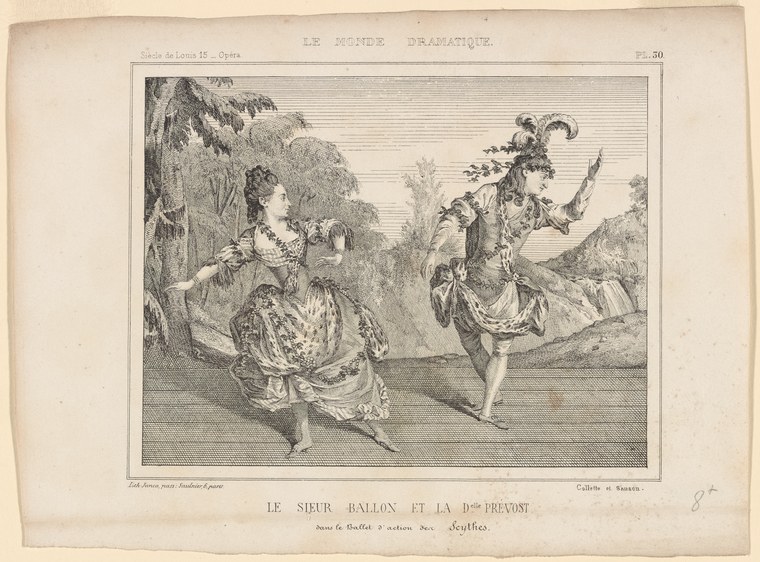
Le sieur Ballon et la delle. Prévost dans le ballet d'action des Scythes
Unknown artist
- Collection:
- Prints depicting dance
- Source:
- New York Public Library
- Rights:
- Public domain — free to use, share and adapt.
- Recorded as:
- Public Domain
This image preserves evidence of how the first great ballet dancers actually moved and held themselves on stage. Ballon and Prévost were transformative figures who elevated dance from courtly pastime to a serious theatrical art; this print is one of the few visual records of their technique and presence. The ballet d'action was a revolutionary form that would define ballet's identity for centuries, and this image documents its early practice.
What you are looking at
A theatrical scene set in a wooded landscape with trees framing both sides. Two dancers in elaborate 18th-century dress dominate the composition: a woman on the left in a pale patterned gown with deep neckline and full skirts, her body angled toward a male dancer on the right; the man wears ornate costume with plumed headdress, decorative coat, and striking pose with one leg extended. The ground is a flat stage platform. The background shows classical landscape elements—distant trees and atmospheric perspective rendered in fine engraving lines. The light is even and frontal, typical of theatrical prints, with no dramatic shadow. The moment captures a moment of formal address or courtship dance between the two principals, characteristic of the ballet d'action genre.
The dancing
The woman's body inclines toward the man in an attitude of attention or reception, her arms gesturing with the vocabulary of 18th-century court dance. The man's posture is one of formal presentation and display: one leg extended in a pronounced développé or dégagé, his torso upright, his arms and headdress commanding visual attention. Both dancers maintain the vertical alignment and turned-out placement characteristic of early ballet. The composition is bilateral and symmetrical in intent but offset to create narrative: they are addressing each other across the stage space rather than dancing in unison.
The dance depicted
This depicts a scene from a ballet d'action—a narrative ballet with dramatic pantomime and dance. The title identifies the dancers as Monsieur Ballon (or Balon) and Mademoiselle Prévost, celebrated performers of the early 18th century, in a ballet on a Scythian theme. The d'action format combined courtly dance vocabulary with dramatic expression and storytelling; this image captures a moment of emotional or narrative significance between the principals. The costumes and setting indicate a theatrical work of substantial production value, likely performed at the Académie Royale de Danse or a court venue. The dance itself employs the turned-out positions, arm positions, and formal address of early ballet technique, already refined by this period.
How it was made
This is a line engraving, executed with the fine parallel hatching and precise linear technique characteristic of French theatrical prints of the early 18th century. The technique allowed wide circulation of theatrical imagery among an educated elite who collected prints documenting notable performances and dancers. Engravings of this quality required skilled craftsmen and were expensive to produce, indicating a substantial audience and commercial value for images of celebrated dancers. The inscription below identifies both the performers and the source publication (the catalogue note suggests it comes from a series documenting opera and ballet scenes), placing it within a systematic archive of French theatrical dance.
About this work
This is a documentary theatrical print recording a performance by two of the most celebrated dancers of the early 18th century. Monsieur Ballon and Mademoiselle Prévost were pioneers of the ballet d'action—the genre that would establish ballet as a narrative and dramatic art form distinct from pure court dancing. The print preserves a moment from a specific work on a Scythian subject, capturing the dancers in full theatrical costume during a scene of courtship or dramatic address. It belongs in a dance gallery as both a record of an important performance and as visual evidence of how early ballet dancers moved, held their bodies, and engaged with dramatic narrative. The print also documents the high status of dance in early 18th-century French culture, where celebrated dancers were recorded and circulated as cultural icons.
How to look at it
Attend to the formal geometry of the bodies: both dancers maintain the turned-out leg position and upright carriage of ballet technique, yet their interaction is charged with emotion and narrative intention. Notice how the engraver has captured Ballon's extension and apparent weightlessness in the extended leg—a quality for which he was famous. Observe the woman's inclination and arm gesture toward him, expressing attention or desire rather than abstract form. The theatrical print tradition freezes a single moment, often the moment of greatest visual or narrative intensity; here the artist has chosen the instant of address between the two dancers, using their poses to convey both technical mastery and dramatic meaning.
The period
This engraving dates to the early 18th century, a pivotal moment in the history of ballet. Louis XIV had established the Académie Royale de Danse in 1661, codifying the basic vocabulary of ballet; by the early 1700s, professional dancers were moving away from purely geometric court dances toward narrative and dramatic forms. Monsieur Ballon (c. 1676–1739) was renowned for elevation, turning, and technical virtuosity; Mademoiselle Prévost (1680–1741) was celebrated for her dramatic expressiveness and innovation. The ballet d'action, pioneered in works like Prévost's famous solo 'Les Caractères, ou Les Mœurs' (c. 1717), introduced storytelling and character into ballet, moving beyond the abstract patterns of baroque court dance. French theatrical prints were at this period among the most accomplished in Europe, and the documentation of celebrated dancers in engraved form was a mark of their cultural importance.
Where it lives
The work is held in the New York Public Library's collection of prints depicting dance. It appears to be part of a series documenting French opera and ballet scenes, a common format for theatrical prints circulated among subscribers and collectors in the 18th century.
Dance in this work
Questions about this work
Who were Ballon and Prévost?
Monsieur Ballon and Mademoiselle Prévost were two of the most celebrated dancers of early 18th-century France. Ballon was renowned for his elevation and technical brilliance; Prévost was celebrated for dramatic expression and innovation. Together they were at the forefront of developing the ballet d'action, a narrative form of ballet that combined dance with pantomime and storytelling.
What is a ballet d'action?
A ballet d'action was a form of theatrical ballet that told a story through dance and pantomime, combining the classical vocabulary of ballet with dramatic narrative and character. It emerged in the early 18th century as a departure from purely abstract court dances and became the foundation for classical ballet as we know it.
What does the costume tell us?
The elaborate, decorated costumes indicate this was a major theatrical production, likely performed at court or at the Académie Royale. The costumes are theatrical versions of 'exotic' dress—Scythian in this case—a common convention of the era for narratives set outside contemporary France. Both dancers wear the slippers and lightweight clothing that allowed the technical movement ballet required.
How do we know this is a real performance and not imagined?
The inscription names the dancers and the ballet by title, and both Ballon and Prévost are well-documented historical figures. This print was part of a systematic effort to document and circulate images of celebrated performances, so it represents an actual work performed by actual dancers, not a fantastical or allegorical scene.
More dance artwork





