49 works in this view — arrow keys or swipe to move between them.
Dance in Art
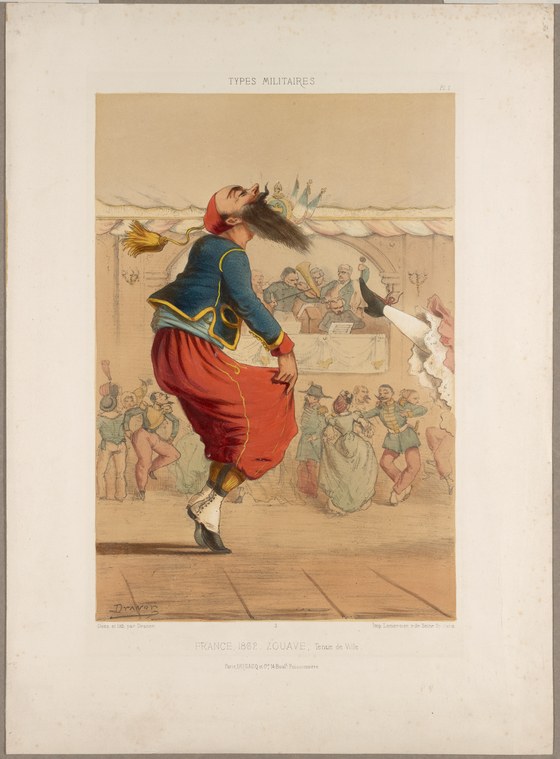
France, 1862, Zouave
Unknown artist
- Collection:
- Prints depicting dance
- Source:
- New York Public Library
- Rights:
- Public domain — free to use, share and adapt.
- Recorded as:
- Public Domain
The Zouave print documents a now-vanished category of nineteenth-century popular performance—the military acrobat as celebrity entertainer. For historians of theatre and spectacular display, it shows how military exoticism (the colonial Zouave as glamorous foreign soldier) was theatricalized and packaged for metropolitan audiences. For dance historians, it marks a moment when acrobatics, gymnastics, and theatrical movement were not yet disciplined into separate categories; the print shows an era when extreme flexibility and military bearing could coexist on the same stage.
What you are looking at
A military dancer in French Zouave uniform executes a dramatic leap or high kick before a crowded audience in what appears to be a theatrical or public performance space. The dancer wears the distinctive costume of the French colonial infantry: a dark blue jacket with gold braiding, a red fez, and voluminous red trousers. The body is arched backward in an exaggerated posture, with one leg extended high and arms spread. The setting is a wooden stage with a painted backdrop suggesting architecture or scenery; the audience fills the lower portion of the composition—a dense crowd of spectators in period dress, rendered in lighter tones and smaller scale. The hand-colored print employs a pale ochre ground with careful attention to the contrast between the soldier's vivid costume and the softer tones of the crowd. The moment captures the peak of a spectacular movement, emphasizing acrobatic virtuosity and the novelty of military physicality as entertainment.
The dancing
A single male figure dominates the composition, captured mid-jump with the torso strongly arched backward, the extended leg nearly vertical, and the arms spread wide in a dynamic asymmetrical frame. The spine shows extreme flexibility—this is not a ballet port de bras but an acrobatic exaggeration. The weight appears to be at the peak of a vertical jump rather than in a controlled dance position. The figure's muscularity and the violence of the extension suggest trained athleticism rather than balletic refinement. No partner or chorus is present; the performer is a soloist commanding the stage.
The dance depicted
This image documents a Zouave, a soldier-dancer performing in the mid-nineteenth century. The Zouaves were colonial infantry units of the French army, and their distinctive costume and martial bearing made them objects of fascination in European popular culture. Some Zouaves achieved fame as performers, demonstrating acrobatic and gymnastic feats on stage—a hybrid between military drill, gymnastics, and theatrical spectacle. The extreme arching and high leg extension shown here suggest a performance combining elements of contortion, acrobatics, and possibly the gymnastic traditions that influenced theatrical movement of the period. This is not ballet, but rather a military-acrobatic display that was part of nineteenth-century popular entertainment.
How it was made
This is a hand-colored lithograph or engraving (the record does not specify, but the fine line work and chromatic character suggest lithography). The technique allowed for rapid reproduction and mass circulation—such prints were sold as popular souvenirs and theatrical ephemera. The hand-coloring is competent but not refined, with the title and publication information applied typographically below the image. The medium's affordance—quick production, wide distribution, affordable prices—made it ideal for documenting novelty acts and fashionable performers of the moment. Such prints served as early fan merchandise, advertising the spectacle to a broad public.
About this work
This print preserves a moment from the theatrical life of the mid-nineteenth-century Zouave performer—a figure at the intersection of military display, acrobatic entertainment, and popular culture. The image shows a soldier in full parade uniform executing a spectacular vertical jump with extreme spinal extension, frozen at the apex of the movement before a dense audience. The work belongs to a category of theatrical documentation that captured fashionable military curiosities and exotic performers for a mass market; it testifies to the period's appetite for displays of physical virtuosity and the theatrical potential of military costume. It is neither pure dance nor pure athletics, but rather an early modern hybrid entertainment that collapsed the boundaries between these categories.
How to look at it
Notice the extreme spinal extension and the precise vertical alignment of the raised leg—this is not a balletic movement but an acrobatic one, emphasizing flexibility and strength over grace. The artist has frozen the moment at the very apex of the jump, where the body is maximally extended and most dramatically silhouetted against the stage. Watch how the costume's volumetric red trousers read as a shape in motion, and how the small, densely packed audience in the background emphasizes the solitary spectacularity of the performer's body. The hand-coloring makes the vivid military costume the visual anchor of the print, suggesting that the novelty of the Zouave body and dress was as much the draw as the acrobatic feat itself.
The period
The Zouaves rose to prominence in French military and popular culture following their deployment in North Africa in the 1830s. By mid-century, their distinctive uniform—especially the vivid red trousers and fez—had become iconic. In the 1860s (the date given here), Zouave regiments had become subjects of intense public curiosity, and some soldiers achieved theatrical fame performing acrobatic and gymnastic feats. This print coincides with the height of Zouave popularity in French culture—a moment when colonial military spectacle fed directly into stage entertainment. The print's style and subject matter reflect the broader nineteenth-century appetite for exotic, martial, and acrobatic display as forms of popular theatre.
Where it lives
This print is held in the New York Public Library's collection of prints depicting dance. It was produced for mass circulation as theatrical ephemera and popular entertainment documentation, part of a broader category of mid-nineteenth-century prints capturing fashionable performers and spectacles.
Dance in this work
Questions about this work
Was the Zouave a ballet dancer?
No. The Zouave was a French colonial soldier, but by the mid-nineteenth century, some individual Zouaves had become theatrical performers, demonstrating military drill, acrobatics, and gymnastics on stage. This print documents that theatrical side—a hybrid entertainment that combined military display with acrobatic spectacle. The movement shown here is acrobatic and gymnastic rather than balletic.
What is the red fez and blue uniform?
The Zouave uniform, which became iconic after the French deployed Zouave regiments in North Africa from the 1830s onward. The red fez, blue jacket with gold braiding, and distinctive red trousers made the Zouaves immediately recognizable and glamorous in European popular culture. The costume was a significant part of the Zouave's appeal as a performer.
Is this a dance?
It is a theatrical performance by a soldier trained in military movement, acrobatics, and gymnastics. The categories of 'dance,' 'athletics,' and 'military drill' were less sharply separated in the nineteenth century than they are now. This print shows a moment when all three traditions intersected on the stage.
More dance artwork





