49 works in this view — arrow keys or swipe to move between them.
Dance in Art
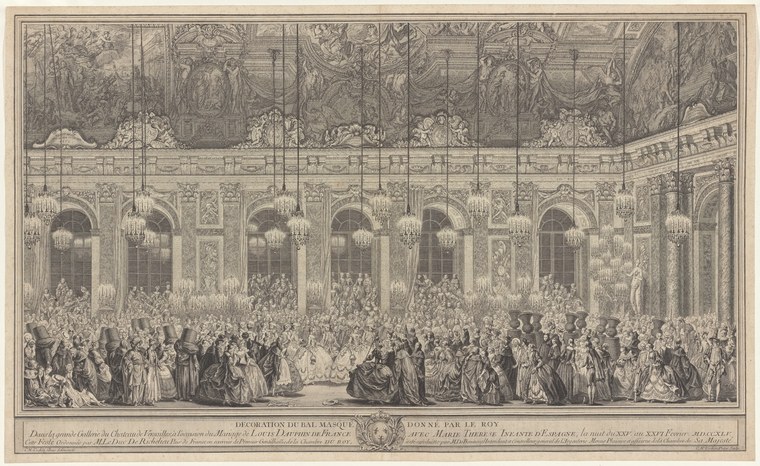
Decoration du bal masqué donné par le roy dans la grande gallerie du chateau de Versailles: à l'occasion du mariage de Louis Dauphin de France avec Marie Therese Infante d'Espagne, la nuit du XXV. au XXVI fevrier, MDCCXLV
Unknown artist
- Collection:
- Prints depicting dance
- Source:
- New York Public Library
- Rights:
- Public domain — free to use, share and adapt.
- Recorded as:
- Public Domain
Masked balls were crucial venues for the performance of court identity and loyalty in the Old Regime, and dance was the central activity through which that performance occurred. This engraving is a rare large-scale visual record of how hundreds of courtiers moved together in formal choreography under royal auspices—evidence of the social discipline and aesthetic values that court dance embodied. For scholars of 18th-century court culture, masked balls, and the role of women in ceremonial life, this image is a primary source of exceptional richness.
What you are looking at
A grand masked ball fills the enormous Gallery of Mirrors at Versailles, celebrating the 1745 marriage of the Dauphin Louis to the Spanish Infanta Marie Thérèse. The engraving captures the full length of the gallery with its soaring barrel vault, massive arched windows, and hanging chandeliers casting light on hundreds of elegantly dressed figures. Guests in formal court dress, many wearing masks and cloaks, cluster in conversation, promenade, and dance across the polished floor. The composition is divided into distinct zones: in the foreground, musicians occupy a raised platform; in the middle ground, couples move through formal dance figures; beyond them, crowds gather in smaller groups. The spatial depth emphasizes the almost overwhelming scale of the event—this is not an intimate assembly but a state occasion involving the entire court. The engraver has captured the theatrical nature of the masked ball, where identity is obscured, rank momentarily suspended, and the dance becomes one element of a larger spectacle of courtly display.
The dancing
Dancers appear throughout the composition in various positions. In the middle ground, couples are visible in what appears to be processional or contredanse formation—men and women arranged in lines or sets rather than closed holds. The postures are formal and upright; women's elaborate gowns with full skirts extend far from the body, constraining movement to restrained, geometric patterns. Men stand in courtly posture, some with one arm extended toward a partner. Most figures maintain considerable physical distance from one another, consistent with formal court dance of the period rather than intimate partnering. The density of the crowd makes individual footwork impossible to discern, but the overall impression is of coordinated, stately movement rather than vigorous action.
The dance depicted
This depicts the contredanse and related court dances of the French court under Louis XV. The masked ball was an important social institution where courtiers performed their allegiance to the king and each other through formal dance, particularly the contredanse, minuet, and passepied. The engraving suggests multiple simultaneous dances rather than a single figure dominating the floor. The scale and formality of the event, the presence of musicians, and the orderly arrangement of dancers confirm that this was a choreographed court spectacle. The masquerade element—visible in the masks, cloaks, and costumes—was integral to the aesthetics of the ball, permitting a degree of social play and flirtation that strict court etiquette would otherwise forbid.
How it was made
This is an engraving, likely a copperplate engraving given the fine detail and the date of the work. The title cartouche at the bottom, rendered in formal script, frames the composition as a commemorative record of the event rather than an artistic fantasy. The scale and distribution of figures—hundreds of minute forms—required both technical skill and careful compositional planning. Engravings of this type circulated among the nobility and were collected as records of important court occasions; they served documentary and propagandistic purposes, celebrating royal power and the magnificence of Versailles. The detail possible in engraving allowed the artist to depict the architecture, costume, and social hierarchy of the scene with precision that would have been valued by collectors and historians.
About this work
This is a commemorative engraving of a masked ball held at Versailles in February 1745 to celebrate the marriage of the Dauphin Louis to the Spanish Infanta Marie Thérèse. It is both a dance record and a document of court ceremony, capturing the moment when formal court dance, elaborate costume, and royal ritual converged in a single, meticulously staged event. The work shows the contredanse and related court dances as vehicles for courtly display—ordered, hierarchical, and deeply embedded in the politics of absolutism. For the historian of dance, it provides crucial evidence of scale, formation, and the role of dance in court life; for the art historian, it exemplifies the commemorative engraving as a form of political documentation and aristocratic self-representation.
How to look at it
Trace the movement through space: begin with the musicians and platform at the left foreground, then follow the lines of dancers moving through the gallery. Notice how the formal dress constrains and shapes movement—the enormous skirts enforce width and breadth rather than vertical lift or rotation. Observe how far apart partners remain and how the overall composition privileges spatial extension and processional order over intimate connection. The density of the crowd at the far end of the gallery, receding into shadow, suggests the enormous scale of the event and the perspective from which the viewer (the reader of the engraving) is positioned—as if standing at one end of the gallery watching the spectacle unfold. Attend to the costumes and masks: the variety of dress demonstrates that this is a mixed crowd of nobility, officials, and courtiers, each identity carefully signaled through costume even as the mask offers a degree of anonymity.
The artist
The artist is not identified in the catalogue record. Commemorative engravings of royal occasions were typically produced by professional court engravers working in Paris, often in collaboration with architectural draftsmen and history painters. The cartouche and formal title suggest a commissioned work intended for official distribution and collection. The scale of the plate and the complexity of the composition indicate a major workshop production, likely involving multiple hands.
The period
The masked ball was a fashionable and politically significant form of entertainment for the European aristocracy in the 17th and 18th centuries. In France, they flourished under Louis XIV and Louis XV as occasions for controlled transgression—the mask permitting social play while the formal choreography of dance maintained order and hierarchy. The contredanse, which had risen to prominence in the mid-18th century, was the dominant form at such occasions, displacing the minuet as the primary social dance. The 1745 marriage of the Dauphin represented a major diplomatic alliance with Spain, and the ball was a state occasion designed to celebrate both the union and the magnificence of the French crown. Engraved records of such events were essential to the visual propaganda of absolutism, circulating among European courts as evidence of French cultural and political preeminence.
Where it lives
This engraving is held in the New York Public Library's collection of prints depicting dance. It appears to be a contemporary commemorative print, likely produced in Paris shortly after the ball in 1745 and distributed among the French and European nobility as a record of the occasion.
Dance in this work
Questions about this work
What is a masked ball and why did the French court hold them?
A masked ball was a formal evening entertainment where attendees wore masks and cloaks, permitting a degree of social anonymity and play while the structure of formal dance maintained courtly order. They were occasions for political display, courtship, and controlled transgression—the mask allowed social mobility and flirtation that rigid court etiquette would otherwise forbid. Louis XIV and Louis XV both used masked balls to celebrate major state occasions and to reinforce the magnificence and cultural preeminence of the French crown.
What dances would have been performed at this ball?
The primary dances at a mid-18th-century masked ball were the contredanse, minuet, passepied, and occasionally the rigaudon. The contredanse, which involved couples or groups arranged in lines or sets, was the most social and democratic of court dances and dominated such occasions. The minuet, more elaborate and hierarchical, would have been performed by higher-ranking courtiers earlier in the evening or as a formal prelude.
How do we know this is a record of an actual event?
The title cartouche at the bottom of the print gives specific details: the location (Versailles gallery), the occasion (the marriage of the Dauphin), the date (February 25–26, 1745), and the names of the royal couple. The cartouche is written in the formal style of commemorative engravings, which were produced as official records and distributed among the nobility. Such engravings served as visual propaganda and historical documentation of important state occasions.
What does the architecture tell us about court dance?
The enormous Gallery of Mirrors, with its soaring vault, monumental arches, and hundreds of candles, was one of the most impressive interior spaces in Europe. Its scale and grandeur shaped how dance was performed—dancers moved through vast spaces in formal processions and lines, visibility and geometric order were paramount, and the individual body was subordinate to the choreographic whole. The gallery itself was a stage for the performance of royal power.
More dance artwork





