49 works in this view — arrow keys or swipe to move between them.
Dance in Art
Femme de qualité dansant
Unknown artist
- Collection:
- Prints depicting dance
- Source:
- New York Public Library
- Rights:
- Public domain — free to use, share and adapt.
- Recorded as:
- Public Domain
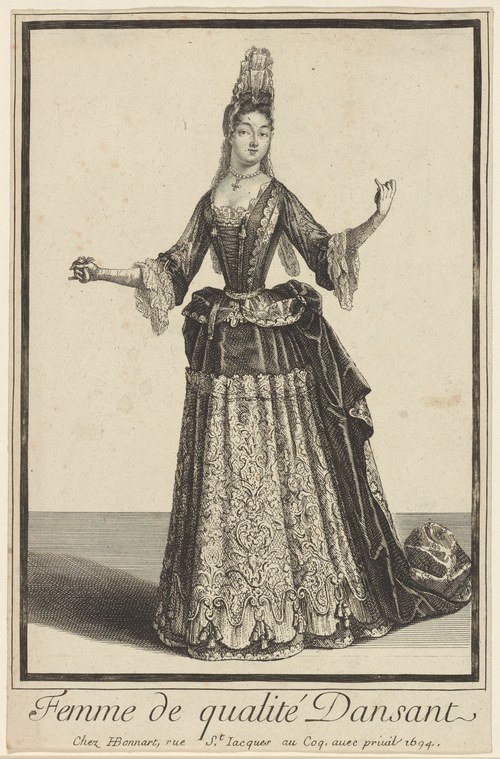
This print is a primary document of how Baroque court dance was transmitted and understood in its own time. The figure's posture, arm positions, and formal frame record the specific aesthetic of noble carriage that defined court dance of the period. The image also shows the material culture of dance—the elaborate dress, the styled hair, the accoutrements of status—which were inseparable from the movement itself.
What you are looking at
A single female figure stands against a plain background in a three-quarter pose, her body oriented to the viewer's right while her gaze addresses the audience directly. She wears an elaborate dark velvet or silk gown with a fitted bodice, deep décolletage bordered with lace, and a full skirt of ornately patterned fabric (possibly brocade or embroidered silk) that extends to the floor. Over this she wears a dark overdress or robe with trailing sleeves of sheer material, lined and finished with decorative trim. Her hair is styled high and elaborate, topped with a tall ornamental headdress of the type worn at the French court. She holds her arms in an open, welcoming gesture—the left arm raised at roughly shoulder height with palm outward, the right arm extended lower and to the side. Her stance suggests both composure and display; her weight appears evenly distributed, and her posture is upright and formal. A small dog or lapdog sits at the lower right of her skirts. The entire composition is framed by a simple rectangular border in the manner of a print.
The dancing
The dancer stands in a relaxed but dignified contrapposto, with weight centered and both feet visible beneath the skirt. Her arm positions—one raised, one extended—create an open frame across her torso, a gesture of welcome or presentation rather than technical dance positioning. The arms lack the turn-out and precision of balletic movement; instead they read as courtly deportment and social address. There is a single figure only, isolated against the void, making this a portrait of the dancer herself rather than a scene of dance in action.
The dance depicted
The title identifies this as a woman of quality dancing (*Femme de qualité dansant*), yet the image shows a posed figure rather than a captured moment of movement. The dress is consistent with 17th-century French court fashion, and the formal presentation suggests this is a portrait of a court dancer, likely from the era of Louis XIV's ballets de cour. The figure's posture and gesture are those of court dance: upright, open, and centered on the dignity and display of the body. The raised arm, the open frame, and the composed stance all accord with the noble carriage required in court dances of the Baroque period. However, no specific footwork or turning is visible, and no partner or ensemble is present, which limits identification to the broad tradition of historic court dance rather than a named choreography.
How it was made
This is an engraving or etching, executed in black line on paper. The technique is apparent in the consistent line weight, the use of parallel hatching for shadow and texture (especially visible in the fabric folds and the hair), and the clear, deliberate cross-hatching that models the face and hands. The simplicity of the background and the frontal composition are typical of costume and character prints of the 17th and early 18th centuries. The medium allowed for rapid reproduction and distribution, suggesting this was a commercial print made for a broad audience of courtiers, dancers, and the curious public—not a unique work but a multiple produced to document and disseminate knowledge of court fashion and dance.
About this work
This engraved print documents a woman of quality in the act of social or courtly dancing, using the conventions of Baroque court portraiture to present her as both subject and performer. The figure is shown in formal dress appropriate to the French court, in a posed stance that reflects the upright carriage, open frame, and dignified bearing of Baroque court dance. The print is a hybrid document: part fashion plate, part dance notation, part social portrait. It records not a narrative moment but a type—the trained, accomplished woman dancer of the aristocracy, presented in the formal gear and posture of her art. The work belongs in a dance gallery as evidence of how court dance was understood, taught, and circulated: through the costume, the carriage of the body, and the social occasion of the dancer's presentation.
How to look at it
Notice first the open, welcoming arm positions and the upright, centered stance—these are the hallmarks of Baroque court carriage, not the turned-out, lifted frame of later theatrical ballet. Observe how the figure addresses the viewer directly: this is a presentation, a formal showing of the dancer herself. Look at the precision with which the dress is rendered—the fabric, the lace, the ornamental detail—because in court dance, the costume was part of the choreography, and the dancer's ability to move through such garments with grace was itself a measure of skill. The small dog at her feet signals her rank; this is a woman of leisure and status, not a professional performer.
The period
This print was produced in the era of Louis XIV's court, when ballet de cour was the dominant form of aristocratic performance and social accomplishment. Dancing was a required skill for nobility, and women of quality were expected to move with grace, control, and an open, welcoming frame. The Baroque aesthetic valued symmetry, dignity, and the display of the body's noble bearing. Prints like this one circulated among courtiers and aspiring dancers as models of correct deportment and dress. The figure's elaborate clothing and formal posture encode the values of the court: rank, refinement, and the cultivation of the self as an object of aesthetic regard.
Where it lives
The work is held in the New York Public Library's collection of prints depicting dance. The engraving bears an imprint attributing it to the publisher Deuseaux, rue S. Jacques au Cog surmée, with a date line of 1694, which would situate it in the late 17th century.
Dance in this work
Questions about this work
Is this woman actually dancing?
She is posed in the formal stance and carriage of Baroque court dance, but she is not in the middle of a choreographed movement. The print captures the deportment and dress of the court dancer—how she should stand, how she should hold her arms, how she should present herself—rather than a specific step or figure. In court dance of this era, standing beautifully and maintaining noble carriage were themselves accomplishments.
What does the title mean?
*Femme de qualité* means a woman of quality or rank—a noblewoman. The subtitle *dansant* means dancing or in the act of dancing. Together, the title presents her as a woman of the aristocracy engaged in one of the refined arts of the court.
Why is she holding her arms that way?
In Baroque court dance, the arms were held in open, graceful positions that displayed the body and created a welcoming frame. The raised arm and extended arm are both typical gestures of court deportment. The positions differ markedly from later ballet, in which the arms are more turned out and the frame more strictly codified.
How was this print made and distributed?
This is an engraving, a multiple-copy print made by cutting an image into a metal plate and inking it. The technique allowed the image to be reproduced many times and distributed cheaply among the court and the public. Such prints served as costume plates, models of deportment, and souvenirs of court life—a way of sharing knowledge of how to dress and move in refined society.
More dance artwork





