49 works in this view — arrow keys or swipe to move between them.
Dance in Art
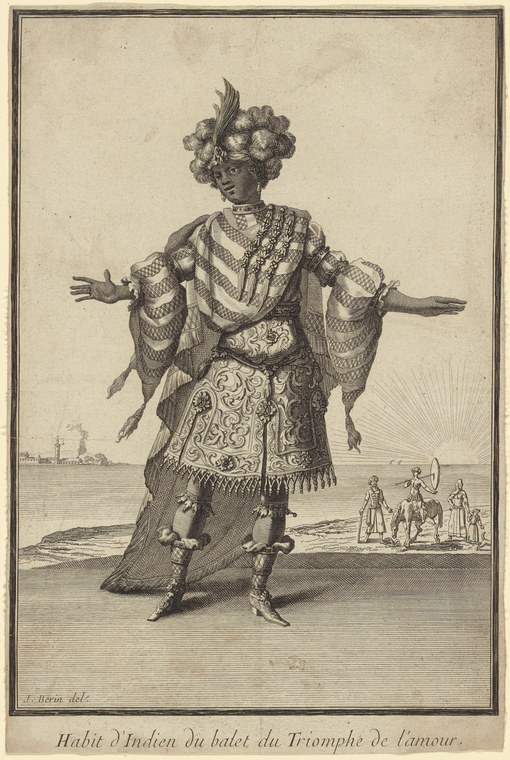
Habit d'Indien du balet du Triomphe de l'amour
Unknown artist
- Collection:
- Prints depicting dance
- Source:
- New York Public Library
- Rights:
- Public domain — free to use, share and adapt.
- Recorded as:
- Public Domain
This is a primary document of French court ballet in its period of greatest elaboration and international prestige. It shows how dance documentation worked before photography—through the codification of costume and pose—and how the visual and decorative arts dominated over movement in the theatrical calculus of the period. For historians of dance, costume, and court spectacle, it is direct evidence of the appearance and character-types within a celebrated production.
What you are looking at
A single dancer stands alone on a vast, empty stage or landscape, posed in a formal, frontal stance with both arms extended outward at shoulder height in an attitude of presentation or display. The figure wears an extraordinarily ornate costume: a richly patterned tunic or jacket with diagonal striping and elaborate embroidery, a heavily decorated skirt with deep fringe at the hem, and what appears to be layered or draped sleeves that extend as separate panels or wings from the arms. The head is crowned with an elaborate headdress of curled feathers or plumes. The dancer's legs are bare or in tights, with decorated shoes or gaiters at the ankles. The setting is minimal—a flat, featureless ground with distant fortifications or buildings visible on the horizon at right, and water or sky at left. The engraving technique creates a theatrical clarity: the figure is the sole focus, monumentalized against emptiness, presented as a specimen or emblem rather than caught in the flow of movement.
The dancing
The dancer occupies a symmetrical, heraldic pose: feet planted firmly apart, arms extended horizontally in a gesture of display that opens the body to view rather than executing a step or turn. The weight is neutral and centered; there is no suggestion of motion, weight shift, or traveling. The pose is frontal and stative, designed for visibility and presentation rather than the documentation of movement through space. The elaborate costume—sleeves extended as separate panels, plumed headdress, heavily fringed and embroidered skirt—dominates the visual field and may itself constrain or define the permissible range of motion.
The dance depicted
This is a costume design or habitué for a dancer in the ballet du Triomphe de l'amour, identified by the French inscription. The "Habit d'Indien" (Indian dress) suggests the figure represents an exotic or imported character type within a courtly theatrical production. The pose and presentation indicate this is documentation of a costume and character rather than a captured moment of choreography. The garment itself—with its patterned weaving, elaborate plumage, and architectural construction—may have been a constraint on movement, and the frontal, symmetrical stance suggests a formal presentation mode typical of court ballet, where spectacle and visual splendor often took precedence over technical virtuosity.
How it was made
This is an engraving, as evidenced by the fine parallel hatching, the linear definition of form, and the crisp black-and-white contrast. The technique allowed for precise reproduction of ornamental detail and made the work suitable for circulation in print form—likely distributed as a record of the production, a reference for costume makers, or a souvenir for courtly audiences. The signature at lower left appears to read "J. Bérain fecit," suggesting attribution to the Bérain workshop, prominent designers of court ballet costumes in the late 17th century. Engravings of this kind were a primary means of documenting and publicizing the increasingly elaborate visual spectacles of French court ballet.
About this work
This engraving documents a costume for the ballet du Triomphe de l'amour, a major court production likely from the 1680s. It records not movement but costume and character type—an "Indian" attendant or exotic figure within a spectacle designed to glorify the French crown. The image reveals the centrality of visual splendor, exotic signification, and heraldic presentation in court ballet. As a printed document, it circulated knowledge of the production beyond those who witnessed it, and served as a template for costume execution and reproduction.
The work sits at the intersection of dance history and material culture: it documents what a dancer wore and how they presented themselves within a highly formalized theatrical context, offering evidence of the relationship between costume, pose, and the constraints and possibilities of movement in this period.
How to look at it
Attend to the stasis of the pose and what it tells you about the constraints of the costume and the priorities of the form. The extended arms and plume are not in motion; they are presented for inspection. The symmetry and frontality reflect the heraldic, emblematic language of court ballet, where character and allegory were often conveyed through visual signs and poses held for the audience's contemplation. Notice how the ornamentation—the striped and patterned weaving, the fringe, the feathered crown—overwhelms the body beneath it, suggesting that in court ballet, the costume was often as important as the dancer's technique. The engraver's precision in rendering every stitch and plume reflects the value placed on these objects as records and status symbols.
The artist
The signature suggests the Bérain atelier, which designed costumes and scenery for the French court ballet under Louis XIV. Jean Bérain the Elder (1640–1711) and his son Jean Bérain the Younger (1678–1726) were among the most influential theatre designers of their era, setting standards for ornate, allegorical, and exoticizing costume design that influenced European court culture throughout the late 17th and 18th centuries.
The period
The late 17th century was the era of the court ballet's fullest flowering in France under Louis XIV. Dance had become an integral part of court ritual and political display, with ballets increasingly elaborate in their scenery, machinery, and costume. At the same time, French courtly culture was deeply invested in exoticism and the representation of distant lands—a visual rhetoric that both asserted European sophistication and fantasized dominion over colonial subjects and trading partners. The Triomphe de l'amour itself, first performed in 1681, was a watershed moment: it was the first court ballet to include professional women dancers alongside the noblemen and professionals who had dominated the form. Printed records of costumes like this one became a means of codifying and circulating the visual language of court ballet internationally.
Where it lives
The work is held in the New York Public Library's collection of prints depicting dance. It is an engraving, likely published in the late 17th or early 18th century as a record and advertisement of the court ballet du Triomphe de l'amour.
Dance in this work
Questions about this work
What was the Triomphe de l'amour?
A court ballet first performed in 1681 at the French royal court, celebrated as a landmark production that introduced professional female dancers to the genre. It was an elaborate allegorical work combining dance, music, scenery, and machinery to celebrate the glory of the monarchy and the triumph of love (and royal power) over discord.
What does 'Habit d'Indien' mean?
It is French for 'Indian dress' or 'Indian costume.' In court ballet of this period, 'Indian' was an exoticizing category that could refer to inhabitants of the Americas, the East Indies, or Africa—a sign of otherness and spectacle used to frame characters as foreign, exotic, or subject to European dominion.
Why is this just a costume, not a dance?
Court ballet documentation before photography worked through the codification of costume and character. Engravings like this one recorded what performers wore and how they presented themselves; they were templates for costume makers and records for courtly audiences. Movement was less often documented than the visual spectacle itself.
Who designed this costume?
The signature suggests the Bérain workshop, prominent theatre designers under Louis XIV. The Bérain atelier created costumes and scenery for royal spectacles and set international standards for elaborate, allegorical court ballet design.
More dance artwork





