49 works in this view — arrow keys or swipe to move between them.
Dance in Art
Costume de l'Amour
Unknown artist
- Collection:
- Prints depicting dance
- Source:
- New York Public Library
- Rights:
- Public domain — free to use, share and adapt.
- Recorded as:
- Public Domain
Cupid designs like this reveal how deeply classical dance training—the turned-out leg, the lifted torso, the balletic arm—was embedded in theatrical costume and characterization by the 1730s. The work documents a moment when ballet technique was being formalized and standardized across theatrical roles. For historians, this is evidence of how allegorical theater shaped and was shaped by the development of classical technique.
What you are looking at
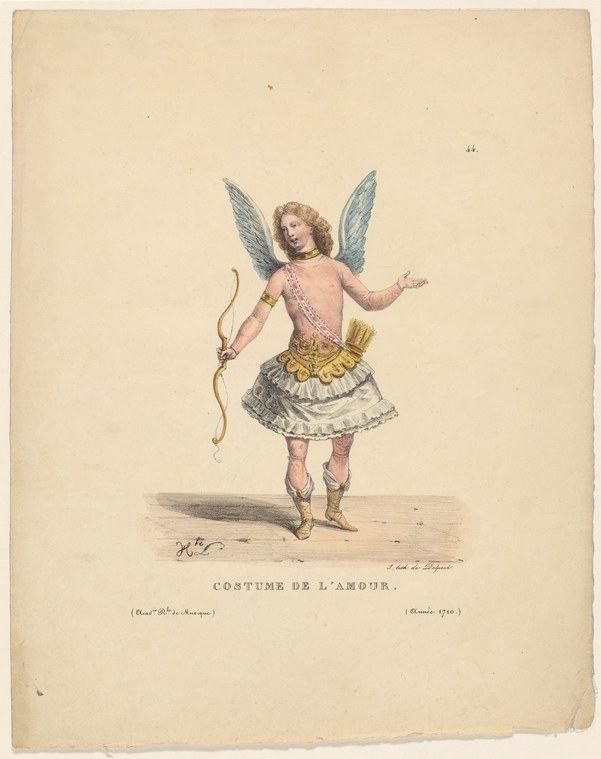
A winged child figure, recognizable as Cupid or Eros, stands in classical contrapposto pose against a plain cream background. The figure has the proportions and idealized features of a putti—full-cheeked, curly-haired, with delicate wings sprouting from the shoulder blades. He wears a draped skirt or fringed kilt in grey and gold, with an elaborate gold belt or girdle cinching the waist. His left arm is raised in an open, welcoming gesture; his right hand holds a curved bow and a single arrow. His stance is light and balletic, weight shifted onto one leg, the other leg subtly bent. The figure is rendered in hand-colored engraving or etching, with delicate cross-hatching for shading and pale watercolor washes defining the fabric and flesh tones. The title below reads "COSTUME DE L'AMOUR" (Costume of Love/Cupid), with a date or annotation that appears to read "Année 1730" or similar.
The dancing
The figure embodies classical dance training and elegance. The pose is one of supple asymmetry: the body is upright and dignified, but the raised arm and open palm convey grace and invitation rather than rigidity. The bent-leg stance suggests lightness and readiness to move—the weight distribution is forward and alive. The slight turn of the torso and the angle of the head create a sense of turning or looking over the shoulder, a gesture familiar from baroque court dance. The wingedness removes the figure from purely human choreography, signaling allegory and the realm of theater rather than social dance.
The dance depicted
This is a costume design or character study for a theatrical role, likely from a baroque opera, ballet héroïque, or comedy-ballet tradition of the early 18th century. Cupid was a stock character in theatrical productions of the period, appearing in intermèdes, pastoral plays, and elaborate court entertainments. The pose and gesture suggest the refined, ethereal movement idiom of the baroque stage—a blend of balletic technique (the turned-out leg, the elevated arm, the balanced stance) with theatrical character acting. The figure is not engaged in a partnered or group dance but rather presented as a singular character ready to act or move. The costume itself—the short kilt or tunic, the precious belt, the bow—identifies this as an allegory, and the gestural vocabulary suggests a character designed to move with a combination of nobility and playful mischief.
How it was made
This is a hand-colored engraving or possibly an etching, rendered with fine lines and delicate cross-hatching for modeling. The technique would have allowed for fine detail in the drapery and facial features, and the color appears to have been applied afterward in watercolor washes—the gold of the belt is distinctly more vivid than the surrounding tones. This printing technique suggests a wide circulation: engravings and etchings of costume designs were produced for theatrical companies, collected by patrons, and circulated among costume makers, dancers, and amateur theater enthusiasts. The small scale and the archival context indicate this was likely a reference document, possibly for a costume maker or a record of an actual production.
About this work
This is a costume design for a theatrical Cupid, drawn from the baroque tradition of French court ballet and opera in the early 18th century. The figure combines classical dance poses—the turned leg, the balanced weight, the raised arm—with the allegorical iconography of love mythology. The work is neither a record of an actual dance nor a choreographic notation, but rather a character study showing how an allegorical figure should appear and move within the theatrical conventions of the period. It belongs in a dance gallery because it documents the embodied training and aesthetic values of baroque stage movement: the ideal body, the language of gesture, and the costume that enabled and defined that movement. The image shows us not what a dancer did, but what kind of body and presence the theater of the period expected and cultivated.
How to look at it
Notice the weight of the body: despite the theatrical character, the pose is balletically grounded, with the supporting leg clearly engaged and the free leg bent and ready. The raised arm is neither rigid nor limp—it has the quality of baroque 'port de bras,' the arm lifted from the elbow and wrist with grace and control. The turn of the torso and the direction of the gaze suggest the figure is captured mid-interaction or mid-gesture, not in a static pose. The wings are delicate and feathered, not massive or cumbersome, suggesting they would not impede movement on stage. The costume is designed to reveal the body's lines and movement: the short tunic, the absence of heavy trains, the fitted waist. This is not fashion design but movement design.
The period
The early 18th century, especially in France, was the golden age of the ballet héroïque and the elaborately costumed court entertainment. Following the reign of Louis XIV and the establishment of formal ballet technique through the Académie Royale de Danse, theatrical dance had become increasingly professionalized. Cupid was a perennial favorite in opera-ballet and pantomime, appearing in works by Lully, Rameau, and their successors. Costume designs of this type served multiple purposes: they recorded actual productions, they guided costume makers, and they circulated as collectible prints and references within the theater world. The date and title suggest this is from the 1730s, a period of high production and formal refinement in French theatrical design.
Where it lives
The work comes from the New York Public Library's print collection, part of a broader archive of theatrical and dance design from Europe. The archival identifier suggests this is one of a series of similar costume studies, possibly all from the same production or theater company. The small scale and printed nature indicate this was a working document or a circulated reference, not a unique artwork.
Dance in this work
Questions about this work
Was Cupid always danced by the same person?
No; Cupid was a stock character that appeared in many productions across the 18th century. Different dancers would have played the role in different theaters and productions. This design may record a specific production or may be a type reference, showing the ideal costume and character regardless of the particular dancer.
How do I know this is for a dance and not just theater?
The pose itself tells the story. The turned-out leg, the balanced contrapposto, the lifted arm position, and the overall deportment are unmistakably drawn from classical dance training. While the figure is allegorical and theatrical, the body language is that of a trained dancer moving through space with balletic grace.
What would this character have actually done on stage?
In baroque opera-ballet, Cupid typically appeared in divertissements or intermèdes, singing and dancing to celebrate love or to intervene mischievously in the plot. The raised arm and open gesture suggest a welcoming or commanding presence—the figure might have gestured to other dancers, delivered lines, or performed a solo or ensemble number. The bow identifies Cupid as a hunter or archer figure, roles often associated with movement vocabulary that combined grace with a suggestion of action or purpose.
More dance artwork





