49 works in this view — arrow keys or swipe to move between them.
Dance in Art
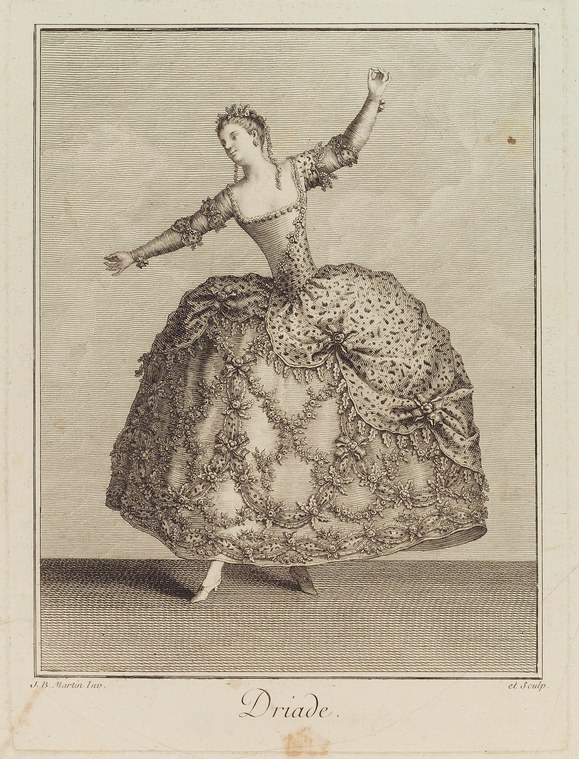
Driade. J. B. Martin inv. sculp.
Unknown artist
- Collection:
- Prints depicting dance
- Source:
- New York Public Library
- Rights:
- Public domain — free to use, share and adapt.
- Recorded as:
- Public Domain
The print is a direct record of a named character role in 18th-century theatre dance, showing exactly how mythological character pieces were costumed and danced at a moment when ballet was becoming increasingly technically sophisticated. For historians of dance, costume, and theatre, it provides concrete visual evidence of the vocabulary, the dress codes, and the scale of ambition in professional dance at a specific moment in the form's development.
What you are looking at
A single female dancer occupies the entire composition, posed in a moment of exuberant movement against a plain background. She wears an elaborate dress of the mid-18th century: a fitted bodice with short sleeves decorated with lace or embroidery, and a voluminous skirt of patterned fabric (likely printed silk or similar material) caught up at the sides to reveal the construction beneath and suggest motion. The skirt is drawn up asymmetrically, creating a dramatic silhouette. Her hair is styled in the fashion of the period, dressed high on her head. She stands in a contrapposto stance with her weight on one leg, her arms spread wide in an open, joyful gesture—one arm raised nearly to shoulder height, the other extended downward and to the side. The pose conveys lightness and buoyancy; her body appears to be captured at the peak of a leap or bound. The engraving technique creates fine linear detail throughout the fabric patterns and the delicate textures of lace and trim.
The dancing
The dancer's weight is carried on one leg in a lifted position, with the other leg extended behind or to the side in a line suggesting elevation. Both arms are open and extended, creating a frame that emphasises the width of the torso and projects an expansive, uninhibited energy. Her torso is upright and her gaze directed outward, conveying confidence and control. The pose suggests the vocabulary of mid-18th-century theatrical dance—the turned-out legs, the arm carriage, and the deliberate lift of the body all reflect the technical vocabulary of the period.
The dance depicted
This is almost certainly a theatrical solo from the mid-18th century, likely a danced character or divertissement from a ballet or opéra-ballet. The title *Driade* (a Dryad, a tree nymph from classical mythology) indicates this is a mythological character piece of the type common in French court and theatre dance of the period. The elevated, weightless pose and the open arm position are consistent with the emerging Romantic aesthetic, though the precision of the turned-out legs and the formal geometry of the frame suggest training in the academic vocabulary that would become codified as classical ballet. The dress—elaborate, impractical, and explicitly displayed—marks this as theatrical performance dress intended to showcase skill and the dancer's body.
How it was made
This is an engraving, executed with fine parallel lines (hatching and cross-hatching) to create tone and texture. The technique allows precise delineation of fabric patterns, ornamental detail, and the fine articulation of the figure's anatomy. Engravings of this type were produced for circulation among the aristocracy and the educated public; they served as both documentation of celebrated performers and as fashion and cultural records. The artist has signed the plate (J. B. Martin inv. sculp., indicating that Martin both invented the composition and engraved the plate). The size and finish suggest this was a finished print, likely issued individually or as part of a series of celebrated dancers or character roles.
About this work
This engraving documents a theatrical solo role from the mid-18th century, featuring a named character—a Dryad—captured in a moment of virtuosic elevation. The work belongs to a tradition of prints recording celebrated dancers and distinctive roles in French baroque and early neoclassical theatre. It combines precise observation of the body in motion with meticulous attention to costume detail, creating a record both of technique and of fashion. The image demonstrates how theatrical dance was circulated and celebrated in print culture, and what the aesthetic values of the period considered worth preserving and displaying.
How to look at it
Look at the moment the artist chose to freeze: the dancer is captured at the apex of a jump or bound, with both feet leaving the ground. This is not a static pose but a split-second of airborne movement, and the engraver has rendered the lightness and elevation that the period associated with technical accomplishment. Notice how the costume is explicitly caught up and displayed—the irregular gathering of the skirt is not accidental, but a deliberate choice to reveal the dancer's legs and the construction of the dress, much as a dancer would manage her skirt in performance. The open arm position and the turned-out legs reflect the academic vocabulary of the period; the composition presents the body and its training as the primary subject.
The artist
J. B. Martin was an 18th-century engraver known for prints of theatrical subjects and performers. The signature and the inscription suggest this was a professional commercial print, likely executed on commission to record a celebrated performance or dancer. The level of technical accomplishment in the engraving indicates Martin was trained and established.
The period
This engraving dates to the period of transition from baroque to early neoclassical aesthetics in European dance and theatre (mid-to-late 18th century). The 1730s–1760s saw the codification of academic ballet technique and the rise of the professional dancer as a celebrated public figure. Theatrical dance was increasingly documented and circulated in print, reflecting both its growing status and the market demand for images of celebrated performers. The clothing and the pose reflect the fashion and movement vocabulary of French court dance, which was the prestige standard across Europe.
Where it lives
This engraving is held in the Prints collection of the New York Public Library, where it is catalogued as a work depicting dance. The catalogue record identifies it as a print from an unknown date by an unknown artist, though the signature on the plate (J. B. Martin) indicates the engraver. The work is part of the broader holding of prints documenting dance, theatre, and performance.
Dance in this work
Questions about this work
Who was the Dryad, and why does a dancer perform this role?
A Dryad is a tree nymph from classical mythology. In 18th-century ballet and opéra-ballet, mythological characters like Dryads were standard subjects for solo dances and divertissements. They allowed dancers to perform virtuosic, character-specific movement while remaining within the framework of narratives drawn from classical literature. The role would have been part of a larger theatrical work, not necessarily a standalone piece.
What does her pose tell us about 18th-century dance technique?
The lifted, weightless pose and the turned-out legs show that by the mid-18th century, ballet technique was already highly developed and standardised. The dancer's weight is carried on one leg, with the other extended in a line; her arms are open and framing the body. This vocabulary—turnout, extension, the use of the arms to frame and balance—would become the foundation of classical ballet.
Why is her skirt gathered up like that?
The bunched, asymmetrical skirt is not a damage or a mistake; it is how dancers managed long skirts in performance, especially during virtuosic movement. By gathering and lifting the fabric on one side, the dancer exposes her legs to show her footwork and line, and reduces the drag of heavy material during movement. This practical choice became part of the visual language of 18th-century theatrical dance.
What is an engraving, and why were dancers recorded in this medium?
An engraving is a print made by incising lines into a metal plate; it was a primary medium for circulation of images before photography. Engravings of celebrated dancers and theatrical roles were produced in editions and sold to collectors and patrons. They served as both documentation and souvenirs, circulating a record of notable performers and celebrated roles throughout literate society.
More dance artwork





