49 works in this view — arrow keys or swipe to move between them.
Dance in Art
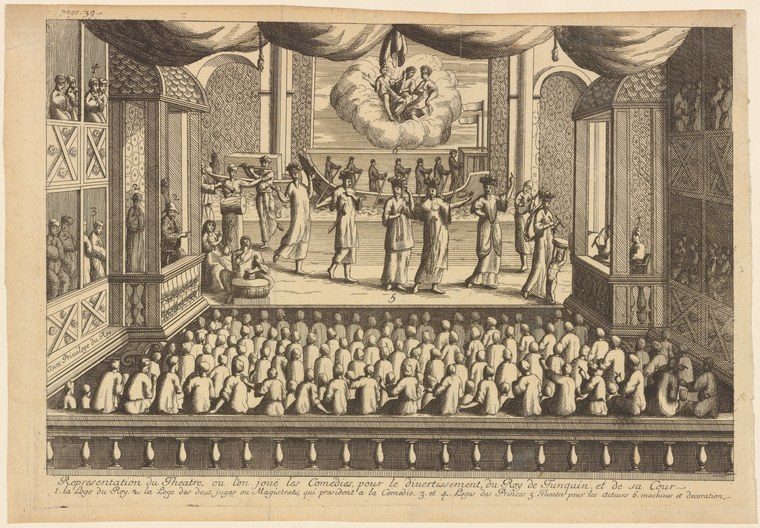
Representation du théatre ou l'on joue les comédies pour le divertissement du Roy de Tunquin et de son cour: pour le divertissement du Roy de Tunquin et de son cour
Unknown artist
- Collection:
- Prints depicting dance
- Source:
- New York Public Library
- Rights:
- Public domain — free to use, share and adapt.
- Recorded as:
- Public Domain
This image is a rare surviving document of cultural exchange in early modern court entertainment, showing how European court ballet was presented to and received by non-European courts. It demonstrates the prestige and exportability of European theatrical spectacle, and the role of prints in making court entertainment visible to those who could not attend. For dance historians, it provides rare evidence of how court ballet was represented and explained to distant audiences.
What you are looking at
A grand theatrical performance in an ornate hall with classical architecture. The stage features a proscenium arch framed by decorated pilasters and draped fabric. In the upper register, figures perform what appears to be a formal court entertainment or ballet: women in long skirts and men in period dress move across the stage in organized groups, with some figures elevated or in aerial positions suggesting mechanical effects or staged illusion. The focal point is a large decorated oval or circular frame at stage center, possibly a cloud machine or theatrical device, from which additional figures emerge or are suspended. The lower register shows the audience—a densely packed crowd of spectators, primarily women in long dresses, seated in the orchestra or pit, facing the stage. The engraving employs fine parallel lines and cross-hatching to create depth and shadow, establishing the architectural volume of the hall and the theatrical space.
The dancing
The performers on stage are arranged in formal, symmetrical groups characteristic of court spectacle. Several figures appear to be in upright, processional postures; others are positioned at angles suggesting movement through space or posed tableaux. The exact footwork and hold are difficult to determine at this scale, but the overall composition suggests stately, formal movement rather than vigorous action. Bodies are elongated and posed rather than captured in dynamic motion, consistent with period convention. The audience members sit upright and attentive, their bodies oriented toward the stage.
The dance depicted
This is a court ballet or theatrical spectacle, most likely French or European, depicting an entertainment given for an Asian royal court. The title explicitly states it represents a comedy or theatrical performance mounted 'for the amusement of the King of Tonkin and his court.' The setting and costume—the dramatic architecture, the formal procession of courtiers, the suspended figures—are consistent with 17th-century court ballet, a form in which dance, music, machinery, and visual spectacle were integrated. The elevation of certain figures and the elaborate stage machinery suggest this was a sophisticated production employing theatrical technology; the stately arrangement of performers indicates courtly decorum rather than popular or folk dance.
How it was made
This is an engraving on paper, executed with fine parallel lines and cross-hatching to create tonal gradation and spatial depth. The technique is consistent with 17th- or early 18th-century reproductive print-making, allowing for wide distribution and legibility at small scale. The level of architectural and figural detail suggests it was made from a detailed drawing or design, possibly a stage design or scene model. The engraving format indicates this was a commercial or documentary print, intended to circulate as a record or advertisement of the spectacle, rather than a unique artistic object.
About this work
This engraving documents a court ballet or theatrical spectacle performed for the royal court of Tonkin (Vietnam), an exotic subject for European print culture. It is a record of European court entertainment as exported or adapted for Asian aristocratic consumption, and simultaneously a demonstration of European theatrical technology and courtly arts to a European audience. The work exemplifies the role of printmaking in circulating knowledge of court spectacle and the interconnected world of seventeenth-century court culture.
How to look at it
Attend first to the spatial organization: the strict symmetry of the stage arrangement, the clear separation of performers from audience, and the architectural frame. Notice the role of machinery and spectacle—the elevated central device and suspended figures—which are as much the subject as the dancers themselves. The engraving's formal precision and legibility reflect the court's desire to document and disseminate an image of power, refinement, and technological mastery. The densely packed audience at the bottom of the frame reminds us that this was not a participatory court dance but a spectacle created for observation and admiration.
The artist
The artist is not recorded, and the engraving is likely a commercial documentary print rather than an authored artwork. Such prints were often made by workshop engravers from designs or descriptions supplied by court officials, stage designers, or travelers. The style and execution are consistent with mid-to-late seventeenth-century European print production.
The period
This work dates to an era when European court ballet was at its height of technical sophistication and political importance. The mid-to-late seventeenth century saw court ballet evolve from a participatory entertainment for courtiers into a professional spectacle for an audience of observers. The use of mechanical scenery, fly systems, and elaborate stage machinery—evident in the suspended figures and the framed 'cloud machine' center stage—reflects the increasing influence of Italian court spectacle and opera on French practice. The existence of this print testifies to the global reach of European courtly culture and the appetite for printed documentation of court ceremony and performance.
Where it lives
Held by the New York Public Library as part of its collection of prints depicting dance. The work's inscription on the lower margin provides the title and contextual information. The print survives as a historical document of court spectacle and early modern print culture.
Dance in this work
Questions about this work
What is the Tonkin mentioned in the title?
Tonkin (Tonkin) refers to the Kingdom of Tonkin in what is now Vietnam, an important Southeast Asian power in the seventeenth century with which European trading companies and courts sought diplomatic and commercial relations. The reference in the title indicates this was either a spectacle performed for a Tonkinese royal visitor to Europe, or an image of a European spectacle created to appeal to European interest in Asian exoticism and courtly grandeur.
Is this a depiction of actual dance or a fantasy?
It is a depiction of an actual court spectacle—likely a court ballet with mechanical scenery, music, and sung text. However, as a print made after the event (or from a design), it represents the spectacle as the creator or commissioner wished it to be understood and remembered, emphasizing formality, geometry, and technological sophistication rather than capturing live movement as it occurred.
Why are so many figures elevated or suspended?
The elevated and suspended figures likely represent theatrical machinery at work—cloud machines, fly systems, or raised platforms that were hallmarks of elaborate court spectacle. These mechanical effects created a sense of the miraculous or divine and were expensive demonstrations of the court's technical mastery and wealth.
More dance artwork





