25 works in this view — arrow keys or swipe to move between them.
Dance in Art · 2024
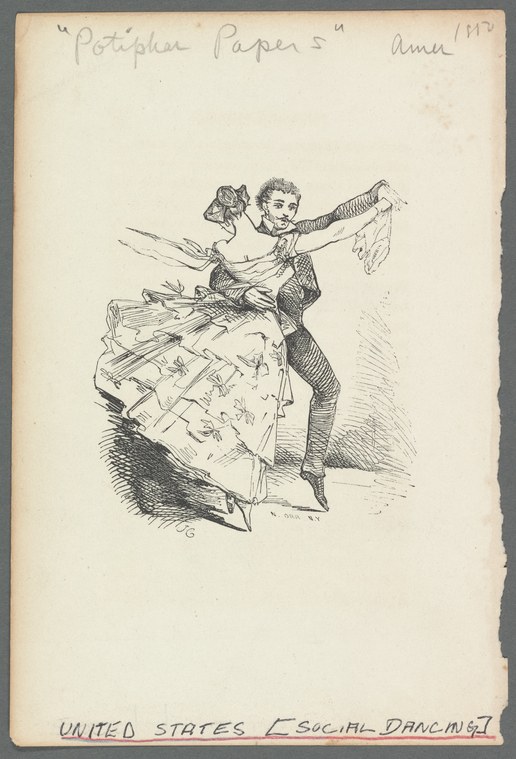
Dancing couple, with penciled notation "Potiphar Papers"
Unknown artist
- Medium:
- Drawing/Sketch
- Dance:
- Notation/Choreography
- Source:
- New York Public Library
- Rights:
- Public domain — free to use, share and adapt.
- Recorded as:
- public_domain
This sketch documents the visual conventions and physical reality of elite social dancing in the 19th century—the posture, the frame, the dress, the moment of motion the artist chose to freeze. For historians of dance and material culture, it shows how ballroom dance was understood and represented in the popular press, and how intimacy and formality coexisted in the waltz.
What you are looking at
A man and woman in formal 19th-century dress execute a partnered social dance. The woman wears a full-skirted gown with a patterned or decorated fabric, her torso corseted and upright, her arms extended in an open frame. The man, in dark coat and trousers, supports her with one arm while extending his other arm to meet hers. The woman's skirt billows outward, caught mid-motion, suggesting rapid turning or forward travel. The composition is intimate and frontal, focusing on the couple's upper bodies and the play of their limbs. The background is minimal—loose pen strokes suggest an undefined interior space. The entire scene is rendered in black ink with fine cross-hatching to suggest shadow and fabric weight. The notation "Potiphar Papers" in pencil at the top suggests this sketch was made as editorial illustration or satirical commentary.
The dancing
The man stands slightly behind and to the side of the woman, his posture erect and leading. His right arm curves around her waist in a classic closed dance position; his left arm extends outward at shoulder height to receive her right hand. The woman's frame is open and responsive: her left arm reaches back toward his shoulder, her right hand meets his extended hand. Both dancers' spines are vertical, their weight distributed for forward motion. The woman's head turns slightly toward her partner, her expression animated. The artist has captured the woman mid-motion, her skirt splayed and her body in a position of travel or rotation, suggesting a waltz or similar turning dance of the period.
The dance depicted
This is a social ballroom dance, most likely a waltz or similar partner dance popular in the mid-to-late 19th century. The closed position, the vertical frame, the emphasis on turning (suggested by the billowed skirt), and the formal dress all point to the waltz, the dominant partnered dance of the Romantic and Gilded Age periods. The notation at the top—"Potiphar Papers"—is a literary reference (to the Biblical Potiphar, often invoked in satirical or moralistic contexts) and suggests this may be a social or editorial illustration rather than a straightforward dance documentation. The sketch captures the sociability and spectacle of ballroom dance as a performed pastime among the educated classes.
How it was made
This is a pen-and-ink sketch, likely executed with a steel nib and possibly touched with cross-hatching wash or ink work to suggest volume and shadow. The line work is assured and economical—the artist defines form through gesture and contour rather than elaborate shading. The medium allowed for rapid composition and reproduction via wood engraving or lithographic transfer, making it suitable for periodical or book illustration. The informality of the notation and the sketch's small scale suggest it was a working drawing or proof, not a finished exhibition work.
About this work
This is a pen-and-ink sketch of a couple performing a formal ballroom dance, most likely a waltz, in the dress and style of the mid-to-late 19th century. The work captures the partnered social dancing of the Romantic and Gilded Age eras—the period when the waltz dominated European and American ballroom culture. The sketch's notation ties it to the *Potiphar Papers*, a 19th-century periodical known for satirical social commentary, suggesting the work was created as editorial illustration. The artist demonstrates clear understanding of ballroom frame and the mechanics of turning partnered dance, encoding both the physical form and the social ritual in a few economical lines.
How to look at it
Notice the moment the artist selected: not a static pose, but a couple in travel, the woman's skirt caught mid-turn. This suggests the artist understood and wanted to convey the waltz's signature motion—the continuous rotation around the room. The closed frame is precise: the man's leading arm, the woman's responsive follow, the extended joined hands. The artist chose to show the dance as a physical and social partnership, with both figures equally present and engaged. The informal line work and the literary notation at top suggest the sketch is playful—a comment on ballroom culture as much as a record of its physical form.
The period
The waltz emerged in the late 18th century as a scandalous innovation—a dance in which partners held each other closely and traveled rapidly across the floor in three-time. By the mid-19th century, when this sketch was likely made, the waltz had become the dominant social dance of the European and American ballroom, taught in dancing schools and performed at every formal ball. The *Potiphar Papers* (published 1853–1856) was a satirical serial by George William Curtis, known for gentle critiques of American manners and social pretension. Ballroom dance was a frequent subject of social satire in the period, as it represented both refinement and potential impropriety—the close hold between partners raised eyebrows, and dancing itself was viewed by some as frivolous or morally suspect.
Where it lives
The work is held by the New York Public Library. It is catalogued as a sketch or drawing, and the pencil notation "Potiphar Papers" at the top indicates a connection to the periodical of that name, likely dating it to the 1850s. The institutional source and the associative notation suggest this was a working drawing for editorial use rather than an independent artwork.
Dance in this work
Questions about this work
What dance is this?
This is almost certainly a waltz or a similar turning ballroom dance popular in the 19th century. The closed frame, the vertical posture, the woman's billowed skirt, and the forward-turning motion all point to the waltz, which was the dominant partnered social dance of the Romantic and Gilded Age.
What does "Potiphar Papers" mean?
The *Potiphar Papers* (1853–1856) was a collection of satirical essays by George William Curtis about American manners and social life. The notation suggests this sketch was created as illustration for the periodical or a related publication, implying the image carries social commentary about ballroom culture and dancing.
Why is the woman's dress so full?
The full skirt was standard in the mid-19th century—created by layers of petticoats and crinoline. In a turning dance like the waltz, the skirt would lift and billow outward due to centripetal force, and the artist has captured this moment to convey motion and the spectacle of the dance.
How do historians know this is from the 1850s?
The notation "Potiphar Papers" is the primary evidence. The dress style—the woman's corseted waist, full skirt, and the man's formal coat and trousers—is consistent with the 1850s. The drawing technique and the style of the periodical support this dating, though the catalogue record does not give a definitive date.
More Notation/Choreography artwork