43 works in this view — arrow keys or swipe to move between them.
Dance in Art
Solo Dancer — Plate 24
Gregorio Lambranzi
- Medium:
- Copper-plate engraving
- Dance:
- Notation/Choreography
- Era:
- 1700s (Enlightenment/Minuet Era)
- Collection:
- Nuova e curiosa scuola de' balli theatrali (1716)
- Source:
- Library of Congress
- Rights:
- Public domain — free to use, share and adapt.
- Recorded as:
- Public Domain
For dance historians and practitioners, Lambranzi's work is a rare detailed record of how theatrical dances were actually performed and taught in the early eighteenth century—not recreated from written description, but shown in the body and annotated with music. The precision of the engraving and the standardized format allowed this knowledge to circulate and survive; without such manuals, theatrical dance practice of the period would be largely lost.
What you are looking at
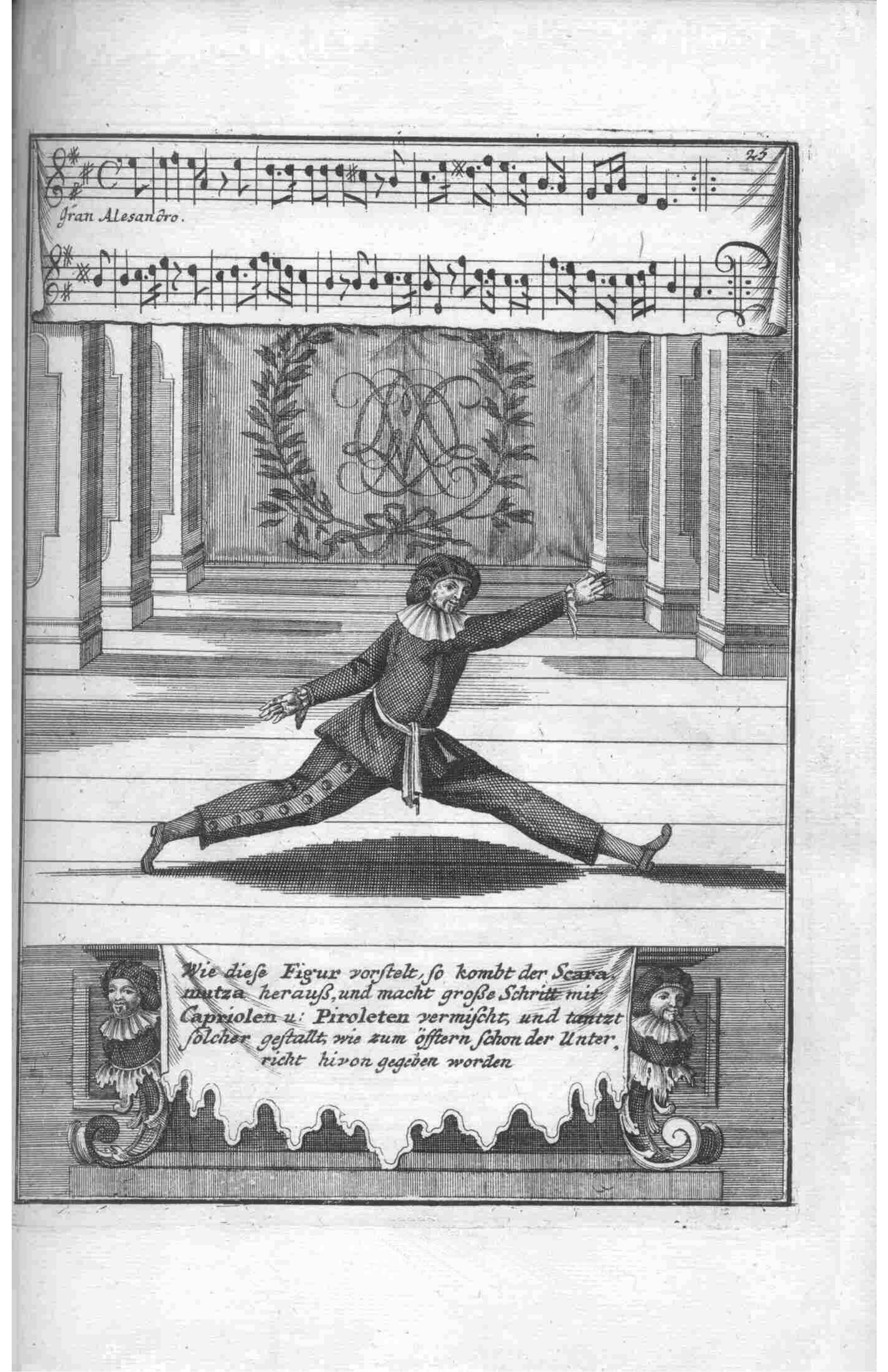
A single male dancer in theatrical dress performs a deep lunge on a stage framed by drawn curtains. He wears a dark patterned doublet with a stand collar, fitted hose or breeches decorated with geometric patterns, and soft shoes appropriate to theatrical dance of the period. His left leg extends fully forward in the lunge while his right leg stretches behind; his arms are spread wide—one raised toward the curtain, the other extended laterally—creating an expansive, dynamic silhouette. The stage is rendered in linear perspective with columns visible at either side, and a large ornamental tapestry or coat of arms hangs in the upper center. The lighting is even and schematic, typical of the engraving medium. Above the scene, two staves of notated music labeled *Gran Alessandro* provide the choreographic accompaniment. Below, a German verse caption in an ornamental cartouche identifies and describes the figure and step.
The dancing
The dancer's weight is clearly committed to the forward leg, with the torso upright and shoulders level despite the extension. The arms are held in an open, generously spread position—neither in a formal ballroom frame nor in the constrained port de bras of later ballet, but in a theatrical display position that emphasizes line and amplitude. The deep lunge with extended rear leg suggests a springing or jumping action just arrested, or the landing position from a jump. The posture and proportions show understanding of the demands of theatrical dance: the figure is stable yet appears mid-motion, capable and controlled.
The dance depicted
This is a theatrical solo dance step or allegro movement, likely a saltarello or variant, as the catalogue record suggests. The *Nuova e curiosa scuola de' balli theatrali* (1716) documents theatrical dances of the late baroque period performed in court and commercial theaters. The lunge position, the lateral arm spread, and the notation above indicate a step with a musical accompaniment—this was notated, learned, and repeated, not improvised. Saltarello denoted both a social dance and a theatrical variation step marked by jumps and rebounds; the lunge here could represent either the gathering position before a jump or the landing and extension after one. The title *Gran Alessandro* suggests this may be a character or narrative solo, possibly heroic or dramatic in intent.
How it was made
This is a copper-plate engraving, a technique that allowed fine linear detail and wide distribution. Engraving requires careful planning and reverses the composition on the plate, so the artist worked from a prepared design. The uniformity of line weight and the bold, readable rendering of the figure's silhouette are characteristic of the medium and the period's didactic intent—this is a teaching manual, and clarity was essential. The engraving's precision and repeatability made it ideal for instruction: dancers, choreographers, and theater practitioners could own and study multiple copies, and the notation alongside the figure meant the visual and the music were inseparable.
About this work
This plate from Gregorio Lambranzi's influential *Nuova e curiosa scuola de' balli theatrali* (Nuremberg, 1716) pairs a notated musical phrase with a single theatrical dancer in a teaching illustration. Each of Lambranzi's plates follows the same formula—music notation, costumed figure, stage setting, and identifying text—creating a comprehensive archive of late-baroque theatrical dance technique and choreography. The *Scuola* was one of the era's most authoritative and widely consulted manuals, copied and referred to long after its publication, and represents a crucial moment when theatrical dance vocabulary was being systematized, notated, and made portable in print.
How to look at it
Look at the exact moment the artist chose: not the landing, but the moment of fullest extension—legs spread, arms flung open, the body's limits tested. This is characteristic of theatrical dance representation: not the most stable or balanced position, but the most spectacular and dynamic. The engraving technique, with its even line and clear silhouette, makes the body's geometry visible and teachable. Note how the notation above is not merely decorative but functional—a dancer learning from this print would read the music and the image as a unit, understanding that the step and its musical phrasing were inseparable.
The artist
Gregorio Lambranzi was an Italian dancer and choreographer active in the early eighteenth century. He is documented primarily through the *Nuova e curiosa scuola de' balli theatrali*, published in Nuremberg in 1716 and reissued in an expanded two-volume edition in 1728. The work was illustrated with engravings by an unnamed artist (possibly Lambranzi himself) and compiled a repertoire of theatrical solos, duets, and group dances, each with notation and performance instructions. Lambranzi's manual stands alongside Raoul-Auger Feuillet's *Chorégraphie* (1700) as a foundational printed source for baroque dance notation and vocabulary, though Lambranzi's focus was explicitly theatrical and dramatic rather than ballroom.
The period
In the early eighteenth century, theatrical dance was rapidly professionalized and codified. The notational systems pioneered by Feuillet and others made choreography recordable and repeatable, and printed manuals allowed dancers and choreographers across Europe to learn standardized technique and choreography without direct apprenticeship. The baroque theatrical tradition emphasized dramatic solo roles—often male heroes or comic characters—performed on stage with elaborate costume and music; these solos required virtuosic jumps, turns, and dynamic spatial command. Lambranzi's work documents this world at its height, capturing the vocabulary and aesthetic just before the shift toward the narrative ballet d'action and the emergence of ballet as we know it.
Where it lives
This plate is from the 1716 first edition of the *Nuova e curiosa scuola de' balli theatrali*, held by the Library of Congress. The work is a printed manual of theatrical dances, with each plate serving as a discrete lesson or reference illustration.
Dance in this work
Questions about this work
What does 'Gran Alessandro' mean?
*Gran Alessandro* is Italian for 'Great Alexander,' likely indicating a character or dramatic solo, possibly depicting a heroic male figure. Many baroque theatrical solos were named after characters or scenarios; the title may refer to a specific dramatic role or a famous dancer known for this part.
Is this step a saltarello?
Probably. The catalogue identifies it as possibly a saltarello, and the lunge position with extended rear leg is consistent with the rebound and landing of a jumping step. Saltarello could denote a social partner dance or, as here, a theatrical solo variation marked by springs and rebounds. The deep extension suggests a moment of ballistic motion arrested mid-sequence.
How would a dancer use this page?
A dancer or choreographer would study the figure alongside the notated music, learning both the visual form of the step and its musical timing and phrasing. The notation at the top is not decoration but instruction; the step and its music were one unit, and understanding the musical rhythm was essential to performing the step correctly.
Why is Lambranzi's manual important?
The *Scuola* is one of the few surviving detailed visual and notational records of theatrical dance practice in the early eighteenth century. It shows how dances were actually performed, what they looked like, how they were taught, and how they related to music—knowledge that would otherwise be lost to history.
More Notation/Choreography artwork