27 works in this view — arrow keys or swipe to move between them.
Dance in Art
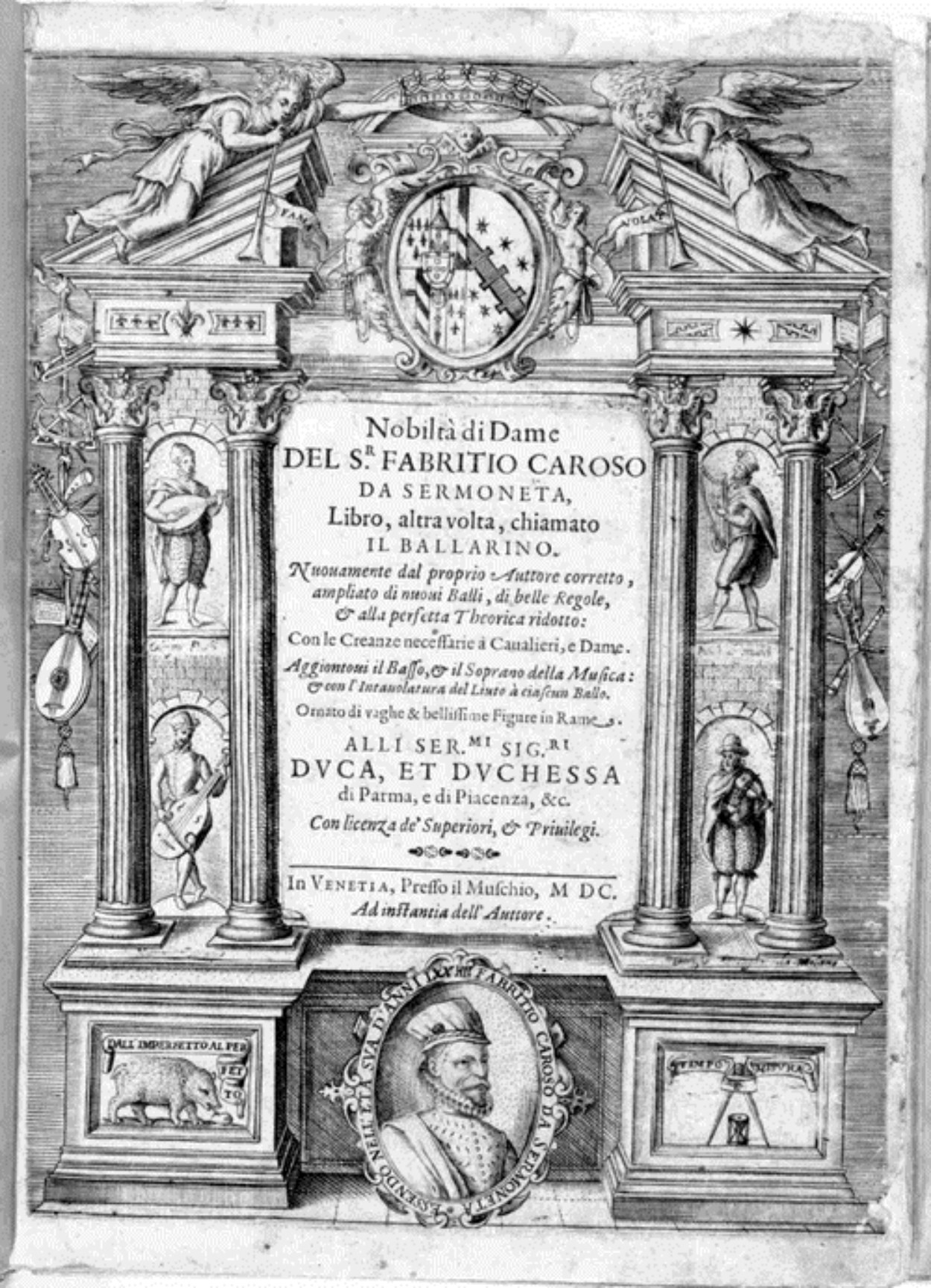
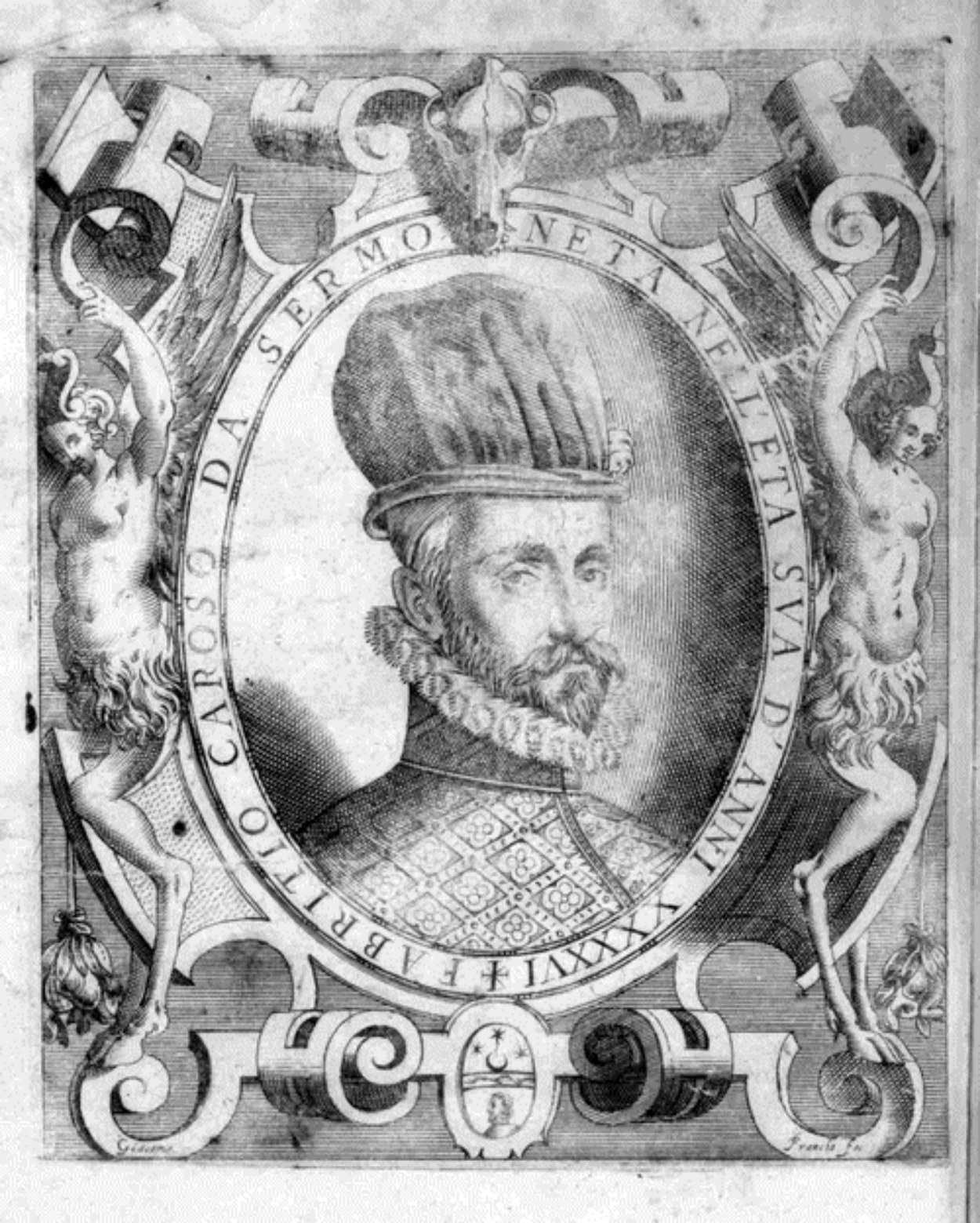
Caroso — Title Page (plate 1)
Fabritio Caroso da Sermoneta
- Medium:
- Woodcut
- Dance:
- Notation/Choreography
- Era:
- Pre-1700 (Renaissance/Baroque)
- Collection:
- Il Ballarino (1581)
- Source:
- Library of Congress
- Rights:
- Public domain — free to use, share and adapt.
- Recorded as:
- Public Domain
For historians of Renaissance dance, this frontispiece is the gateway to one of the two most authoritative surviving dance manuals of the 16th century (alongside Thoinot Arbeau's *Orchésographie*). It offers concrete evidence of how professional dancing masters in Venice presented themselves and their art to elite patrons and students—as repositories of classical learning and courtly virtue. The portrait preserves the appearance and social standing of Caroso, one of the few named Renaissance choreographers, and the allegorical framing tells us how dance was intellectually positioned in the cultural hierarchy of the Renaissance.
What you are looking at
A woodcut portrait of a bearded man in three-quarter profile, wearing an elaborately pleated bonnet and a richly patterned doublet with ornate brocade or damask weaving across the chest. The sitter occupies an oval frame within a decorative architectural cartouche, flanked on either side by allegorical female figures—likely personifications of virtues or the arts—rendered in classical contrapposto poses. Above the portrait, two cherub heads support ornamental scrollwork and heraldic devices. An inscription circles the oval in Latin: "HIERONIMO CAROSO DA SERMONETA NOBILISSIMO CAVALIERO" (or similar—the exact text is difficult to read in reproduction). The entire composition is set within an ornamental border of scrolls, acanthus leaves, and architectural details typical of Renaissance woodcut design. The engraver's signature appears at bottom left.
The dancing
The allegorical figures flanking the portrait are posed in contrapposto with one leg bearing weight while the other relaxes; their arms are gracefully positioned—one raised, one lowered—in the classical manner. They are nude or lightly draped, their bodies rendered with attention to anatomical proportion and the S-curve characteristic of Renaissance ideals. Their poses suggest movement without narrative action, the vocabulary of dance and courtly grace repurposed as abstract virtue. The portrait itself, being a head study, shows no active movement, but the elaborate dress and composed bearing suggest the authority and refinement the sitter wishes to project.
The dance depicted
This is not a depiction of dance in action, but rather a portrait frontispiece designed to present the author of a dance manual. Fabritio Caroso da Sermoneta (c. 1526–after 1605) was a dancing master and choreographer of late-Renaissance Italy, and this image introduces his treatise *Il Ballarino* (Venice, 1581), a foundational text on Italian court dances. The allegorical figures framing the portrait invoke the visual language of dance and movement—their classical poses and balanced positioning gesture toward the disciplined, courtly body that Caroso's dances trained. The work thus uses dance-adjacent vocabulary (the posed, idealized body; the rhetoric of grace) not to show dance itself but to authorize the author as a master of courtly refinement.
How it was made
This is a woodcut, a relief printing method in which an image is carved into the surface of a wooden block, with ink applied to the raised portions. The medium is visible in the bold, confident linework and the strong contrasts between light and dark; the technique allowed for multiple impressions from a single block and made the image economical to reproduce for a title page. Woodcut was the standard technology for book illustration in the 16th century, particularly in Venice, and its architectural clarity and linear precision were well suited to formal frontispieces and allegorical imagery. The technique also meant the work circulated widely—every copy of *Il Ballarino* carried this image.
About this work
This is the title-page woodcut of *Il Ballarino* (Venice, 1581), a landmark Italian Renaissance dance manual by the dancing master Fabritio Caroso. Rather than depicting dancers in motion, it presents Caroso himself in formal portraiture, framed by allegorical female figures in classical poses that evoke the visual and bodily ideals his dances embodied. The work belongs to a genre of Renaissance instructional texts on courtly arts—deportment, dance, music, rhetoric—that combined practical instruction with humanist philosophy. The image is not a dance scene but rather an architectural and allegorical frame built to authorize the author and signal the elevated, classical status of Italian court dance to its readers.
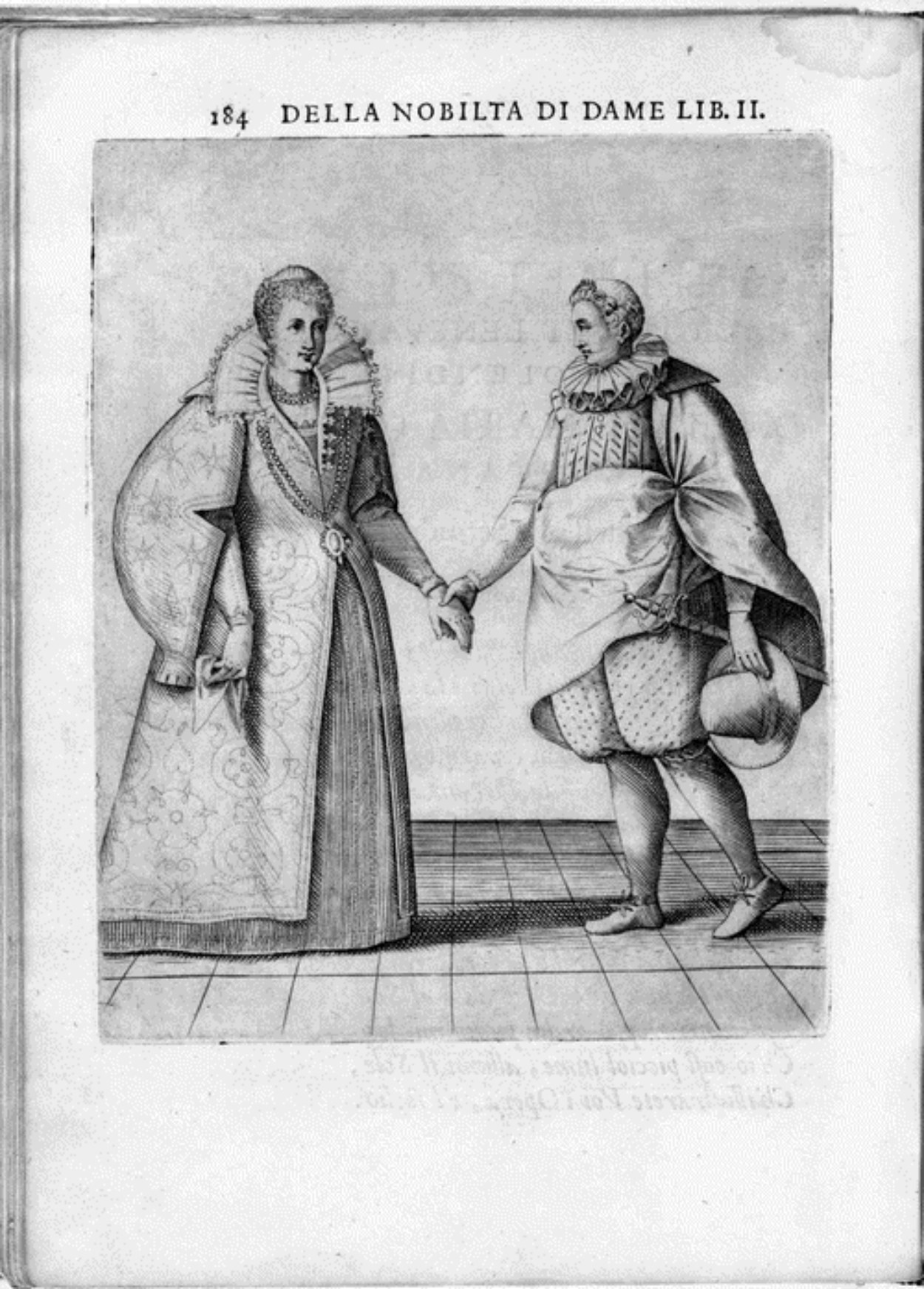
Caroso's *Il Ballarino* was one of the most important surviving documents of 16th-century European dance. The manual includes detailed descriptions and paired-figure illustrations of dances like the pavane, galliard, and volta, with geometric floor patterns and instructions for both steps and style. This frontispiece, with its invocation of classical virtue and Renaissance learning, sets the tone for a treatise that positioned dance as a learned art rooted in antiquity, not merely entertainment. The work's survival and influence shaped how later dancers and historians understood Renaissance technique.
How to look at it
Attend first to the allegorical figures rather than the portrait: their poses encode the movement vocabulary and bodily ideals that Caroso's dances trained—the slight bend of the supporting leg, the elongation of the spine, the grace of the raised arm. These are not historical dancers caught mid-step, but rather classical nudes presented as ideals of movement and virtue. The inscription and the coat of arms signal the formal, authoritative context; this is not entertainment but instruction from a learned master. The ornamental frame—heavy with scrollwork and classical motifs—places Caroso's work within the broader humanist project of recovering and systematizing classical knowledge. The portrait itself, with its careful attention to dress and bearing, is meant to convey authority and social standing; this is a master worthy of emulation.
The artist
Fabritio Caroso da Sermoneta (c. 1526–after 1605) was an Italian dancing master and choreographer of Venetian and Roman circles. He was active at courts and among the nobility of central and northern Italy during the latter half of the 16th century and served as one of the primary sources of knowledge about Italian Renaissance court dance. *Il Ballarino*, published when he was in his 50s, represented the accumulated knowledge of a lifetime of teaching and choreography. Caroso later published a revised and expanded edition, *Nobiltà di Dame* (1600), which became equally influential. His work was characterized by a sophisticated understanding of music, geometry, and the rhetoric of the body—he positioned dance not as a mere physical accomplishment but as a liberal art comparable to music and poetry. Little is known of the engraver or woodcut artist, a common condition for reproductive prints of the period.
The period
The late 16th century saw a flourishing of printed dance manuals as courts became centers of humanist learning and the aristocracy cultivated refined arts. Italian Renaissance courts, particularly in Venice and Rome, were models of courtly sophistication, and dance was understood as essential to the education of the nobility—a means of displaying grace, control, and classical learning. The publication of *Il Ballarino* in 1581 came amid a broader movement to systematize and document courtly arts in written and illustrated form; similar treatises on fencing, rhetoric, and music-making appeared throughout Europe during this period. The allegorical iconography of the frontispiece—the virtues, the classical references, the architectural frame—reflects the Renaissance ideology that dance was a civilizing art rooted in ancient philosophy. This was also the era of the Medici court, the Este court, and the cultural efflorescence of Venice, all centers where Caroso's dances would have been performed.
Where it lives
This is plate 1 of *Il Ballarino* (Venice, 1581), the title page or frontispiece to Fabritio Caroso's dance manual. The work survives in multiple institutional holdings of the printed book; the Library of Congress holds at least one copy. The woodcut would have been created in Venice for the initial publication and remained in use as long as the block was preserved, making it one of the most widely circulated images of a Renaissance dancing master.
Dance in this work
Questions about this work
Did Caroso dance himself?
Yes. Caroso was a professional dancing master and choreographer who taught and performed at courts throughout Italy. The portrait presents him at the height of his career, establishing his authority as the author of the manual. The work and its success suggest he was a recognized and respected figure among the nobility.
What dances are described in Il Ballarino?
The manual documents Italian court dances of the late 16th century, including the pavane (a slow, processional dance), the galliard (a leaping, athletic dance), the volta (a turning dance with lifts), and many others. Each dance is introduced with paired-figure woodcuts showing the two dancers and their positioning, followed by written descriptions of steps and patterns.
Why is this a woodcut and not an engraving?
Woodcut was faster and cheaper to produce than engraving, making it ideal for book illustration. The bold, clean lines of the woodcut also reproduced well in multiple printings, so every copy of *Il Ballarino* would have carried the same crisp image of Caroso.
What do the allegorical figures represent?
They likely represent virtues or aspects of courtly accomplishment—grace, nobility, wisdom, or the arts themselves. In Renaissance allegorical tradition, female figures in classical dress embodied abstract ideals. Here, they frame Caroso's portrait and invoke the classical learning that Renaissance dance was thought to embody.
More Notation/Choreography artwork