49 works in this view — arrow keys or swipe to move between them.
Dance in Art
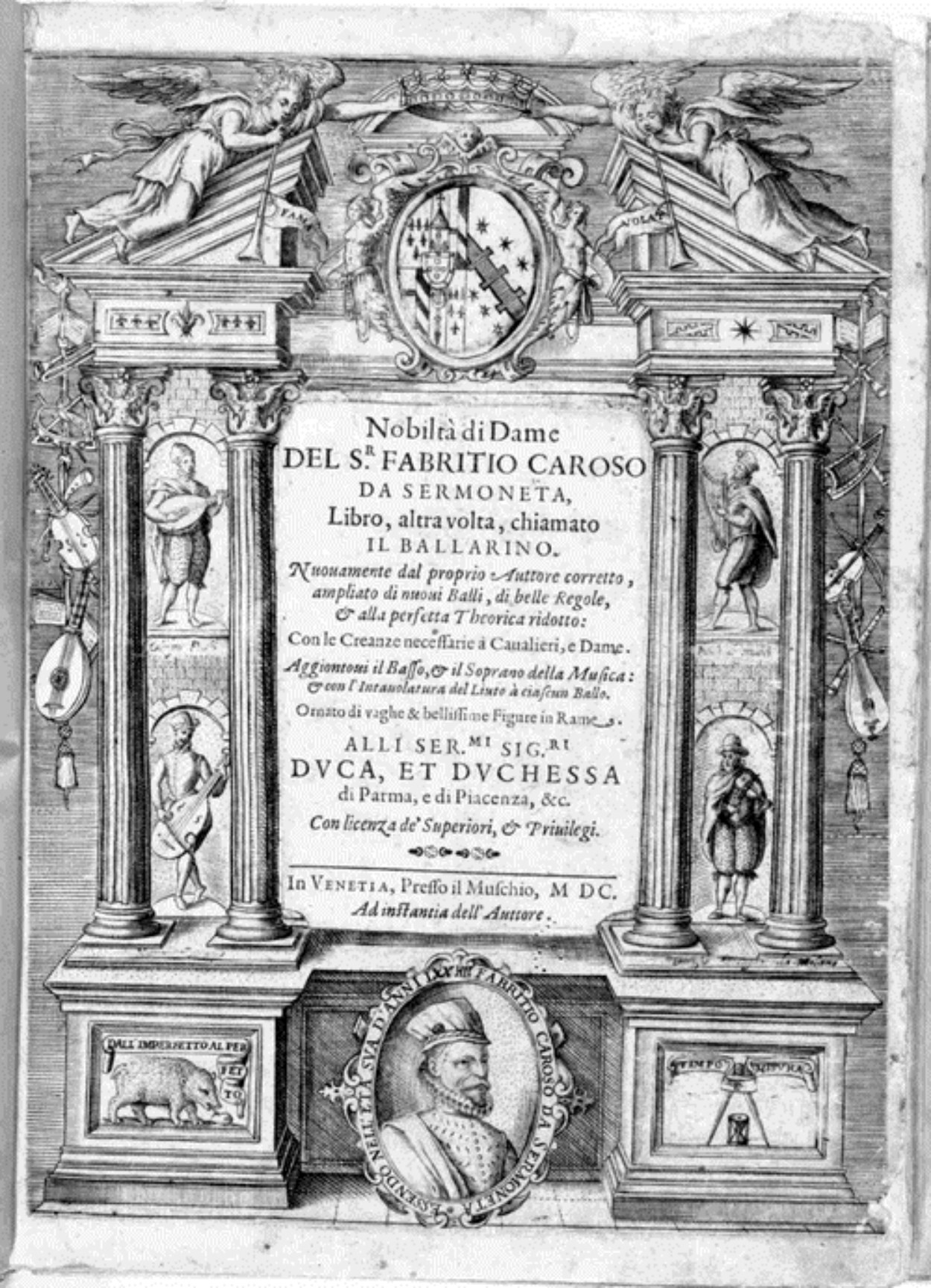
Caroso Nobiltà — Title Page (plate 2)
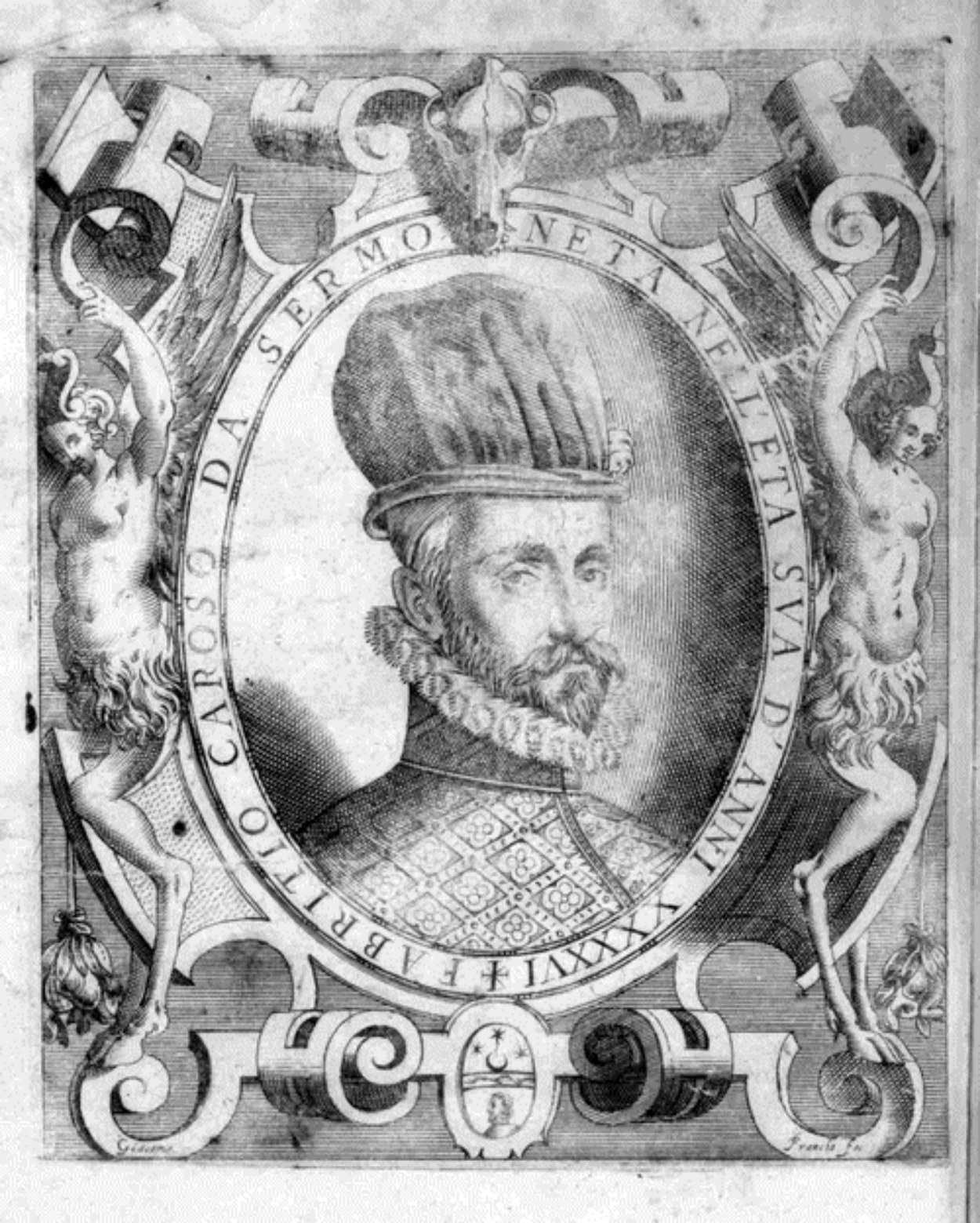
Fabritio Caroso da Sermoneta
- Medium:
- Woodcut
- Dance:
- Notation/Choreography
- Era:
- Pre-1700 (Renaissance/Baroque)
- Collection:
- Nobiltà di Dame (1600)
- Source:
- Library of Congress
- Rights:
- Public domain — free to use, share and adapt.
- Recorded as:
- Public Domain
This page directly documents the audience and aesthetic ideal of one of the Renaissance's most important dance manuals. For historians of Renaissance dance, court culture, and dress, it establishes the visual reality of how dancers of that period presented themselves—the weight and structure of their clothing, the formality of their bearing, and the connection between dance instruction and noble status. For art historians, it demonstrates the woodcut technique and the conventions of dedicatory portraiture in early modern printed books.
What you are looking at
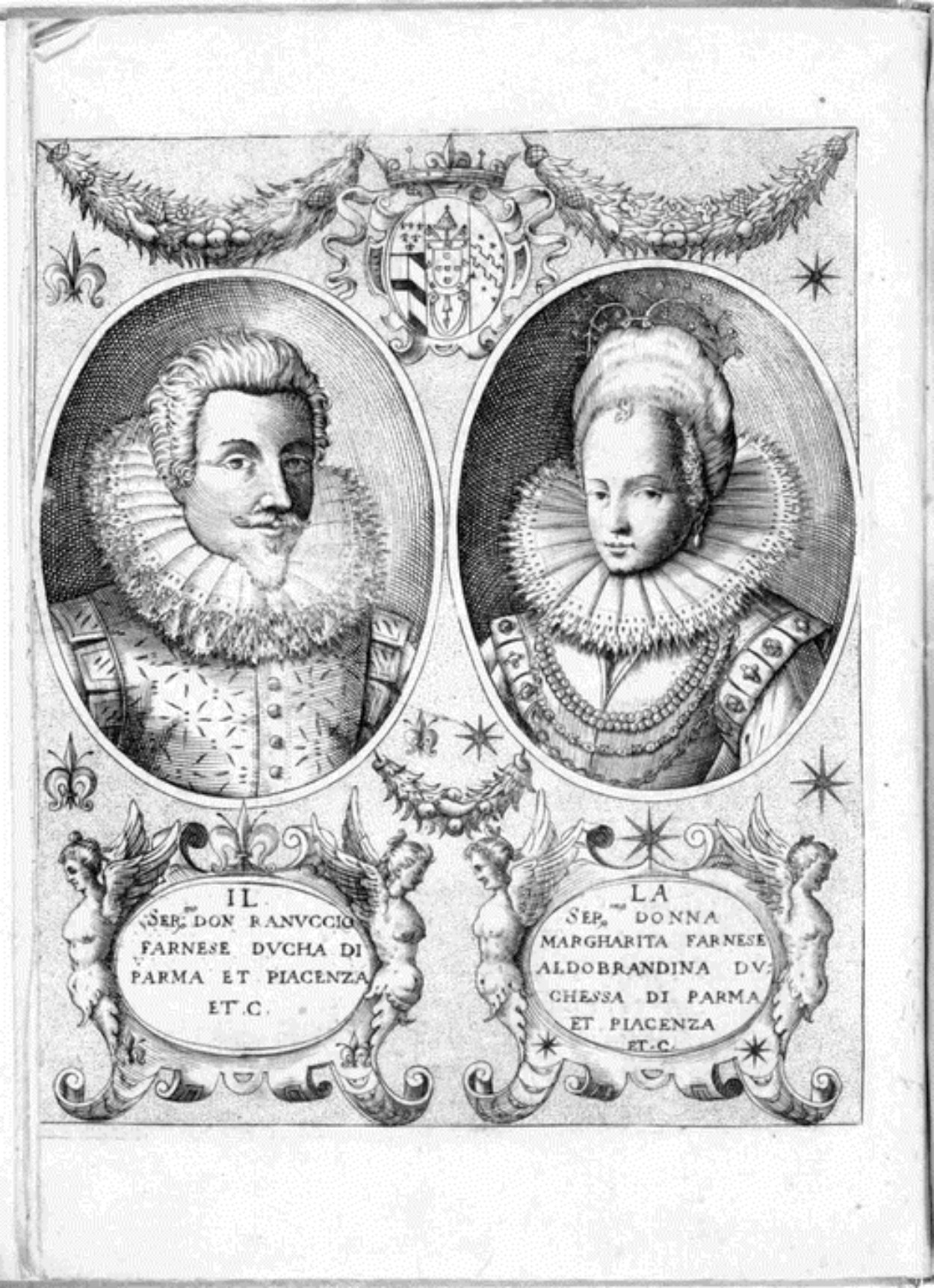
This is a formal double portrait engraving, presented as a title page or frontispiece. Two figures occupy oval frames set side by side, surrounded by elaborate decorative elements. On the left is a bearded man in rich court dress: a doublet densely embroidered or patterned, a high standing collar, and an enormous ruff of fine linen pleated into sharp, radiating folds that frames his face. On the right is a woman, her face delicate and composed, wearing a similar ruff of even greater volume and fineness, her hair arranged high on her head. Both figures are rendered in the formal three-quarter pose standard to Renaissance and early Baroque portraiture. Above the ovals hangs an ornate coat of arms or noble crest with scrollwork, and the space is decorated with classical flourishes—winged putti at the base, floral and architectural ornaments, and radiating stars. The style is characteristic of high-quality woodcut or engraving work of the early 17th century: fine cross-hatching defines the folds of fabric and the modeling of faces, and every surface—ruff, sleeves, jewels—is rendered with meticulous attention to texture and rank.
The dancing
Both figures are presented in the formal, static pose conventional to noble portraiture: upright, frontal, with hands positioned to display their dress rather than demonstrate action. The enormous ruffs frame both faces and dominate the composition, demonstrating wealth and fashionable status rather than freedom of movement. Neither figure's body suggests the flexibility or extension required for dance; the composition is heraldic and processional rather than kinetic. The dress itself—stiff, heavily ornamented, architecturally structured—is court wear designed for display in formal ceremonies and dances, but the moment captured is one of stasis and rank, not action.
The dance depicted
This is not a depiction of dance in action but rather a formal title-page portrait of two members of the nobility, presented as the dedicatee and perhaps the author or patron of Caroso's *Nobiltà di Dame*. The woman on the right is identified by the inscription below as Margareita Farnese, Duchess of Parma and Piacenza. The dress and deportment indicate that both figures are associated with the refined courtly culture in which the dance forms taught in *Nobiltà di Dame* were performed. The image establishes context and authority rather than demonstrating a specific dance or its execution. It serves as a title page, signaling the work's audience and its association with elite court culture.
How it was made
This is a woodcut, a relief-printing technique in which an image is carved into the surface of a wooden block, with inked areas standing in relief to receive ink. Woodcut allowed for broad distribution of images at relatively low cost, making it the standard medium for book illustration in the Renaissance and early Baroque. The technique is evident in the bold, clear outlines, the use of parallel lines and hatching to indicate shadow and texture, and the hierarchy of values that makes the portraits legible even at small size. The fine detail of the ruff and the modeling of the faces demonstrate the skill of the carver and the quality expected for a prestigious dedicatory work.
About this work
This is the title page of Fabritio Caroso's *Nobiltà di Dame* (Venice, 1600), an influential treatise on courtly dance. The engraving presents formal portraits of a noble woman and man in the dress of the Italian Renaissance court—specifically, the refined fashion of the late 16th and early 17th century. Rather than depicting dance itself, the work establishes the social and material context in which the dances taught in the book were performed: a world of hierarchy, wealth, and formal court ritual. The two figures embody the nobility and nobility of character (*nobiltà*) that the title promises. As a title page, this woodcut functioned both as an advertisement of the work's prestige and as a visual statement about the exclusive, courtly world the book addressed.
How to look at it
Observe the weight and structure of the dress, especially the ruff: the carver has rendered each pleat and fold individually, conveying the stiffness and volume of starched linen. Notice the stillness of the poses—they are heraldic and ceremonial, designed to display rank and costume rather than suggest motion. The coat of arms above and the ornamental framing assert the nobility of the figures. The inscriptions identify the woman as a duchess and anchor the image to a specific person and a specific dedication. The quality of the engraving—the fine hatching, the precision of the lines—signals that this is a prestigious, expensive book aimed at a cultivated, elite readership.
The artist
Fabritio Caroso da Sermoneta (c. 1526–after 1605) was a celebrated dance master and choreographer active in Rome and the Italian courts. He is known principally for two treatises: *Il Ballarino* (1581), which codified the dances, steps, and figures of the mid-16th-century Italian court, and *Nobiltà di Dame* (1600), a refined and expanded revision incorporating later developments in courtly dance. Caroso was not the engraver of this title page but rather the author and the dedicator of the work; the engraving was produced by a skilled professional printmaker working in Venice. Caroso's treatises are among the most complete records of Renaissance dance notation and choreography, and *Nobiltà di Dame* in particular is a primary source for understanding the dances, music, and social rituals of the late Renaissance Italian court.
The period
This work dates to 1600, at the threshold between the Renaissance and the Baroque, and at a moment of significant change in European court dance. The late 16th century saw the codification and refinement of a repertoire of dances—pavanes, galliards, branles, and others—that are documented in Caroso's earlier *Il Ballarino*. By 1600, courtly dance was becoming more elaborate, more closely integrated with music and spectacle, and more bound up with the emerging forms of court ballet (especially in France). The dress shown in this engraving—the enormous, meticulously starched ruff, the structured doublet and sleeves—reflects the aesthetic and material culture of the late Elizabethan and Jacobean courts. The care lavished on these garments indicates that display and movement were inseparable: clothing that constrained the body was a sign of rank and refinement, and the ability to move gracefully within such dress was a mark of courtly skill.
Where it lives
This woodcut is the title page of *Nobiltà di Dame*, Caroso's printed treatise published in Venice in 1600. The work is held in the Library of Congress and is one of the most important surviving documents of Renaissance court dance.
Dance in this work
Questions about this work
Why is the woman's ruff so enormous?
The ruff was the height of fashionable dress in the late 16th and early 17th centuries, especially in Italian and Northern European courts. It required meticulous starching and pleating and considerable expense in fine linen. The size of the ruff was a direct marker of wealth and status. For the wearer, large ruffs restricted neck and shoulder movement, but they also displayed the wearer's access to luxury goods and their ability to afford the labor required to maintain such garments. In courtly dance, one moved around and within these constraints rather than despite them.
Is this a picture of a dance?
No—this is a formal portrait, not a depiction of dancing bodies in action. It is the title page of a dance treatise and establishes the elite, courtly context in which the dances taught in the book were performed. The figures are posed formally, as was conventional in Renaissance portraiture. However, the dress and the setting tell us much about what Renaissance dancers wore and how they presented themselves.
Who was Margareita Farnese?
According to the inscription, she was the Duchess of Parma and Piacenza. The Farnese were one of the great noble families of Italy, and the duchy of Parma and Piacenza was one of the significant Italian states of the period. The dedication of Caroso's treatise to a woman of her rank indicates that women of the nobility were serious participants in courtly dance, and that Caroso's work was aimed at an elite, educated audience.
What does 'Nobiltà di Dame' mean?
'Nobiltà di Dame' translates as 'The Nobility of Women.' The title suggests that the book is about not only the dances themselves but also the refinement, grace, and nobility of character that a woman demonstrates through dancing. This was a central ideal of Renaissance courtesy literature and court culture: dance was understood as a practice through which one cultivated nobility not as a legal status but as a moral and aesthetic quality.
More Notation/Choreography artwork