49 works in this view — arrow keys or swipe to move between them.
Dance in Art
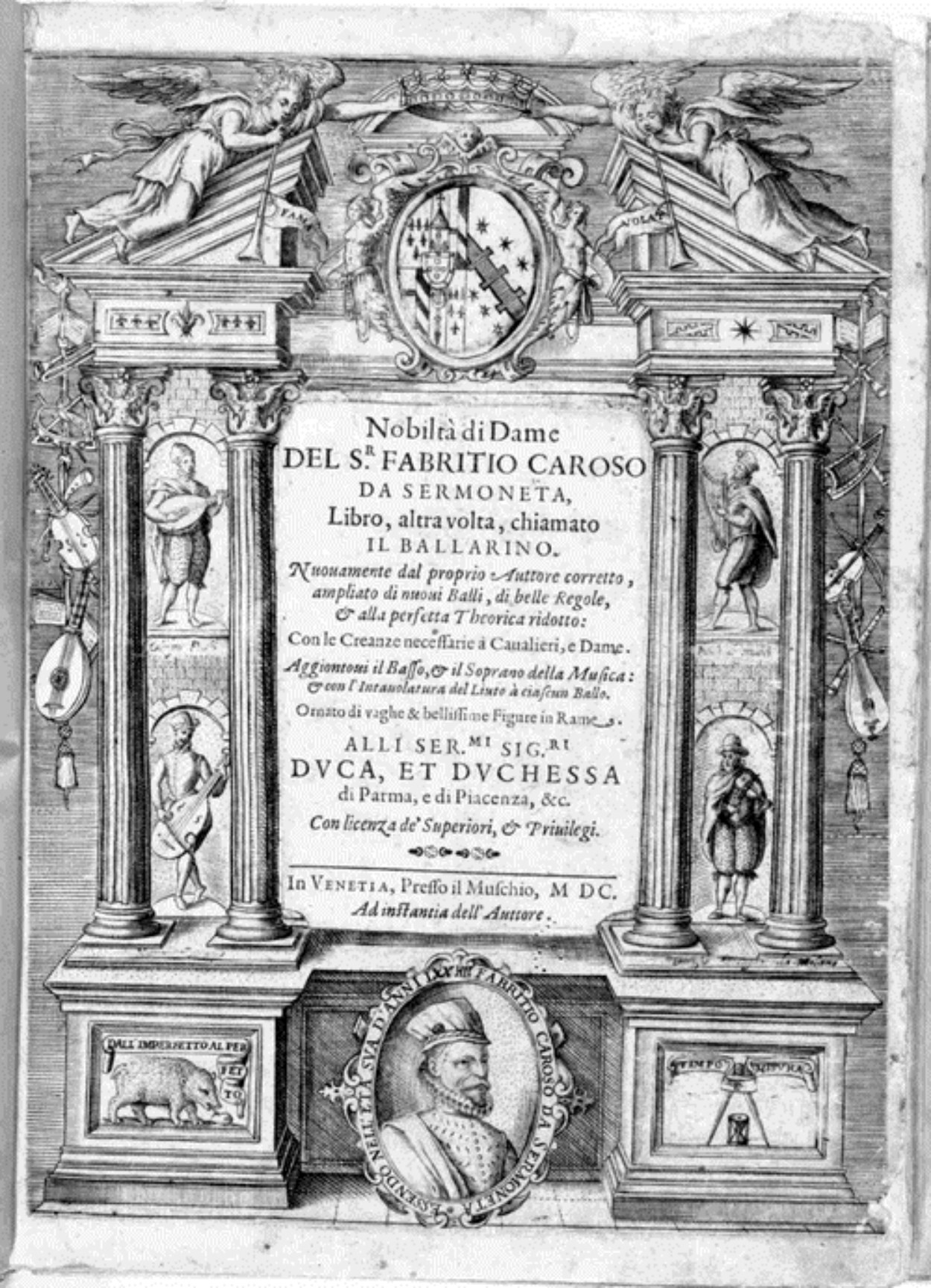
Caroso Nobiltà — Title Page (plate 1)
Fabritio Caroso da Sermoneta
- Medium:
- Woodcut
- Dance:
- Notation/Choreography
- Era:
- Pre-1700 (Renaissance/Baroque)
- Collection:
- Nobiltà di Dame (1600)
- Source:
- Library of Congress
- Rights:
- Public domain — free to use, share and adapt.
- Recorded as:
- Public Domain
Caroso's treatises are among the few primary sources that preserve the choreography and technique of Renaissance and early Baroque court dances in systematic, reproducible form. This title page is the gateway to that knowledge: it signals the work's ambition, scope, and social importance. For historians of dance notation, print culture, and courtly performance, it is a crucial artifact showing how dance knowledge was codified, packaged, and circulated in this period.
What you are looking at
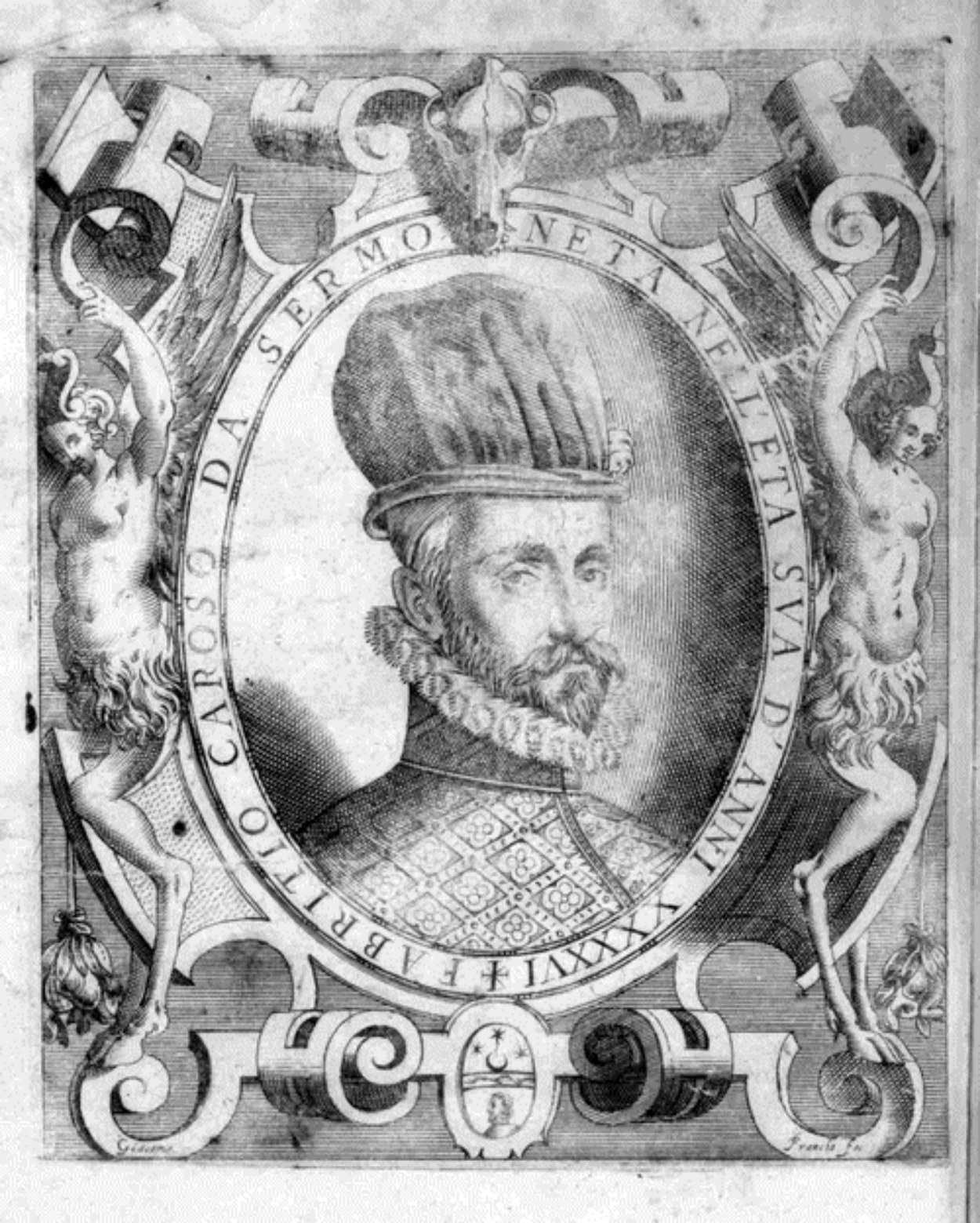
This is the ornate title page of Caroso's *Nobiltà di Dame* (1600), a woodcut engraving that frames a central text cartouche within an elaborate architectural and allegorical composition. Two Corinthian columns flank the central panel, their capitals supporting entablature decorated with scrollwork and heraldic emblems. Above, two winged putti (cherubs) recline on the cornices, their bodies extending diagonally outward in classical poses; between them hangs a heraldic shield bearing stars and crossed swords. The columns themselves are decorated with small classical figures—male and female—arranged vertically along their shafts in oval frames, suggesting the range of dancers and courtiers who would have studied from this manual. At the page's base sits a portrait medallion in profile, ringed with text, showing a bearded man in period dress. The composition employs the full visual apparatus of Renaissance print culture: symmetry, classical orders, allegorical ornament, and the fusion of text and image to signal authority and refinement.
The dancing
The putti frame the composition with their bodies in contrapposto, one leaning leftward, one rightward, their weight distributed across hip and shoulder in the classical manner. The standing figures along the columns maintain upright, formal postures—some in profile, some frontal—with arms at rest or held in poses suggesting courtly decorum. Their dress indicates the Renaissance Italian court: fitted doublets on the men, fitted gowns and elaborate headdresses on the women. No active dance position is depicted, but the arrangement of multiple figures suggests the variety of roles (knights, dames, gentlemen, pages) who would participate in court dances.
The dance depicted
This is not a depiction of a dance in progress, but rather the framing apparatus for a choreographic treatise. Caroso's *Nobiltà di Dame* (1600) was a revised and expanded edition of his earlier *Il Ballarino* (1581), containing detailed instructions—likely with accompanying diagrams—for the dances fashionable in Italian courts at the turn of the seventeenth century. The title page signals the work's scope through its visual abundance: the multiple figures suggest the social range of dancers; the heraldic imagery and courtly dress indicate that these were dances of the nobility; the classical orders and allegorical refinement claim a place for dance within humanist culture. The portrait at the base (likely Caroso himself) establishes authorship and authority. The dances within would have included Renaissance forms such as the galliard, pavane, and volta, performed by couples and small groups in the formal settings of Italian aristocratic life.
How it was made
This is a woodcut, a relief printing technique in which an image is carved into the surface of a wooden block, with ink applied to the raised portions. The technique allows for bold, clear lines and strong contrasts of black and white, which the artist has exploited to create sharp definition in the architectural elements, the heraldic details, and the figures. Woodcut was the primary method for illustrating printed books in this period, and its relatively low cost compared to copperplate engraving meant that illustrated treatises could reach a broader audience than luxury hand-illuminated manuscripts. The precision of the architectural framing and the fineness of the figure work suggest a skilled practitioner. As the title page of a printed book, this image would have been seen by every owner or reader of the treatise, making it a crucial form of visual communication about the work's content, authority, and intended audience.
About this work
This is the title page of Fabritio Caroso da Sermoneta's *Nobiltà di Dame* (Venice, 1600), one of the most important dance treatises of the Renaissance and early Baroque periods. It is a woodcut engraving that combines classical architectural forms, allegorical figures, and heraldic imagery to frame the work's title and dedication. The page does not show a dance in action, but rather uses visual rhetoric—the ornament, the variety of figures, the profile portrait—to establish the treatise's authority, its grounding in courtly culture and classical learning, and its comprehensiveness. For dancers and dance historians, this page is essential evidence of how dance was understood and transmitted in the Renaissance court: as a refined art form worthy of written instruction, worthy of print, and worthy of the full visual apparatus of humanist book culture.
How to look at it
Attend first to the architectural framing: the classical columns and entablature establish the work's claim to humanist refinement and authority. Then examine the figures along the columns—their formal postures, courtly dress, and variety of types (male, female, young, old, noble, servant) suggest the social hierarchy and gender dynamics of court dance. Note the heraldic shield at the top: it signals the work's dedication to a noble patron (likely Christine of Lorraine, as the record indicates). Finally, look at the portrait medallion at the base: this personalization establishes Caroso as the authority behind the text and technique. The title page is designed to convince the reader that this is a comprehensive, authoritative, and refined guide to courtly dance.
The artist
Fabritio Caroso da Sermoneta (c. 1535–after 1605) was a celebrated dancing master of the Italian Renaissance, known for his two major treatises on courtly dance: *Il Ballarino* (1581) and *Nobiltà di Dame* (1600). Both works combined detailed written instructions with woodcut illustrations to teach the steps, timing, and social protocols of court dances. Caroso was part of a tradition of Renaissance dancing masters—including Guglielmo Ebreo and Thoinot Arbeau—who sought to systematize and elevate dance through print and humanist learning. His works were widely circulated and influential across European courts, making him one of the most important codifiers of Renaissance choreography.
The period
The turn of the seventeenth century saw a shift in Italian court culture: the energetic, athletic galliard and volta were giving way to slower, more formal dances such as the pavane and courante. Caroso's revision of his 1581 treatise reflected these changes, incorporating new dances and modified technique while retaining the foundational Renaissance forms. In the broader context of print culture, the early seventeenth century was a moment of consolidation, when practical knowledge—including dance—was being systematized, illustrated, and circulated through the printing press. The elaborate title page reflects the conventions of humanist book design, with classical orders, allegorical figures, and heraldic imagery signaling the work's cultural authority and intellectual ambition.
Where it lives
This woodcut is the title page (plate 1) from *Nobiltà di Dame*, published in Venice in 1600 by Francesco Ziletti (as indicated by the colophon). The work was the first major revision and expansion of Caroso's earlier *Il Ballarino* (1581). Multiple copies of the 1600 edition survive in libraries and archives across Europe and North America, making it widely accessible. This particular image comes from the Library of Congress holding.
Dance in this work
Questions about this work
Did Caroso invent these dances or just document them?
Caroso was both documenting existing court dances and actively shaping their practice through his treatises. As a dancing master employed by Italian courts, he taught these dances to the nobility; his written treatises then codified and standardized them for circulation and transmission. His revisions between the 1581 and 1600 editions reflect changes in actual court practice over those two decades.
How were these dances learned before printed treatises?
Before the advent of printed dance manuals in the late fifteenth century, dances were learned through direct instruction from a dancing master, by observation and imitation, and through oral transmission. Caroso's treatises represent a revolution in dance pedagogy: they made choreographic knowledge portable, reproducible, and teachable without the presence of a master.
What is the difference between the 1581 and 1600 editions?
The 1600 *Nobiltà di Dame* is a revised and expanded edition of the 1581 *Il Ballarino*. It contains new dances, revised technique reflecting changes in court practice, expanded written descriptions, and is dedicated to Christine of Lorraine rather than Catherine de' Medici. Both editions contain choreographed dances with music, making them among the most specific sources for Renaissance court dance.
Could people learn these dances just from reading the book?
Probably not without already having some training. Caroso's descriptions are detailed and systematic, but they assume readers understand basic courtly movement, hold, and deportment. The treatises were most useful as supplements to or reminders of instruction received from a dancing master, or as references for people already versed in court dance conventions.
More Notation/Choreography artwork