49 works in this view — arrow keys or swipe to move between them.
Dance in Art
Combat/Duel — Plate 29
Gregorio Lambranzi
- Medium:
- Copper-plate engraving
- Dance:
- Notation/Choreography
- Era:
- 1700s (Enlightenment/Minuet Era)
- Collection:
- Nuova e curiosa scuola de' balli theatrali (1716)
- Source:
- Library of Congress
- Rights:
- Public domain — free to use, share and adapt.
- Recorded as:
- Public Domain
For historians of dance and stage combat, this engraving is rare primary evidence of how martial action was choreographed and notated before video or film. For performers, it shows a working example of how notation and image together could convey complex, dynamic movement to a skilled reader. The image also reveals the social and theatrical context of male dance in the early 18th century—combat dances were not marginal but central to the repertory, and they required the kind of training and precision that we now associate with ballet.
What you are looking at
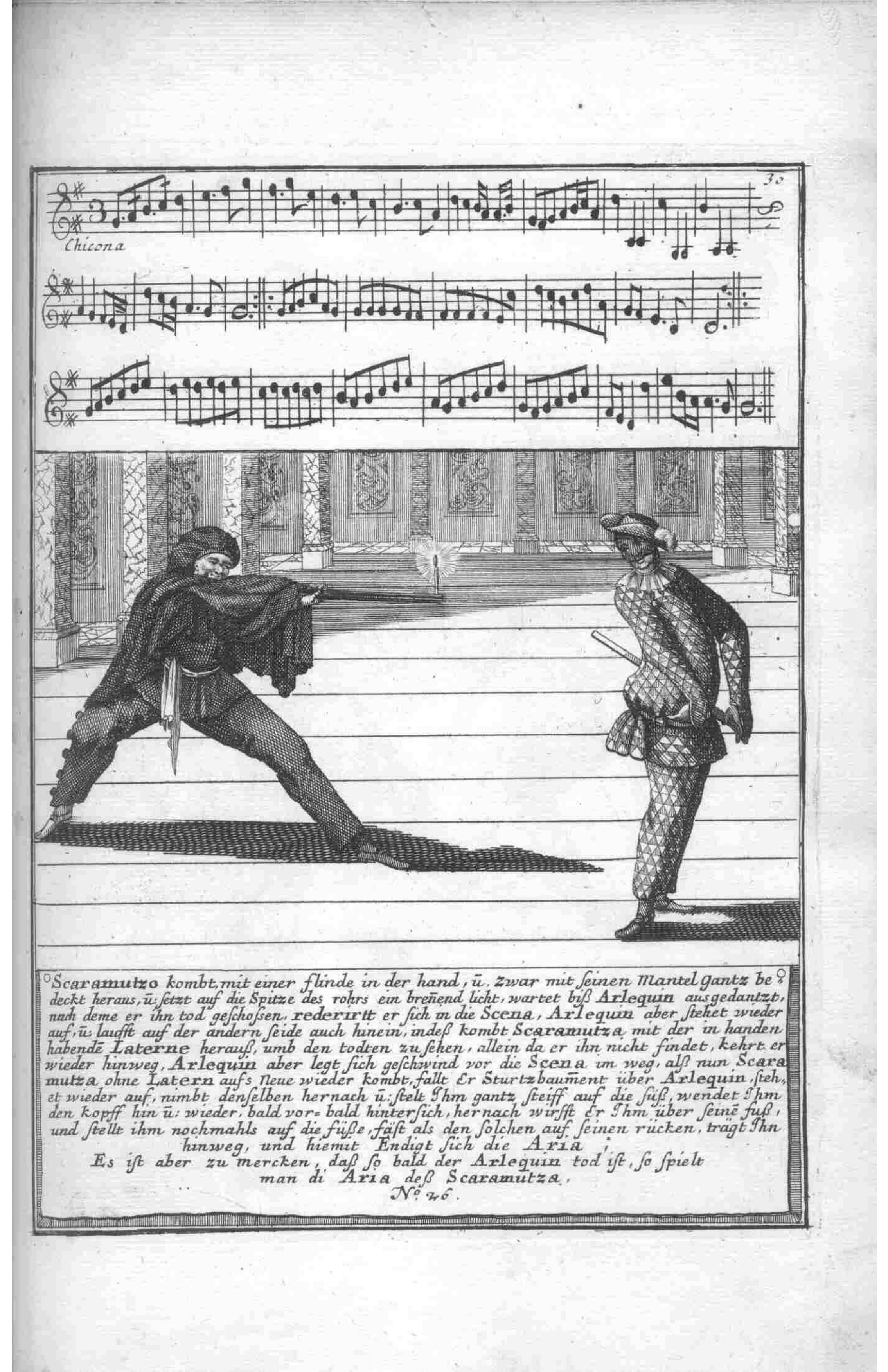
A theatrical duel unfolds on a bare wooden stage framed by ornate curtains and gilt pilasters. Two male dancers face each other in combat stance, each armed with a sword. The figure on the left wears a dark coat with deep folds and extends his sword-arm in a lunge; the figure on the right stands in a contrasting diamond-patterned costume and assumes a defensive posture. The stage space is shallow and frontal, emphasizing the geometric opposition of the two bodies. Above the scene, three staves of notated music provide the accompaniment for this martial choreography.
The dancing
Both figures stand in a fencing posture with legs bent and weight forward, arms extended toward each other with swords raised. The left dancer leans into an aggressive lunge with his torso twisted, while the right dancer pulls back slightly, creating a moment of dramatic tension between attack and defense. Neither figure displays the symmetry or formality of ballroom partnering; instead, the two bodies are locked in opposed diagonal lines that suggest combat vocabulary translated into dance. The asymmetry of their costumes—one dark and plain, one patterned—heightens the contrast between aggressor and defender.
The dance depicted
This is a *battaglia* or combat dance, a theatrical genre in which fencing movements and martial action were choreographed as an extended dance piece. Combat dances were central to the Italian and German theatrical repertory of the 17th and 18th centuries, performed by male dancers in court theaters and public stages. The notation and costuming here suggest a trained, codified movement vocabulary: swordplay was not improvised but learned and repeated from a score. This example shows the genre at a moment of climactic action—the freeze captures one phase of a choreographed duel, designed for dramatic effect within a larger theatrical work.
How it was made
This is a copper-plate engraving, a technique that allowed fine linear detail and wide circulation in printed form. The engraved line defines anatomy, textile texture, and spatial depth with precision. Lambranzi's use of engraving meant his choreographies could be distributed to theaters across Europe as printed manuals; a performer could study the image and the notation together and learn the step. The technique was labor-intensive but economical for mass production, and it remained the standard for dance documentation through the 18th century.
About this work
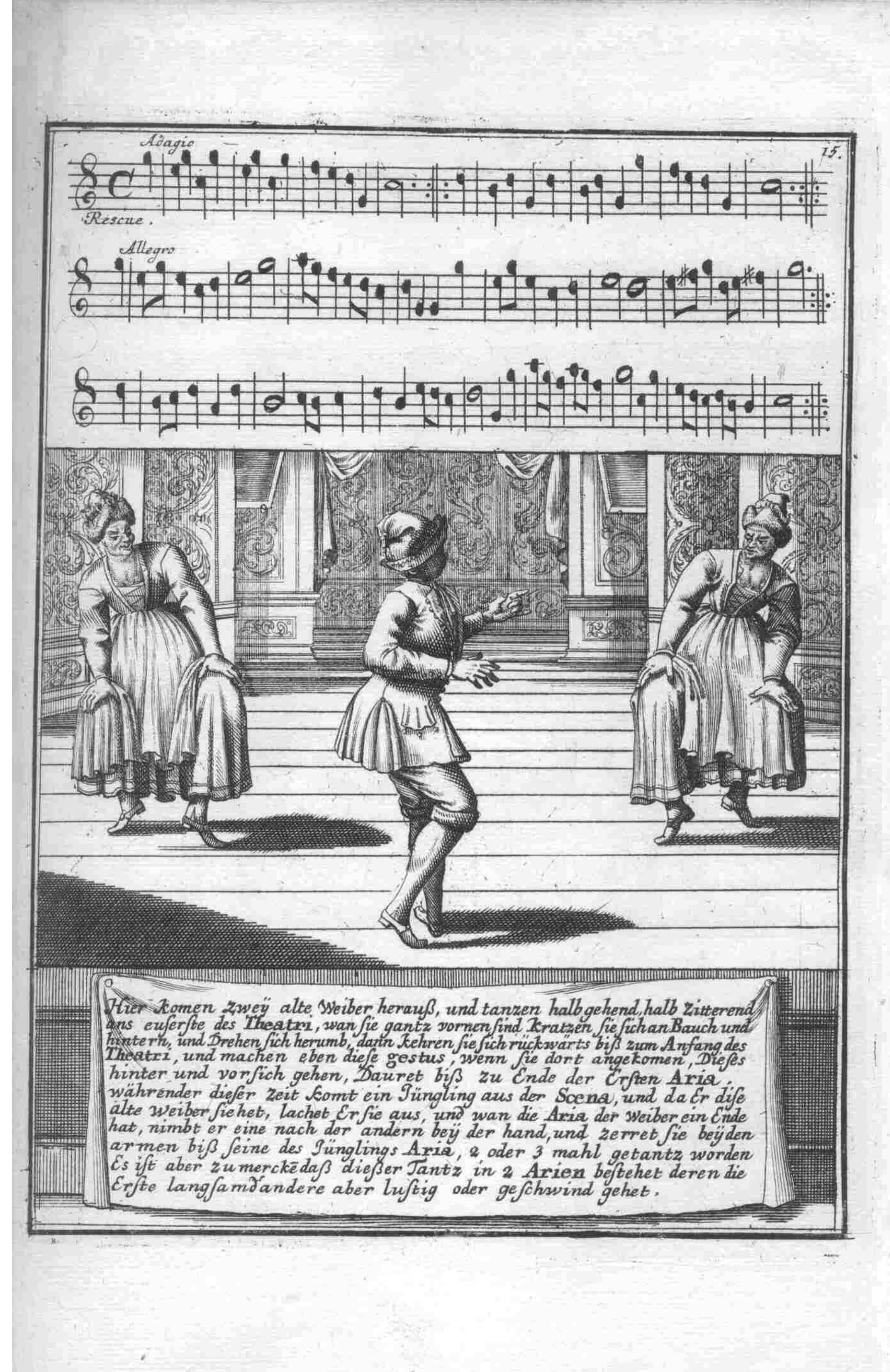
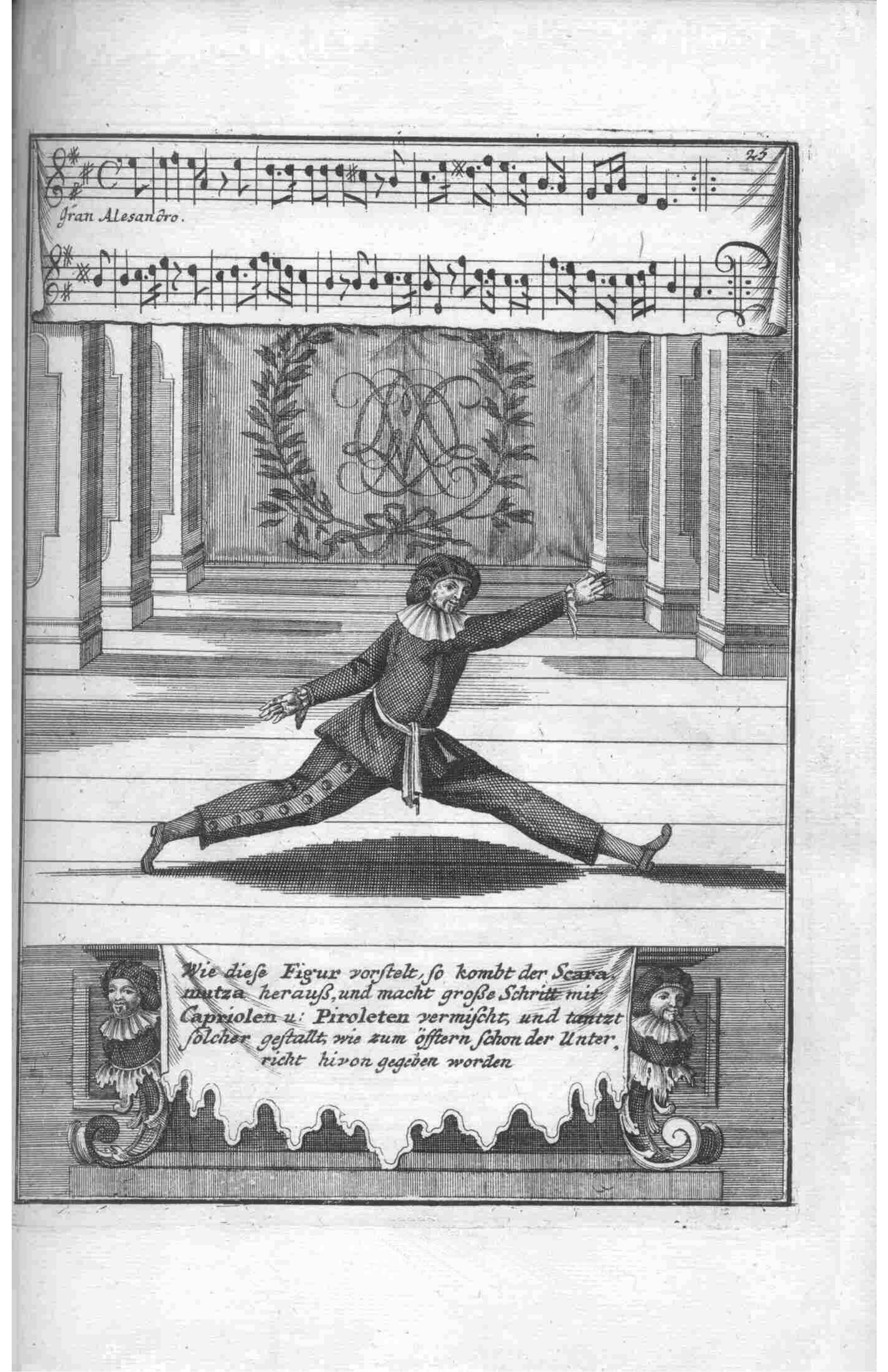
Plate 29 from Gregorio Lambranzi's *Nuova e curiosa scuola de' balli theatrali* (1716) documents a choreographed combat dance, one of the standard theatrical entertainments of the early 18th-century stage. The engraving pairs a notated musical score with a detailed image of two costumed male dancers in the moment of a sword duel, arranged on a formal stage with architectural framing. Lambranzi's manual is one of the most comprehensive surviving documents of theatrical dance practice in this period, and this plate exemplifies his method: combining notation, image, and brief textual description to preserve and transmit dance knowledge. The work belongs to a tradition of printed choreographic manuals that made dance repertory portable and teachable across borders.
How to look at it
Focus on the pose: this is a snapshot of a dynamic phrase, with the left dancer's lunge and the right dancer's withdrawal creating a moment of maximum dramatic tension. The engraver has chosen to show the movement at its point of greatest clarity and opposition rather than at rest. Notice how the notation at the top of the plate is meant to be read alongside the image—a performer would use both together to reconstruct the phrase. The formality of the stage setting (the geometric curtains and pilasters) frames the action as theatrical rather than functional combat, emphasizing that this is a dance about swordplay, not actual dueling.
The artist
Gregorio Lambranzi (c. 1665–c. 1725) was a dance master and choreographer active in Nuremberg and other German courts. He is known almost entirely through this one publication, *Nuova e curiosa scuola de' balli theatrali*, which he compiled and had engraved in two parts (1716 and 1728). The manual contains 77 plates depicting character dances, pantomimes, comic scenes, and martial pieces, each paired with music notation and brief descriptions. Lambranzi's method was to combine visual documentation with written text and notation—a comprehensive approach that made his manual influential in training theatrical dancers across German-speaking Europe. His work represents a moment when dance began to be systematically recorded and published as teachable technique rather than improvised court entertainment.
The period
The early 18th century saw the codification and publication of stage dance techniques across Europe. Choreographic notation systems were being developed (notably Beauchamp-Feuillet notation, used for courtly dances); simultaneously, theatrical dance was establishing itself as a distinct vocabulary separate from social court dances. Combat dances and pantomime were prestigious genres, drawing on fencing mastery and dramatic training. Lambranzi's manual appeared at a moment when the divide between ballet and theatrical pantomime was still fluid, and when a single trained dancer might perform minuets, character dances, and sword fights in a single evening's entertainment. The culture of printed instruction—dance manuals for amateurs, engraved steps for professionals—was expanding rapidly in this period.
Where it lives
This plate is drawn from Lambranzi's *Nuova e curiosa scuola de' balli theatrali*, a printed manual of theatrical dances published in Nuremberg in 1716 (with a second part following in 1728). The Library of Congress holds a copy. Each plate in the manual combines a notated score, a theatrical scene, and a descriptive text in German, making it a hybrid instructional and artistic work.
Dance in this work
Questions about this work
What is a combat dance or battaglia?
A combat dance is a theatrical choreography based on fencing, sword-play, or martial action, performed by trained dancers as part of a larger entertainment. Unlike actual combat, it follows a learned, repeatable sequence of movements synchronized to music. Combat dances were especially popular in Italian and German theater of the 17th–18th centuries, and they required the dancer to have both dance training and sword skill.
What is Lambranzi's manual used for?
The *Nuova e curiosa scuola de' balli theatrali* was a practical guide for theatrical performers, compiled to teach and preserve dance choreographies. Teachers and dancers could buy or consult a printed copy and use the notation and images to learn steps. It circulated across German-speaking Europe and was influential in training theatrical dancers in the 18th century.
How do you read the notation at the top?
The notation at the top uses a system related to Beauchamp-Feuillet notation, the standard system for recording courtly and theatrical dances of this period. The staves show the melody and rhythm; a trained dancer would recognize step-names and positions from the visual symbols. However, the full system required textual explanation, which Lambranzi provides in the German text below each plate.
Who performed these dances?
Theatrical dances like combat pieces were performed by professional male dancers in courts, public theaters, and traveling companies. They were an important part of the repertory in German and Italian theater. Women also performed theatrical dances during this period, but combat pieces were predominantly a male specialty due to the physical demands and the social associations of armed performance.
More Notation/Choreography artwork