49 works in this view — arrow keys or swipe to move between them.
Dance in Art
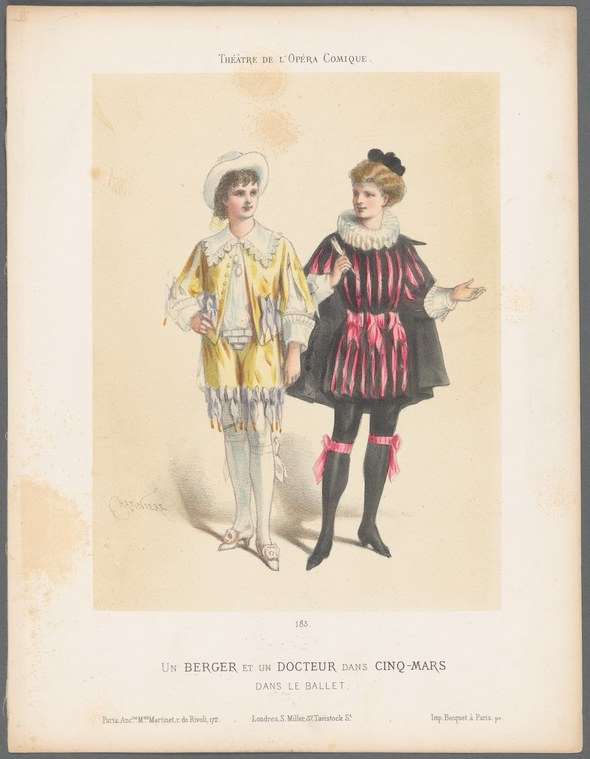
Un berger et un docteur dans Cinq-Mars dans le ballet
Unknown artist
- Collection:
- Prints depicting dance
- Source:
- New York Public Library
- Rights:
- Public domain — free to use, share and adapt.
- Recorded as:
- Public Domain
This print is direct evidence of how court ballet characters were conceived, dressed, and presented to audiences in the early 17th century. For dancers and costume historians, it documents the visual language of court spectacle and the adaptation of commedia dell'arte stock types into aristocratic entertainment.
What you are looking at
Two young male dancers stand together against a plain ochre background in this hand-colored engraving. The figure on the left wears a golden yellow tunic with white undergarments, soft hose, and a white cap—a costume that evokes Renaissance pageantry or commedia dell'arte. His right arm is raised and bent, the left hangs at his side in a relaxed stance. The figure on the right is dressed in a burgundy doublet with bold vertical pink or red stripes, black hose, and a large white ruffled collar typical of early 17th-century court dress. He faces the viewer with his right arm extended outward in a gesture of presentation or invitation, his posture more animated and engaging. Both figures have pale, idealized features and are rendered with careful attention to the texture and fold of their fabrics. The composition is frontal and balanced, presenting the two characters as theatrical types rather than in active narrative or physical interaction.
The dancing
Both dancers are depicted in static, posed positions rather than in the midst of movement. The figure on the left maintains a relaxed, almost observant stance with minimal arm articulation. The figure on the right adopts a more theatrical presentation posture, with his extended right arm suggesting direct address to an audience. Neither figure displays the turned-out legs, pointed feet, or elevated positions associated with ballet technique. Their relationship is lateral and parallel rather than coupled or interactive; they stand as distinct character types presented for view.
The dance depicted
These figures are identified by the inscription as a shepherd and a doctor from the ballet-pantomime 'Cinq-Mars.' The work is associated with early 17th-century French court spectacle, a period when ballet was narrative and allegorical, performed by aristocratic amateurs in elaborate costume. The dress, posture, and presentation here suggest commedia dell'arte characters adapted into court entertainment—stock types common to early ballet de cour. No specific footwork or balletic vocabulary is evident; instead, the image emphasizes costume, character, and social station.
How it was made
This is a hand-colored engraving, a technique that allowed for fine linear detail in the figures and careful rendering of costume. The artist has used color selectively—the yellow tunic, burgundy doublet, pink ribbons, and white elements stand out against the neutral background—to convey the specific identity and status of each character. The engraving technique was ideal for theatrical documentation: prints like this circulated among court patrons, artists, and dancers, serving as a record of costume design and character types for court spectacles.
About this work
This engraving documents two character types from a 17th-century French court ballet, presenting them as static costume studies rather than dancers in motion. The 'Cinq-Mars' ballet was part of the elaborate spectacle culture of early modern European courts, where dance, music, and elaborate costume combined to create allegorical and narrative entertainments. The image preserves the visual vocabulary of court ballet at a moment when the form was transitional—still narrative and commedia dell'arte–inflected, not yet the technical, abstract, and increasingly professionalized practice ballet would become. As costume and character documentation, the print reveals how identity, social role, and theatrical convention were inscribed in dress and pose during the period.
How to look at it
Observe how the artist has frozen each figure in a distinct pose rather than a moment of movement: the shepherd appears contemplative, the doctor actively engaging. The engraving emphasizes costume detail—the precision of the stripes, the ruffled collar, the cap—because in court spectacle, dress communicated character and rank as much as movement did. The plain background isolates the figures as types to be studied, not as dancers moving through space.
The artist
The artist is not recorded in the catalogue. The engraving's style, composition, and subject matter are consistent with theatrical documentation prints produced in Paris in the early-to-mid 17th century, likely by a professional engraver working from sketches or designs by a ballet master or court artist.
The period
This work dates to the flourishing of the ballet de cour in France, a form that dominated courtly entertainment from the 1580s through the mid-17th century. These spectacles combined dance, music, poetry, and visual spectacle; they were performed by nobles and court members, not professional dancers. The period saw the gradual formalization of ballet vocabulary and the influence of Italian dance masters, but narrative content, allegorical meaning, and elaborate costume remained central. Prints like this circulated as documentation and souvenirs of celebrated performances, allowing the court's visual culture to spread beyond the immediate audience.
Where it lives
This print is held in the New York Public Library's collection of prints depicting dance. It is part of a larger body of theatrical documentation prints that survive from early modern European court culture, serving as visual records of now-lost spectacles.
Dance in this work
Questions about this work
What was 'Cinq-Mars' and when was it performed?
'Cinq-Mars' was a ballet de cour, likely performed in the 17th century at the French royal court or a major noble household. The exact date is not recorded, but the costume style and engraving technique suggest the mid-17th century or earlier. Ballet de cour was an aristocratic spectacle combining dance, music, and elaborate costume to tell allegorical or narrative stories.
Why are these two characters a shepherd and a doctor?
In court spectacle, characters represented social types and allegorical concepts. The shepherd and the doctor would have had specific symbolic meanings within the narrative or moral framework of the full ballet—possibly contrasting wisdom, folly, health, or social station. Without the full scenario or libretto, their specific dramatic function remains unclear.
Is this dancers in ballet, or actors in costume?
Both and neither. In the ballet de cour, trained amateurs and nobles danced, but the emphasis was on spectacle, costume, and narrative rather than on developed balletic technique. These figures are shown as theatrical characters first, dancers second—their poses are presentational rather than technically balletic.
Who created this print?
The artist is not identified in the catalogue record. The print was likely created by a professional engraver working in Paris, possibly from a costume design or sketch by a court artist or ballet master involved in the original spectacle.
More dance artwork





