25 works in this view — arrow keys or swipe to move between them.
Dance in Art
Minuet la cour
Unknown artist
- Medium:
- Engraving
- Dance:
- Minuet
- Era:
- 1700s (Enlightenment/Minuet Era)
- Source:
- New York Public Library
- Rights:
- Public domain — free to use, share and adapt.
- Recorded as:
- public_domain
The minuet de cour was the most internationally influential courtly dance form of the 17th and 18th centuries, taught to every European noble. This engraving is one of the few images to clearly depict the formal opening reverence, the crucial moment through which dancers signaled intent and respect. For historians and dancers, it is a rare visual record of how the body was positioned and presented in the highest court contexts.
What you are looking at
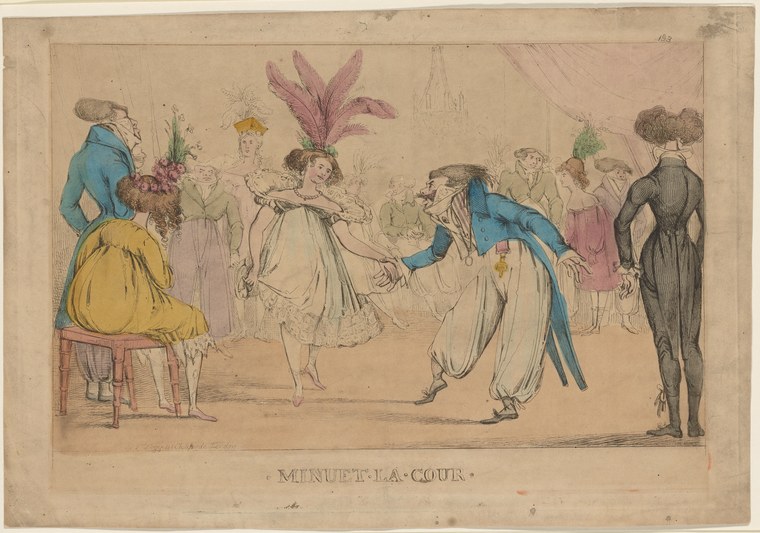
An engraving depicts a formal court dance scene set in an interior space with architectural elements visible in the background. At center, a man in a blue coat with white breeches bows deeply toward a woman in an elaborate white dress with a tall feathered headdress, while a second woman in yellow with a pink underskirt sits to the left observing. Multiple onlookers in fashionable dress line the background—men in dark coats and breeches, women in gowns of varied colors. The composition is shallow and frieze-like, with figures arranged across the width of the print rather than receding into depth. Light is distributed evenly across the scene; the engraver has used fine parallel lines to create tone and texture, with the darkest accents on the men's coats and the lightest areas on the women's skirts and the seated woman's yellow dress.
The dancing
The central male dancer is captured mid-reverence, his torso bent sharply forward with one leg extended behind and arms positioned with studied formality—the classic opening or closing gesture of a minuet de cour. The woman he addresses stands upright with one hand extended toward him in a receptive gesture. The composition emphasizes the geometric precision and bilateral symmetry expected of the dance: the man's bow and the woman's stance are mirror-formal rather than intimate. Onlookers are scattered in small groups, their bodies relaxed and angled toward the dancers, indicating they are witnessing rather than participating in this particular moment.
The dance depicted
This is a minuet de cour, the most prestigious social dance of the 18th-century European court. The engraving captures the opening reverence—the deep, ceremonious bow with which a gentleman solicited a partner for the dance. The minuet was not a couple-dance in the modern sense but a solo statement of elegance and breeding, performed in the presence of an assembled court: the dancer demonstrated control of the body, precision of footwork (though feet are not clearly visible here), and command of the elaborate rules of approach and address. This image is documentary evidence of court protocol as much as of dance technique; the stillness and formality of the pose, the careful distance between partners, and the attentive silence of the onlookers all underline that the minuet was a ritual of courtship and social hierarchy performed for an audience.
How it was made
This is an engraving, a print made by incising lines into a metal plate (likely copper), inking the plate, and transferring the image to paper under pressure. The artist has employed fine parallel lines (hatching and cross-hatching) to suggest volume, fabric texture, and spatial recession. The clarity and precision of the engraved line allowed for wide circulation and reproduction—this was a medium for documents, satire, instruction, and entertainment. The title inscription at the base ('MINUET LA COUR') indicates this was a print intended to be labeled and sold as a reference image or souvenir of court practice, likely aimed at a middle-class or provincial audience learning the conventions of fashionable dancing.
About this work
This is an engraved document of the minuet de cour, the signature dance of the 18th-century ancien régime. The print freezes the moment of the reverence—the formal, choreographed bow through which a gentleman initiated the dance, demonstrating respect, breeding, and control. It belongs in a dance history because it records not just a movement but an entire social ritual: the minuet was inseparable from court hierarchy, courtship ceremony, and the rules of public conduct among the aristocracy. The engraving's documentary clarity—the labeled title, the assembled witnesses, the precision of the pose—suggests it was made to teach, to record, or to memorialize a practice that was already becoming consciously 'classical' in the 18th century. The work is evidence of how dance was understood as a discipline of the body that demonstrated character and rank.
How to look at it
Attend to the posture and distance between the two central figures. The man's deep bow is not a casual gesture but a formal petition—his body is nearly horizontal, and his gesture is answered by the woman's upright receptivity. Notice how the other figures in the room do not dance but watch: the minuet was as much performance for an audience as personal expression. The precision of the engraved line itself—each garment rendered with exact parallel strokes—mirrors the precision required of the dancers themselves. Finally, note the elevation of the scene: this is a court or grand hall, not a tavern or street, and every element of dress, posture, and setting reinforces that this is a dance of and for the aristocracy.
The period
The minuet de cour flourished in France under Louis XIV and spread throughout Europe, remaining a mark of gentility well into the 18th century. By the 1700s—the era of this print—the minuet was becoming somewhat conservative and formalized: it remained the opening dance at balls and state occasions, but newer, livelier dances (the contredanse, cotillion, and country dances) were gaining popularity. Prints and treatises on dance multiplied in this period as dancing masters and engravers sought to capture and teach the movements of courtly practice. This engraving sits at the intersection of documentary impulse and nostalgia: it records the minuet at a moment when it was still dominant but increasingly understood as a historical form requiring instruction and preservation.
Where it lives
The work is held in the New York Public Library collection. It is cataloged as an engraving from the 1700s but lacks attribution to a named artist or engraver. The title is inscribed in the plate itself, suggesting it was a commercial or instructional print rather than a unique work.
Dance in this work
Questions about this work
What is a minuet de cour?
The minuet de cour was the principal court dance of 17th- and 18th-century Europe, performed by nobles to demonstrate grace, breeding, and control. It was danced by individuals or couples in turn before an assembled court, and the opening gesture—shown here—was a formal bow or reverence through which a man invited a woman to dance. The dance itself involved slow, dignified steps and a great deal of protocol.
Why are there so many people standing around?
The minuet was a courtly ceremony as much as a dance. The assembled onlookers—family, courtiers, rivals—watched the dancers as a form of entertainment and social observation. The behavior and elegance of the dancers reflected on their rank and character, so the minuet was a public performance, not a private activity.
Could anyone dance the minuet?
No. The minuet was strictly a dance of the aristocracy and wealthy bourgeoisie. To dance it well required years of instruction from a dancing master. The precision, formal bearing, and knowledge of court etiquette required to execute the steps and gestures marked the minuet as a sign of rank and education.
Is the woman's headdress really necessary for dancing?
Yes, in the aristocratic context. Women wore elaborate headdresses, heavy skirts, and restrictive corsetry as part of their formal dress. The minuet was designed to be danced in these garments—the small steps, upright posture, and restrained arm movements accommodated the constraints of the costume while showcasing the dancer's ability to move gracefully despite them.
More Minuet artwork