49 works in this view — arrow keys or swipe to move between them.
Dance in Art
Le bal
Unknown artist
- Collection:
- Prints depicting dance
- Source:
- New York Public Library
- Rights:
- Public domain — free to use, share and adapt.
- Recorded as:
- Public Domain
This print documents how early-19th-century Europeans visualized dance and desire, using movement to encode allegory and exoticism. It shows that dance was not simply an elite courtly practice but a subject of popular visual culture, circulated in prints for public consumption. For historians of dance, costume, and Romantic-era aesthetics, it offers evidence of how bodies were positioned, dressed, and celebrated in theatrical performance.
What you are looking at
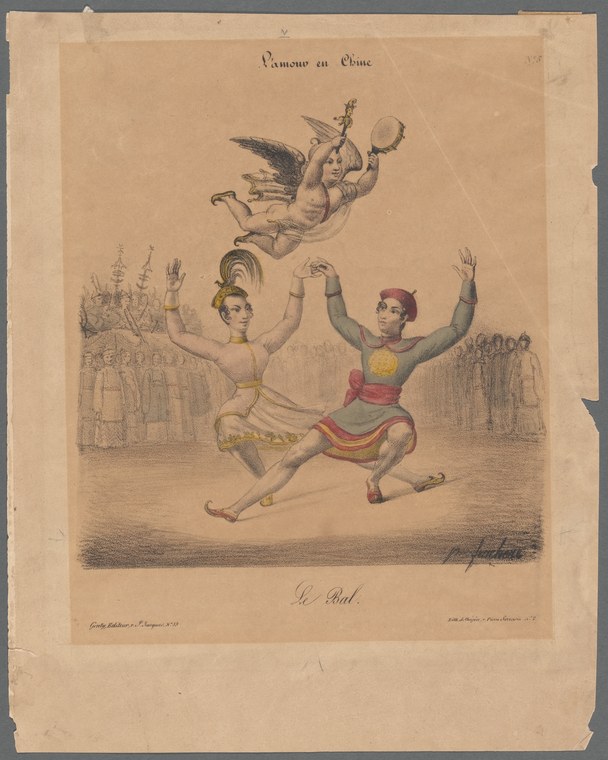
Two figures in classical dress perform an exuberant dance before a crowd in an architectural setting. The dancers occupy the center foreground: a woman on the left in a pale, high-waisted neoclassical gown with her arms raised, and a figure on the right in a shorter yellow tunic with a red sash, also with arms elevated. Both are captured mid-movement with bent legs in a playful, acrobatic pose. Above them hovers a winged putto (cherub) holding a laurel wreath and a spherical object, bestowing a blessing or crown upon the dancers. The background shows a densely packed crowd of onlookers arranged in two groups flanking the dancers, with architectural elements—what appear to be towers or fortifications—visible behind them. The entire scene is rendered in soft tones of sepia and brown with graphite shading, suggesting this is a hand-colored print or lithograph.
The dancing
Both dancers display a similar arabesque-like or grand jeté-adjacent position: legs bent and extended in a playful manner rather than formally balletic, torsos upright and energized, arms raised high and outward. The pose is more acrobatic than strictly balletic—almost gymnastic in its lightness and exaggeration. The two figures mirror each other's energy and gesture in a synchronized, equal partnership. Their dress and the informality of the pose suggest a social or theatrical dance rather than court formality.
The dance depicted
This appears to document a historical social or theatrical dance, most likely from the late 18th or early 19th century based on the neoclassical costume and the putto's presence (a reference to classical allegory). The inscription 'L'Amour en Chine' (Love in China) suggests a chinoiserie theme—a Europeanized fantasy of exotic, non-European aesthetics. The two dancers may represent lovers or allegorical figures of love and amorousness. The playful, energetic poses and the putto's blessing suggest this is a display or theatrical moment rather than everyday social dance, possibly a court entertainment, masque, or public spectacle.
How it was made
This is a hand-colored print—most likely a lithograph or engraving based on the fine linear shading and the precision of the line work. The graphite or ink foundation is visible, and color has been applied by hand in soft washes of brown, flesh tones, yellow, and red. The technique allowed for multiple impressions from a single stone or plate, enabling circulation as a popular theatrical souvenir or satirical broadside. The French text and the refinement of execution suggest this was produced for an educated, urban audience in France during the late 18th or early 19th century.
About this work
This hand-colored print depicts two classical figures dancing in an exuberant, acrobatic pose before a crowd, blessed by a descending putto. The title 'L'Amour en Chine' indicates a chinoiserie fantasy—a European reimagining of exotic aesthetics filtered through allegory. The work captures a moment of theatrical or courtly display, documenting both the movement and the emotional excess of early-19th-century dance spectacle. It belongs in a gallery of dance in art because it preserves not only the poses of historical dancers but also the visual culture that surrounded them: the allegorical frames, the public fascination with exotic themes, and the way movement was understood and celebrated in print.
How to look at it
Attend to the moment of suspension the artist chose: the dancers are caught at the apex of their leap or extension, weightless and exuberant, with the putto descending to meet them—a moment of grace and apotheosis rather than the mechanics of technique. The artist has used the floating putto and the dense crowd to frame the dancers as worthy of celestial attention and public spectacle. Notice how the dancers' legs are bent and playful rather than fully extended in a formal line; this was likely how dancers actually moved in lively theatrical contexts, even if more austere ballet training emphasized turnout and extension.
The artist
The artist is unknown, but the signature or mark on the print may be present in the original; the catalogue does not record it. The work appears to be part of a larger tradition of French theatrical prints documenting dance and performance from the early 19th century, a period when lithography and hand-coloring made theatrical imagery accessible to a broader public beyond the nobility.
The period
This print dates to the Romantic era, a period when European interest in exoticism, allegory, and emotional expression in dance was at its height. Chinoiserie—the European fascination with imagined versions of Asian aesthetics—was a dominant visual and cultural mode in the late 18th and early 19th centuries. Simultaneously, ballet and theatrical dance were becoming increasingly virtuosic and acrobatic, with dancers valued for their lightness and the illusion of effortlessness. The putto and classical allegory reference an earlier, Renaissance and Baroque tradition, suggesting the artist drew on multiple historical visual languages to create this fantasy.
Where it lives
The work is held in the New York Public Library's collection of prints depicting dance. It is a popular theatrical print, likely produced for sale to the public as a souvenir of a performance or as a fashionable image of dance and love.
Dance in this work
Questions about this work
What does 'L'Amour en Chine' mean and why is this image called that?
'L'Amour en Chine' means 'Love in China' in French. The title signals that the scene is a chinoiserie—a European fantasy of exotic, non-European aesthetics. The dancers and setting are imagined as 'Chinese' through a Western lens, blending classical European allegory (the putto, the neoclassical dress) with orientalist fantasy. This was a fashionable cultural mode in the Romantic era.
Is this a real dance or an invented one?
It is likely inspired by actual theatrical or court dances of the late 18th or early 19th century, but the exuberant, acrobatic pose and the allegorical framing ('L'Amour en Chine') suggest this is a stylized, theatrical representation rather than documentation of a specific named dance. The print captures the energy and spirit of movement more than its precise technique.
What is the cherub (putto) doing?
The putto descends from above, holding a laurel wreath and a sphere (possibly representing the world or fortune). This is a classical allegory: the putto is bestowing divine blessing, approval, or coronation upon the lovers below. It elevates the dancers' movement from human sport to a blessed, cosmic event.
Why are the two dancers wearing different clothes?
The woman on the left wears a high-waisted neoclassical gown, fashionable in early-19th-century Europe; the figure on the right wears a shorter tunic and red sash, suggesting either a male dancer or a figure costumed as 'exotic' or 'Chinese' in the orientalist fantasy. The costume difference may indicate gender distinction or may be part of the chinoiserie staging.
More dance artwork





