31 works in this view — arrow keys or swipe to move between them.
Dance in Art
Ballroom dancers
Unknown artist
- Medium:
- Dance:
- Ballroom
- Source:
- New York Public Library
- Rights:
- Public domain — free to use, share and adapt.
- Recorded as:
- public_domain
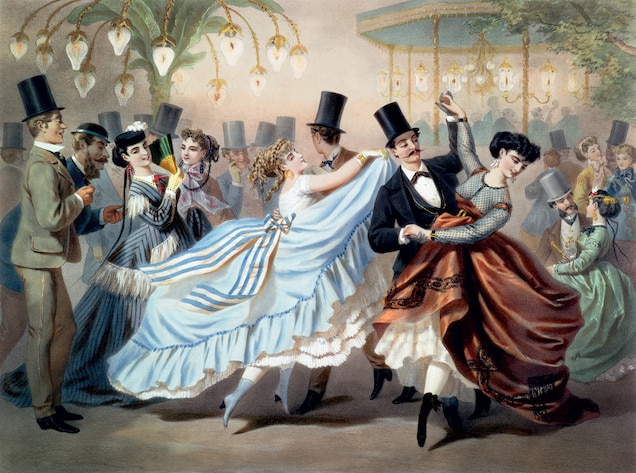
This print is a primary source for how the polka—a dance of explosive social and cultural significance—was actually practiced in the parlor and ballroom. It shows not an instruction diagram but a living moment: the dancer's eye can read the lead, the frame, the weight distribution, and the implied musicality from the bodies alone. It also documents the gendered choreography of 19th-century ballroom dance: the woman's trust, the man's authority of lead, and the theatrical presentation of intimacy within strict social convention.
What you are looking at
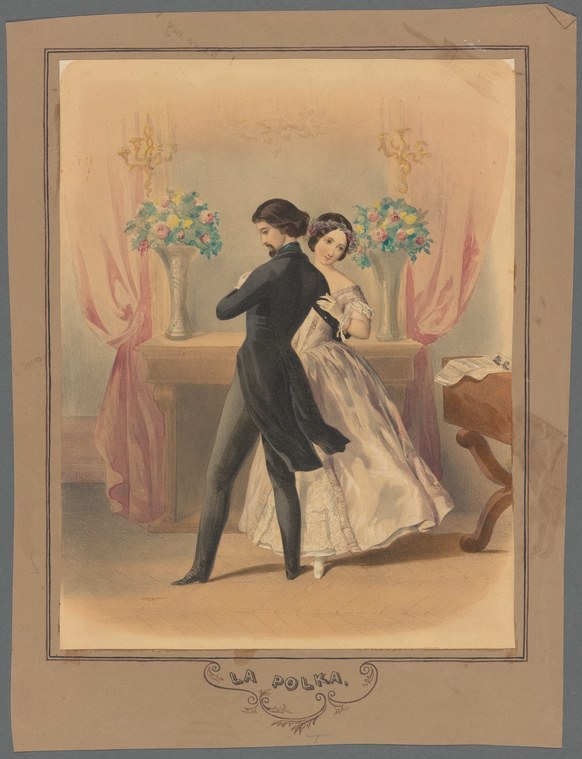
A couple dances in an elegant interior, the man in formal black tailcoat and the woman in a white ball gown with a fitted bodice. He stands behind and slightly to her side, his left arm around her waist, drawing her toward him in a close embrace; her body inclines into his as she looks back toward him over her shoulder. The setting is theatrical: tall windows frame floral garlands (roses in urn-shaped vases), and red damask curtains sweep down on either side. A small table with scattered papers sits to the right. The warm, peachy tonality of the hand-colored print emphasizes the intimate formality of the moment—this is ballroom dancing at its most refined, a moment of courtship or romantic connection frozen mid-movement.
The dancing
The male dancer supports the female dancer in a closed ballroom hold, his torso angled to her back and his right arm extended to clasp hers. Her left arm is raised and her body sways into his with visible trust; her posture is upright but yielding. The distance between them and the angle of her head suggest a partner dance requiring mutual balance and lead-and-follow dynamics. Both figures are poised mid-step, their weight distributed in a way that suggests forward motion or a turning movement.
The dance depicted
This is a ballroom dance of the 19th century, most likely a waltz or polka, the signature partner dances of the Gilded Age drawing room. The closed position, the man's leading posture, and the formal evening dress all point to a social ballroom context. The print's label—barely legible at bottom, but reading 'Polka'—suggests this may depict the Polka specifically, the most fashionable couple dance of the mid-1850s–1870s in Europe and America. The dance was performed in precisely this setting: private balls, salons, and formal evening gatherings where couples engaged in rapid, turning movements with a 2/4 rhythm.
How it was made
This is a hand-colored print, likely a lithograph or chromolithograph based on the soft, translucent washes of color and the characteristic crayon-like texture of the outlines. The technique allowed for rapid reproduction and wide circulation as a fashionable print for middle-class parlors and albums. The hand-coloring (applied after printing) is competent but not precise—note the warm, golden tone overall and the deliberate softness of the background, which keeps focus on the figures. This was a popular format for dance instruction, social documentation, and domestic entertainment imagery in the 19th century.
About this work
A mid-19th-century hand-colored print depicting a fashionable ballroom couple dancing, possibly a polka, in an ornate parlor setting. The image documents both the social ritual and the physical practice of partner dancing at the height of the Victorian ballroom era. The print exemplifies how dance imagery circulated in the 19th-century home—not as high art, but as affordable, accessible documentation of contemporary manners and movement. It belongs in a dance gallery because it captures the aesthetic and social framework in which ballroom dancing was performed, taught, and imagined: the formal dress, the interior setting, the asymmetrical but intimate closeness of the partners, and the moment of momentum that the artist chose to arrest.
How to look at it
Notice the woman's head position: turned back toward her partner even as her body inclines forward into the movement. This is a signature moment in partner dancing—the lead-and-follow dynamic made visible. The man's torso is angled to control the turning motion; his arm frames and supports her. The print captures not a static pose but a moment of momentum: the skirt catches the movement, the bodies are in mid-stride. The ornate, theatrical setting—the curtains, the urns of flowers—emphasizes that this dance, though social, was performed as spectacle, watched and admired by other guests in the ballroom.
The period
The polka entered Western Europe from Bohemia in the 1830s and became the dominant fashionable dance of the 1850s–1870s, displacing the quadrille and rivaling the waltz. It was faster, more playful, and more accessible to the middle class than aristocratic court dances, and its craze swept across the Atlantic to America. In the same period, hand-colored lithographic prints became the primary visual medium for documenting and promoting fashionable dances; they were published as single sheets, in albums, and as part of instruction manuals. This print sits at the intersection of that commercial culture and the domestic parlor, where dancing was a crucial social and courtship ritual.
Where it lives
From the New York Public Library collections. This is a popular print, likely one of thousands produced and distributed in the 19th-century print trade; similar examples exist in museum collections across America and Europe, which suggests both wide circulation and genuine cultural demand.
Dance in this work
Questions about this work
What is a polka, and why was it so fashionable?
The polka is a lively couple dance in 2/4 time, featuring quick steps and pronounced turning. It originated in Bohemia in the 1830s and swept across Europe and America by the 1850s because it was fun, moderately easy to learn, and felt modern—less stiff than the quadrille and more playful than the waltz. It was also one of the first dances to be marketed and reproduced as popular entertainment, making it a symbol of mass culture and social mobility.
How do you lead and follow in a polka?
The man's upper body and arm frame control the direction and turning; the woman reads his movement through the connection in his arm and torso and responds by following his line. The closed position—chest to chest, his right hand on her back—makes this lead-and-follow immediate and intimate. The woman's apparent ease and trust visible in this print depend entirely on a clear, confident lead from her partner.
Why are these prints so important to dance history?
They are among the few visual records of how ordinary people actually danced in the 19th century. Unlike instruction diagrams (which are schematic) or paintings by famous artists (which often distort movement for dramatic effect), popular prints like this one show the real posture, dress, and setting of social dancing. They also prove that dancing was a commercial, reproducible commodity—something people bought, looked at, learned from, and taught to others.
More Ballroom artwork