49 works in this view — arrow keys or swipe to move between them.
Dance in Art
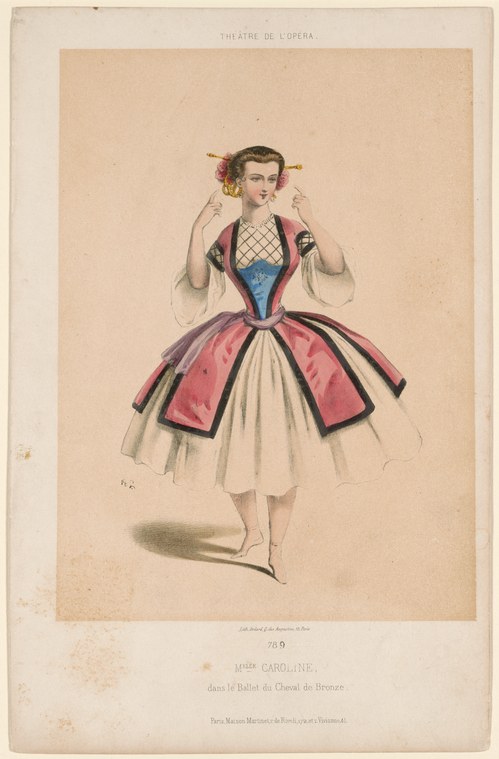
Melle Caroline, dans le ballet du Cheval de bronze
Unknown artist
- Collection:
- Prints depicting dance
- Source:
- New York Public Library
- Rights:
- Public domain — free to use, share and adapt.
- Recorded as:
- Public Domain
Character and folk dances of the Romantic ballet era are often invisible in dance history because they left no notation and appear in few visual records. This print is a rare documentary record of how such a dance was actually performed, and it identifies the specific dancer and the specific role. For historians and dancers studying the breadth of 19th-century ballet beyond the pointe-work of principal roles, this image is direct evidence.
What you are looking at
A single female dancer occupies the center of a cream-colored stage, posed in a moment of spirited movement. She wears the costume of a European folk or character dance: a fitted corset bodice of deep blue with a diamond pattern in lighter blue, over a full skirt composed of a cream underskirt and a striking pink overskirt trimmed in navy ribbon that swings outward as if caught mid-rotation. Her hair is styled close to her head and adorned with flowers or ribbons in red and yellow. Her arms are raised at shoulder height with elbows bent, hands relaxed, in a pose suggesting buoyant joy rather than formal balletic line. She stands on one leg with her supporting foot articulated, while the other leg extends or bounces lightly. The stage is bare and brightly lit, creating a soft shadow beneath her. The composition is frontal and symmetrical, presenting the dancer as a character type rather than as part of a narrative tableau.
The dancing
A single female dancer, caught mid-movement in a pose of celebratory animation. Both arms are raised to shoulder height with the elbows bent and hands open, suggesting a folk or character idiom rather than academic ballet posture. Her upper body is upright; her legs are in a position suggesting a bounce or hop rather than the extended lines of Romantic ballet. The pose conveys lightness and rhythm—the body appears to be springing or turning rather than held in a sustained line. Her weight seems distributed across both feet in an active, momentary attitude.
The dance depicted
This appears to be a character or national dance from a European ballet, most likely French or Italian opera-ballet of the mid-19th century. The costume—the embroidered corset, full skirt with layered overskirts, and floral headdress—is consistent with character dances performed in romantic-era ballets, particularly the peasant, folk, or regional character roles that featured prominently in works like *La Sylphide* and *Giselle*. The title reference to 'Le Cheval de Bronze' (The Bronze Horse) indicates this is a character from that specific ballet or opera-ballet production. The pose and gesture suggest a lively, rhythmic folk dance rather than the sustained, ethereal quality of romantic ballet's principal roles. The energy is grounded and joyful rather than ethereal.
How it was made
This is a hand-colored engraving or lithograph, characteristic of the mid-19th-century theatrical print tradition. The fine linear work defining the figure and the delicate application of color—particularly the subtle shading in the skirt and the precision of the embroidered bodice detail—indicate engraving or possibly colored lithography. The technique allowed for mass production and wide circulation of theatrical imagery; such prints were sold to the public as souvenirs and records of celebrated performances and dancers. The material quality and printing style place this squarely in the commercial theatrical print market of the 1840s–1860s.
About this work
This is a theatrical portrait of a named dancer, Mlle Caroline, performing a character role in the ballet or opera-ballet *Le Cheval de Bronze*. It is a hand-colored engraving documenting a mid-19th-century performance and preserving both the choreography and the costume design of a moment now lost to history. The work is representative of a major form of theatrical documentation in the Romantic era: the colored print that allowed audiences to own an image of their favorite dancer and to circulate knowledge of new choreography and performance across Europe. Character dances and peasant roles were essential to the repertory of the period, providing contrast and comic or folkloric relief to the ethereal principal roles danced on pointe. This image shows us how such dances were costumed, how the body was held, and what kind of energy and joy they conveyed.
How to look at it
Observe the pose carefully: the arms are not extended in the classical fifth position or in the ethereal port de bras of Romantic ballet, but are instead held in a pose of earthy buoyancy—the elbows bent, the gesture open and outward. Look at the placement and articulation of the feet; the dancer is not on full pointe in the manner of a principal ballerina, but appears to be dancing on the ball of the foot or in a bounce. Notice how the pink overskirt is caught in full swing, indicating motion and rotation at the moment the artist chose to represent. The overall effect is one of folk vitality and character specificity, not the weightless grace of the ethereal roles that dominate our memory of Romantic ballet.
The period
This work dates to the Romantic era of ballet (approximately 1830–1870), when European audiences were hungry for exotic and folkloric subjects. Ballets and opera-ballets of the period regularly featured character dances—peasant dances, national dances, folk celebrations—performed by secondary dancers or as interludes. The hand-colored engraving was the dominant technology for theatrical portraiture of this era; theaters and print publishers issued them in series to capitalize on the fame of celebrated dancers. The fashion for such prints reached its peak in the 1840s–1860s, declining only with the advent of photography. *Le Cheval de Bronze* was a successful opera-ballet produced in Paris, and the survival of this print confirms that Mlle Caroline was a notable performer of character roles.
Where it lives
This print is held in the New York Public Library's collection of prints depicting dance. It is one of a significant body of 19th-century theatrical prints, primarily French and Italian in origin, that document performers and roles of the Romantic era.
Dance in this work
Questions about this work
Who was Mlle Caroline?
The catalogue records only the name and the role. She was a dancer of sufficient renown to be commemorated in a theatrical print circulated by her theater or a commercial print publisher, which suggests she was a recognized performer in character and secondary roles in mid-19th-century Paris or European opera-ballet companies. Without archival research, we cannot say more.
What is *Le Cheval de Bronze* and when was it performed?
The Bronze Horse is a French opera-ballet, but without additional research we cannot specify the composer, choreographer, or premiere date from the image alone. The style of dress and print technique suggest a production of the 1840s–1860s, most likely performed in Paris or another major European opera house.
Is Mlle Caroline performing ballet or folk dance?
She is performing a character dance—a hybrid form. Character dances were choreographed theatrical pieces written in a folk or national idiom, performed by trained ballet dancers but with a different aesthetic and vocabulary than the principal ballet roles. They used rhythmic footwork, bent knees, and grounded energy rather than the ethereal suspension and turnout of Romantic ballet's ethereal roles.
Why is she not on pointe?
Pointe work was reserved for the principal, ethereal roles of Romantic ballet—roles danced by the prima ballerina. Character dancers, male dancers, and secondary roles were performed in soft shoes or character shoes, on the ball of the foot, with a different aesthetic and vocabulary. The absence of pointe shoes is a visual marker of the role's social and dramatic status within the ballet.
More dance artwork





