49 works in this view — arrow keys or swipe to move between them.
Dance in Art
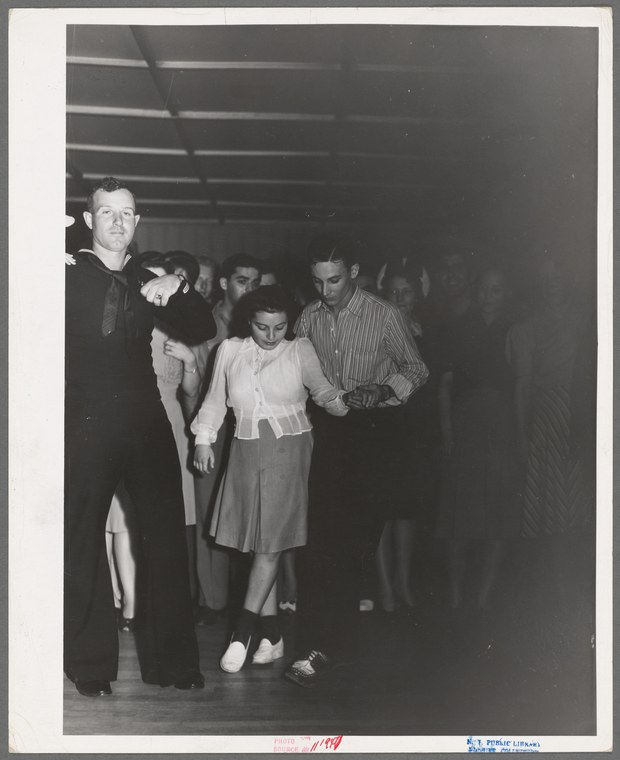
Couple at Sherman's dance hall (newlyweds). San Diego, California
Unknown artist
- Medium:
- Source:
- New York Public Library
- Rights:
- Public domain — free to use, share and adapt.
- Recorded as:
- public_domain
This photograph is one of the few documents of American social dancing as it was practiced outside professional theaters or competitions. It shows not technique but context: the hall, the clothing, the public nature of the activity, and the social role of dance in marking occasions like marriage. Historians of dance and social life in the American West depend on scattered images like this to reconstruct how ordinary people danced.
What you are looking at
A black-and-white photograph captures a moment at Sherman's dance hall in San Diego, California, showing a newly married couple amid a crowd of onlookers. The couple occupies the center of the frame: a man in dark clothing stands to the left, his arm around or near a woman in a light-colored blouse and darker skirt. The woman's posture is upright but somewhat reserved. Behind and around them, other figures—some partially visible, some in sharp focus—create depth; the setting appears to be an indoor venue with a industrial or warehouse-like quality, suggested by the visible ceiling beams and the stark, shadowless lighting typical of flash photography. The crowd's attention seems directed toward the central pair, though most faces are either obscured or in shadow. The photograph's composition emphasizes the newlyweds as subjects of observation rather than as participants in an active dance moment; this is documentation of a social gathering rather than a capture of movement.
The dancing
The central male figure stands with a protective or proprietary arm position, his body angled toward the woman. The woman's frame is vertical and somewhat stiff, her arms at her sides or loosely held; there is no visible closed ballroom hold or fluid partnering. Neither figure displays the weight shift, extension, or postural ease characteristic of active dancers. The surrounding figures are mostly static or in conversational poses. The overall impression is of people assembled for an occasion rather than engaged in the mechanics of dance.
The dance depicted
This photograph documents a social dancing venue—Sherman's dance hall was a public entertainment space where couples would gather to dance—but does not capture an active dance in progress. The pose of the central couple is formal and static, more suggestive of a posed portrait than a candid moment of partner dancing. The setting and context (newlyweds at a dance hall) indicate that social partner dancing of the American smooth or swing era (1930s–1940s, based on dress and photographic style) occurred in this space, but the photograph itself records the social occasion rather than the dance technique.
How it was made
This is a black-and-white gelatin silver print, likely made with flash photography indoors. The harsh, even lighting and the slight grain typical of mid-20th-century news or documentary photography suggest this may be a press photograph or archival documentation. The flash has eliminated shadow and created a somewhat flattened, clinical quality. The print has been preserved in a collection, with catalogue markings visible at the bottom edge. This technique allowed rapid, on-location capture suitable for newspaper publication or institutional documentation, implying this was either a newsworthy event or part of a broader documentary project.
About this work
This photograph documents the social world of American ballroom dancing in the 1930s–1940s, specifically a moment at Sherman's dance hall in San Diego. The image is valuable not as a record of dance technique—the couple shown are posed and still—but as evidence of where and how ordinary people danced in this era. Public dance halls like Sherman's were central to American social life, offering working-class and middle-class couples a venue for partner dancing. The photograph's inclusion of newlyweds suggests the venue was associated with celebration and courtship. Though the specific couple and photographer are unrecorded, the image preserves the material culture and social geography of ballroom dancing in the early-to-mid twentieth century.
How to look at it
This photograph is a still life of a social occasion rather than a capture of movement. Look at the posture and stillness of the central couple, and at how the photograph freezes them in a formal, posed arrangement. The viewer should read this not as evidence of how the couple danced (which would have involved motion and shifting weight), but as evidence of where dancing happened and who the dancers were. The crowd's presence and the institutional setting are more informative than the couple's stance.
The period
The 1930s–1940s were the golden age of American public dance halls. These venues—ballrooms, pavilions, and dedicated halls in cities and towns across the country—were the primary places where working and middle-class Americans learned and practiced partner dancing. The dominant styles were American smooth (waltz, foxtrot) and swing. Sherman's dance hall in San Diego was one of hundreds of such establishments. The photograph's style and the couple's dress are consistent with this era. Flash photography was becoming standard in documentation and journalism during this period, making such indoor candid shots increasingly common.
Where it lives
This print is held by the New York Public Library, which acquired it as part of a documentary or archival collection. The presence of institutional markings and the print's preservation suggests it was part of a deliberate survey or documentation project, though the photographer and the date of creation are not recorded in the available catalogue entry.
Dance in this work
Questions about this work
Is this a photograph of a dance?
Not quite. The photograph documents a dance hall and a social occasion, but the central figures are posed and stationary rather than captured in the act of dancing. It is evidence of where and when people danced, rather than evidence of how they danced.
What was Sherman's dance hall?
Sherman's was a public dance venue in San Diego, California, typical of hundreds of ballrooms and dance halls that operated across the United States in the early-to-mid twentieth century. These were commercial establishments where couples paid to dance to live or recorded music, usually to styles such as waltz, foxtrot, and swing.
Why photograph newlyweds at a dance hall?
Dance halls were important sites of celebration and courtship in American social life. A photograph of newlyweds at such a venue documented a significant social moment. It may also have been taken for a local newspaper or as part of a broader documentary project on American social life.
When was this photograph taken?
The catalogue record does not provide a date, but the photographic technique, the couple's clothing, and the style of the hall all suggest the 1930s to 1940s. The flash photography and the print quality are consistent with that era.
More dance artwork