49 works in this view — arrow keys or swipe to move between them.
Dance in Art
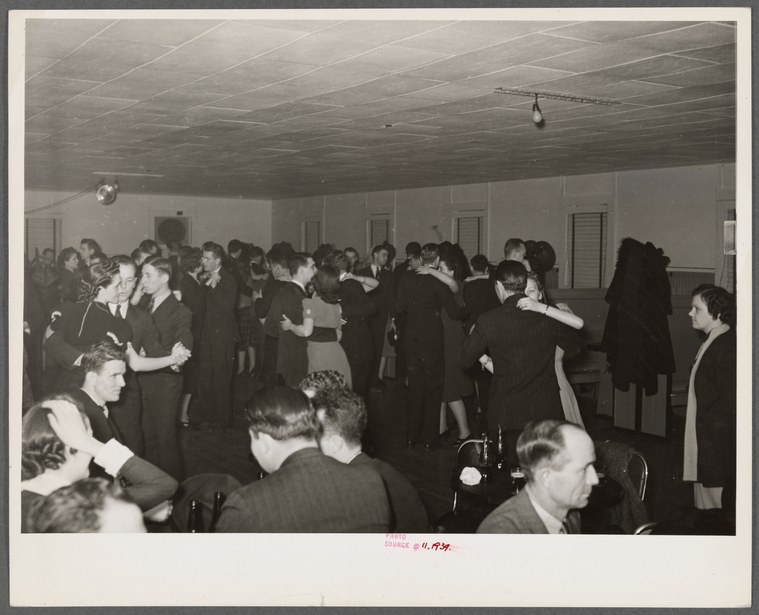
Allen's dance hall near Herrin, Illinois
Unknown artist
- Medium:
- Source:
- New York Public Library
- Rights:
- Public domain — free to use, share and adapt.
- Recorded as:
- public_domain
Most documentary photography of dance focuses on professional performers, theatrical stages, or ethnographic subjects presented as exotic. This image instead records the ordinary, commercial, social dance that occupied the leisure hours of millions of Americans—and shows us the scale of that activity. It is a rare surviving example of a public dance hall interior captured in systematic documentary form.
What you are looking at
A crowded public dance hall, photographed from an elevated vantage point that captures the entire floor in a single frame. Dozens of couples and groups fill a rectangular room with a dark wooden ceiling and white walls punctuated by doorways and ventilation grilles. The crowd is densest in the center and middle distance, with some figures distributed around the edges. Nearly all patrons wear dark formal or semi-formal clothing—suits, vests, and jackets for men; dresses (many knee-length or longer) for women. The lighting is even and artificial, suggesting interior electric illumination. The composition conveys energetic social dancing in progress: figures are in motion, bodies angled toward partners, some couples in closer contact than others. The scene captures the scale and atmosphere of a commercial dance venue serving a working-class or middle-class clientele.
The dancing
Most figures are arranged in pairs, with men and women in face-to-face or side-by-side positions typical of ballroom or social dancing of the early 20th century. Many couples appear to hold a closed ballroom frame—one hand on the partner's back or waist, the other extended outward—though the distance and photograph grain prevent precise reading of arm positions and weight distribution. A few individuals stand at the edges apparently watching or waiting. The density of the crowd and the photograph's high angle make it impossible to read individual footwork or floor patterns, but the scattered orientation of couples suggests various directions of travel across the floor rather than a single synchronized line or formation.
The dance depicted
This is a social ballroom or public dance venue scene, most likely depicting one of the standard partner dances of the 1920s–1930s era—waltz, foxtrot, or quickstep are the strongest candidates given the clothing and venue type. The photograph documents social dancing rather than exhibition or theatrical dance: this is commercial leisure, not performance. The formality of dress and the commercial setting (a named dance hall) suggest that ballroom dancing and its variants were the primary activity. Without close detail of footwork, frame, or body position, the specific style cannot be determined with confidence, though the era and venue point strongly toward American smooth or international standard traditions.
How it was made
This is a black-and-white photographic print, likely taken with a large-format camera positioned to capture the entire hall from above—possibly from a mezzanine or elevated platform. The angle, even exposure, and lack of motion blur suggest a tripod-mounted camera with adequate light. The even tonal range and fine detail in the print indicate professional processing. The photograph's composition—systematic, comprehensive, documentary in intent—suggests it was made by a commercial or institutional photographer, possibly for publicity, journalistic record, or the venue's own archives. The print's archival history (held at NYPL) and the handwritten notation visible at the bottom indicate its value as a historical document.
About this work
This photograph documents a commercial public dance hall in rural Illinois during the early 20th century, capturing the scale and atmosphere of social ballroom dancing in a working-class venue. The image is valuable not as a portrait of a particular dancer or moment of artistic achievement, but as evidence of how and where ordinary people danced—the clothing, the venue, the crowd density, the mixed-gender social structure, and the role of the commercial dance hall in American leisure life. The photograph is a primary historical record of vernacular social dance practice in its commercial context.
How to look at it
Stand back and observe the overall pattern: the density of couples, their distribution across the floor, the formal dress, and the commercial scale of the venue. These details together establish that this is social dancing, not exhibition. Move closer to examine individual couples' positions and frames—most appear to hold a standard closed ballroom position, though the photograph's grain and angle limit precision. Note the mix of ages and body types, the presence of onlookers, and the matter-of-fact formality of both clothing and venue; this is ordinary people's ordinary leisure, not a special event.
The period
The photograph almost certainly dates to the 1920s or 1930s, the peak era of the American public dance hall. Commercial ballroom dancing exploded during this period following the popularization of the foxtrot (c. 1912) and subsequent standardization of American smooth ballroom technique. Dance halls ranged from elegant ballrooms in major cities to modest commercial venues in small towns and industrial areas. Herrin, Illinois, was a coal-mining town with a significant working-class population, and a named dance hall there would have served that population. Photographs of dance halls from this era are uncommon in archival collections, making this record particularly significant for understanding the geography and social scale of American dance culture before and during the swing era.
Where it lives
The photograph is held in the New York Public Library collection. The handwritten notation at the bottom of the print indicates cataloguing or archival annotation. The image's preservation and institutional holding suggest it entered the NYPL collection as a documentary record—possibly acquired from the venue, a local historian, or a newspaper archive—rather than as fine art.
Dance in this work
Questions about this work
When was this photo taken?
The catalogue record lists the date as unknown. However, the clothing style (women's knee-length dresses, men's suits and vests), the formality of dress, the design of the venue, and the photographic process all point to the 1920s or 1930s. The image was likely made during the peak era of the American public dance hall.
What dance are they doing?
The photograph does not provide enough detail to identify a specific dance with certainty. The formal clothing, closed-position couples, and commercial venue type all suggest one of the standard American smooth ballroom dances—most likely waltz, foxtrot, or quickstep. All were danced in public halls during this era.
Why is this photograph historically important?
Most surviving photographs of dance from this era focus on theatrical performances, exhibition dancers, or ethnographic subjects. This image instead documents the ordinary social dance that occupied the leisure hours of working-class and middle-class Americans in a small industrial town. It shows us the scale, venue, dress, and social structure of vernacular ballroom dancing in commercial practice.
Where was Herrin, Illinois, and why would a dance hall there matter?
Herrin was a coal-mining town in southern Illinois with a significant working-class population. Public dance halls served as major social centers for working people during the early 20th century. A documented hall in a small town is rarer in the archival record than city ballrooms, making this image more valuable as a record of how ordinary Americans actually danced.
More dance artwork