49 works in this view — arrow keys or swipe to move between them.
Dance in Art
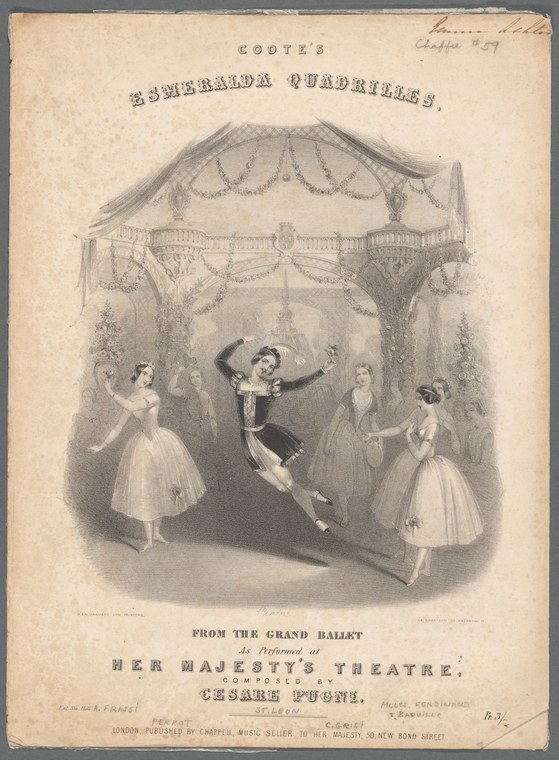
Coote's Esmeralda quadrilles: from the grand ballet as performed at Her Majesty's Theatre
Unknown artist
- Collection:
- Prints depicting dance
- Source:
- New York Public Library
- Rights:
- Public domain — free to use, share and adapt.
- Recorded as:
- Public Domain
This print documents the Romantic-era practice of adapting social dance forms (the quadrille) for theatrical performance and mass-market publication, revealing how ballet and ballroom culture intersected in the nineteenth century. For historians of dance notation and pedagogy, it provides rare visual evidence of how quadrilles were understood and transmitted in the period before standardized notation, and for choreographic historians, it shows what Romantic-era male virtuosity looked like.
What you are looking at
A theatrical stage scene framed by an ornate proscenium arch hung with swags and tassels. Four female dancers in pale tulle skirts occupy the stage in a moment of vivid action. At center, a male dancer in dark costume and heeled shoes springs upward in a dramatic leap, his arms raised and body arched. The three female figures around him—in positions suggesting they have just released him or are responding to his movement—wear the short romantic tutus and pointe shoes of mid-nineteenth-century ballet. The stage floor and backdrop are rendered in atmospheric perspective, and the dancers cast distinct shadows. The overall composition emphasizes the central male figure's elevation and virtuosity; the women's poses read as ensemble support rather than co-equal action.
The dancing
The male dancer at center executes what appears to be an entrechat or other beaten jump, legs crossed or beating beneath him, torso extended vertically, both arms raised in an open, triumphant frame. The three female dancers surround him in attitudes that read as responsive: the leftmost figure gestures toward him; the rightmost leans back; the remaining figure stands poised. All dancers display the turned-out legs, pointed feet, and upright carriage of classical ballet technique. The women's tutus are short and full, characteristic of the Romantic era; the man wears a tunic and tights, with the exaggerated heeled shoe (a male ballet slipper of the period). No closed holds; the dancers occupy separate planes and do not touch.
The dance depicted
This is a quadrille—a social dance suite arranged for four or more couples—but adapted for theatrical performance and choreographic elaboration in the style of the Romantic ballet era (circa 1830s–1850s). Quadrilles were immensely popular as both ballroom social dances and as material for theatrical adaptation; they consisted of five distinct figures or movements. The work is identified as based on the grand ballet *Esmeralda*, which premiered in 1836. The central male leap and the ensemble arrangement suggest this is a moment of theatrical spectacle rather than social dance in the ballroom sense; the women's elaborate tutus and the theatrical framing confirm the stage context. The title 'Coote's Esmeralda Quadrilles' indicates this is likely a published set of dance music or choreographic notation meant for amateur performance or instruction, with the stage image serving as promotion or illustration.
How it was made
This is a lithograph, evident from the stone texture, the tonal range from deep grey to pale cream, and the characteristic lithographic crayon line. The image shows skilled use of the medium: fine parallel lines build shadow and volume in the drapery and architectural surround, while the dancers' limbs are rendered with delicate precision. The soft tonal washes in the background create atmospheric depth. Lithography in the 1830s–1850s was the dominant technology for theatrical prints and sheet music covers; it allowed large print runs at relatively low cost, making it ideal for the commercial distribution of performance documentation, dance instruction, and musical entertainment. The print would have been colored by hand in some copies; this example shows evidence of period hand coloring in pale hues.
About this work
This is a theatrical promotion print for a quadrille suite based on the ballet *Esmeralda*, likely published by Coote (a London music and dance publisher) in the mid-nineteenth century. The lithograph depicts a moment of Romantic-era stage ballet featuring four dancers in the characteristic dress and technique of the period: short tutus, pointe work, and the virtuosic male jump that dominated nineteenth-century male ballet technique. Quadrilles were the dominant social dance of the era, and their adaptation for theatrical spectacle—especially when attached to a fashionable ballet property like *Esmeralda*—made them commercially attractive as both performance material and domestic music-making. The image captures both the technical sophistication of theatrical ballet and the vast appetite for dance entertainment among the urban middle class.
How to look at it
Attend to the moment the artist chose: not a static pose but a moment of violent upward action—the male dancer at the apex of his jump—while the women around him read as grounded or responsive. This freeze-frame captures the Romantic ideal of male virtuosity as the visual center of the composition. Notice how the lithographer used subtle tonal gradation and shadow to suggest the dancers' bodies are separate from one another and from the ornate architectural frame; the dancers are presented as autonomous performers, not decorative elements. The ornate proscenium arch, the atmospheric background, and the formal arrangement of figures all follow the conventions of mid-century theatrical print design, which aimed to flatter the viewer's sense of witnessing a 'real' performance while also making that performance portable and collectible.
The artist
Unknown. The print is credited to Coote, a London publisher active in theatrical and musical prints during the 1830s–1850s. Lithographs of this period were often created by specialized theatrical print makers whose names do not always appear on the work; attribution to the publisher was standard practice.
The period
The 1830s–1850s saw an explosion of Romantic ballet as a theatrical form, marked by pointe work for women, short tutus, ethereal plots, and the emphasis on the (male) dancer's technical brilliance. Simultaneously, the quadrille was the dominant ballroom social dance across Europe and North America, performed at every fashionable ball and taught in dancing masters' studios. Publishers capitalized on this dual appetite by adapting famous ballets into quadrille suites for domestic use—performances at home or small gatherings—and by promoting both through theatrical prints and sheet music covers. The*Esmeralda* ballet, based on Victor Hugo's 1831 novel, was one of the most successful and frequently adapted works of the era.
Where it lives
The work is held in the New York Public Library's collection of prints depicting dance. It is a commercial lithographic print, likely one of many copies distributed as sheet music cover, theatrical promotion, or instructional material.
Dance in this work
Questions about this work
What is a quadrille?
A quadrille is a ballroom dance suite for four couples (or eight dancers) consisting of five distinct movements or 'figures,' each with its own music and choreography. It dominated social dancing from roughly 1800–1870 and was performed at every fashionable ball. Quadrilles were also frequently adapted for theatrical performance and published as sheet music for home use.
What was the Esmeralda ballet?
A grand ballet choreographed by Jean Coralli and Jules Perrot, which premiered in Paris in 1836 and was based on Victor Hugo's 1831 novel *Notre-Dame de Paris*. It was one of the most successful and widely performed ballets of the Romantic era, and like other popular ballets of the time, its music was adapted into quadrilles and other social dances for commercial distribution.
Who is Coote?
Coote was a London music publisher active in the 1830s–1850s, known for theatrical and dance prints and sheet music. Little is known about the publisher's biographical details, but their prints represent a major commercial category of mid-century popular entertainment.
What does the man's costume tell us?
The male dancer wears a tunic, tights, and noticeably heeled slippers—the standard male ballet costume of the Romantic era. The heeled slipper (a male ballet pointe shoe of the time) gave the dancer a raised silhouette and was considered essential to the male dancer's aesthetic line. By the early twentieth century, male dancers abandoned pointe work entirely.
More dance artwork





