49 works in this view — arrow keys or swipe to move between them.
Dance in Art
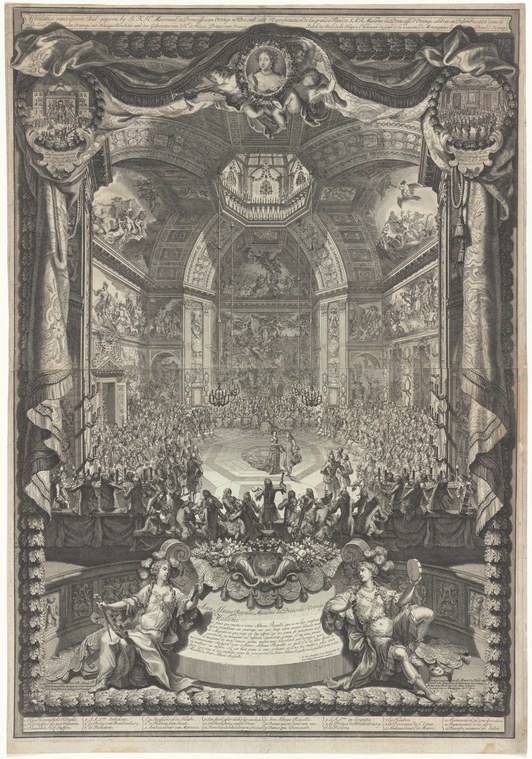
Afbeeldinge van't Groote Bál gegeven by H. K. H. Mevrouwe de Princesse van Orange in Decemb. 1686 op de Saal van Orange in't Haagse Bosch ter eere der Geboorten van S. H. de Heere Prince van Orange: Representation de la grande Feste de S. A. R. Madame de la Princesse d'Orange celebree en Desembre 1686 dans le Salon du Bois de la Haye a l'honneur du jour de la naissance de Monseigneur le Prince d'Orange
Unknown artist
- Collection:
- Prints depicting dance
- Source:
- New York Public Library
- Rights:
- Public domain — free to use, share and adapt.
- Recorded as:
- Public Domain
For historians and choreographers, this engraving is invaluable as a visual record of how Baroque court dance was staged and witnessed. It shows the actual spatial and social context in which formal court dances like the minuet were performed—not as intimate partner dances but as processional displays of rank and order, watched by a hierarchy of courtiers in a room that itself embodies the power of the court. The level of architectural and social detail makes it possible to reconstruct not just the dance steps but the experience of being present at such an occasion.
What you are looking at
This is a formal court ball held in a grand Baroque interior, most likely in the Dutch princely household, as the Dutch and French titles in the inscription together suggest. The scene is organized in strict perspective: a vast rectangular hall recedes into depth, its walls lined with tall columns and elaborate architectural detail, its barrel vault ceiling coffered and gilded. Windows and doorways punctuate the walls at regular intervals. The floor is a polished plane on which the action unfolds. Hundreds of courtiers pack the hall—men in long coats and wigs, women in full-skirted formal dress—arranged in a loose crowd that fills the interior space. At the center of the composition, isolated on a cleared floor, a formal dance or ceremony is taking place. The scale and geometry of the space dominate the image; the figures are numerous but individually small, emphasizing the grandeur of the occasion and the institution that commands it. Allegorical figures in the foreground—a woman reclining with a child and attendants—frame and legitimize the scene from below, as if blessing the festivities. Heraldic motifs, swags, and cherubs crowd the ornamental borders.
The dancing
The dancers at the center occupy a formal, processional arrangement rather than the intimate partnered frames of later ballroom dance. The figures stand with an upright, dignified carriage typical of court ceremony. Couples appear to move in measured steps with deliberation—this is display and order, not spontaneity. The women's voluminous skirts, supported by panniers or rigid petticoats, move as architectural forms in space; the cut and weight of the fabric itself becomes part of the choreography. Men's posture is erect, their legs extended in formal stride. The crowd around the dancers is relatively static, watching rather than moving; there is no suggestion of general dancing across the hall.
The dance depicted
This is almost certainly a court ball in the Baroque tradition, likely a formal menuet or a processional court dance forming part of a ceremonial celebration. The inscription indicates the ball was given in December 1686 by the Princess of Orange in honor of the birth of the Prince of Orange, a significant dynastic occasion. The dress, the formality of the setting, and the processional arrangement all align with Baroque court dance practice, in which dance was a form of spectacle and political statement rather than recreation. The dancers appear to move in slow, measured steps with elaborate spatial geometry—consistent with the minuet or similar court dances of the period. The scale of the event, with hundreds present but only a few dancing at any moment, reflects the hierarchical structure of court life.
How it was made
This is an engraving, recognizable from its monochromatic line work, fine parallel hatching for shadow and tone, and the precision of its architectural rendering. The technique allows for both architectural fidelity and narrative detail: the artist captures the geometric perfection of the Baroque hall while still rendering facial features and textile qualities in the foreground. The engraving's capacity for fine detail and its ability to be printed and distributed made it an ideal medium for recording a court occasion of importance. The care taken with the perspective construction and the allegorical frame suggests this was a commissioned commemorative work, intended to circulate among the court and its diplomatic allies as a record of the event and a demonstration of the household's magnificence.
About this work
This is a commemorative engraving of a court ball given by the Princess of Orange in December 1686 to celebrate the birth of the Prince of Orange. It is a document of Baroque court spectacle at its most formal: dance here is not entertainment but ceremony, a carefully choreographed display of aristocratic order and dynastic power. The engraving preserves not just the event itself but the ideology of court dance—its role in the display of rank, the body's discipline, and the state's magnificence. The work belongs in a gallery of dance in art because it shows how dance functioned as political theater in the early modern court, and because it captures in fine detail the formal movement vocabularies, the dress, and the spatial hierarchies that organized court dancing in this period.
How to look at it
Attend first to the geometric perspective of the hall itself: the artist has used it to create a hierarchy of space, with the dancers isolated at the center on a cleared floor and the watching courtiers arranged in depth around them. This spatial isolation is essential to understanding court dance—it is display, watched and witnessed. Look at the formal, upright carriage of the dancing figures and the slow, measured quality of their movement as implied by their posture and the arrangement of the group. Note the weight and volume of the women's skirts: the costume itself constrains movement and enforces a particular quality of locomotion. The allegorical figures in the foreground (the reclining woman and attendants) are there to legitimize the event and assert its importance—a common rhetorical device in court art of this period.
The period
The 1680s were a period of high formality in Northern European court culture. The minuet had recently emerged as the most fashionable court dance, and by 1686 it would have been the centerpiece of formal court balls. The Dutch court in The Hague occupied a complex position: the Netherlands was a republic, but the House of Orange held quasi-royal status, and the court at the Hague adopted many of the ceremonial forms and spectacles of the French and German princely courts, including elaborate court balls. The engraving's style and technique—with its classical architectural setting and allegorical framing—reflects late Baroque taste. The celebration of a birth was a major occasion for court dancing, as it affirmed dynastic continuity and provided an opportunity to display the magnificence and order of the household.
Where it lives
This engraving is held in the New York Public Library's collection of prints depicting dance. It is a commemorative work, almost certainly commissioned by the court and distributed as a record of a significant dynastic occasion.
Dance in this work
Questions about this work
What dance is being performed here?
The inscription and the formal dress suggest this is likely a minuet or a processional court dance of the Baroque period. The measured posture and slow arrangement of the figures are consistent with the minuet, which by 1686 had become the most fashionable court dance in Northern Europe. However, court balls included multiple dances, and this engraving may show only one moment in a longer evening of celebration.
Why is the dance happening on such a small, isolated floor?
In Baroque court culture, dance was a spectacle for observation and judgment. Only the most important or accomplished dancers would perform before the entire court. The isolation of the dance floor on a cleared space allowed the assembled courtiers to watch and appreciate the dancers' skill and bearing. This was not recreational dancing but a formal demonstration of courtly discipline and grace.
Who attended events like this?
These were elite court occasions, attended by the nobility, important officials, and their families. The hundreds of figures crowding the hall represent the court hierarchy—from the immediate family of the Prince and Princess to nobles, courtiers, and minor officials. It was a display of the household's wealth and order, and attendance itself was a mark of status.
How do we know this is a real event and not an imagined one?
The detailed inscription (in both Dutch and French) specifies the event: a ball given by the Princess of Orange in December 1686 to celebrate the birth of the Prince of Orange. This is a documented historical occasion, and the engraving was created as a commemorative record. The artist has preserved specific architectural details of the venue (the Salon of the Hague Wood) that allow for verification.
More dance artwork





