49 works in this view — arrow keys or swipe to move between them.
Dance in Art
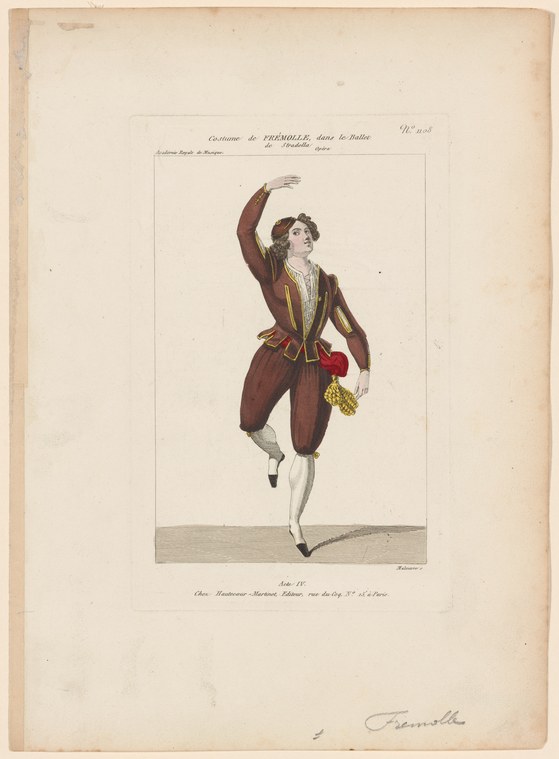
Costume de Frémolle dans le ballet de Stradella, Opéra, acte IV
Unknown artist
- Collection:
- Prints depicting dance
- Source:
- New York Public Library
- Rights:
- Public domain — free to use, share and adapt.
- Recorded as:
- Public Domain
This image documents a moment of professional male dance virtuosity in the eighteenth century, when such displays were central to operatic entertainment but are now largely lost to us. It preserves not only a costume but a specific pose and technique, offering dancers and historians rare visual evidence of how male roles were performed and valued in this period. The print format tells us how such knowledge circulated: not through live performance alone, but through widely distributed images that made theatrical innovation visible across Europe.
What you are looking at
A single male dancer occupies the center of a spare, neutral ground against a pale background. He is caught mid-leap or in an elevated pose, his body angled dynamically with his left arm raised high and his right arm extended lower, his torso twisted as he looks upward. He wears a fitted burgundy jacket with gold embroidery and trim, pale breeches, white stockings, and dark shoes with heels. The costume is formal and ornamental—characteristic of 18th-century court or operatic dress—yet his pose is remarkably athletic and unrestrained. In his right hand he holds what appears to be a small prop or accessory (possibly a hat or plume). The composition isolates the figure entirely, presenting him as a specimen of dance technique against an empty stage. The image is a hand-colored engraving or print, with delicate outlines and carefully applied watercolor washes that define both the figure and the shallow floor line beneath him.
The dancing
The dancer's weight is entirely lifted—he appears airborne or in the moment of greatest elevation. His legs are extended or gathered beneath him in an energetic position; the exact footwork is not entirely clear from the image, but the overall impression is one of brilliant, explosive elevation. His torso is strongly twisted, creating a pronounced contra-posto with his upper body angled differently from his lower. Both arms are active and asymmetrical: the left arm raised nearly vertical, the right lower and extended, framing the turned face. The pose suggests virtuosity and showmanship rather than the restrained elegance of courtly minuet or sarabande—this is a performer trained in theatrical dance, executing a moment of maximum technical display.
The dance depicted
This is a costume design for the character Frémolle in the opera-ballet *Stradella*, Act IV. Frémolle was a male dancer-actor in the eighteenth-century Italian and French opera. The pose and costume suggest the athletic, acrobatic style of professional theatre dance in the mid-to-late 1700s, incorporating elevated jumps (possibly petit allégro or a variant), strong arm work, and the kind of virtuoso display associated with male leads in serious opera-ballets. The burgundy and gold livery indicates a courtly or aristocratic character. The isolation of the figure and the emphasis on a single, explosive moment suggest this was a design document intended to record a specific, celebrated variation or entrance for a particular dancer.
How it was made
This is a hand-colored engraving or etching, printed in black line and then colored by hand in watercolor or gouache. The technique allowed for precise rendering of both the costume's ornamental detail and the body's muscular articulation. Such prints were standard vehicles for circulating dance and theatrical costumes throughout Europe in the eighteenth century—they served as records of performances, as inspiration for other theatre makers, and as collectibles for the educated public. The hand-coloring is selective and economical, focusing color on the costume while leaving the background and much of the body in pale wash, a convention that emphasizes the garment's theatrical impact.
About this work
This is a costume design print for a male dancer in the eighteenth-century opera-ballet tradition. It documents both a specific historical performance (the role of Frémolle in *Stradella*) and a moment of virtuoso dance technique—a high, twisted jump or elevation captured at its apex. The work belongs in a dance history collection both as a record of operatic dance practice and as evidence of how theatrical dance was circulated and preserved through prints in the pre-photographic era. The isolation of the single figure and the dynamic, athletic pose reveal an artist—and an audience—deeply attentive to bodily virtuosity and the spectacle of the male dancer in formal theatrical dress.
How to look at it
Attend to the moment the artist chose to capture: not the beginning or end of the jump, but the peak of elevation, where the body is most exposed and the virtuosity most apparent. Notice how the artist rendered the costume in full ornamental detail (gold braid, fine buttons, the texture of silk and wool) while the body beneath remains somewhat abstracted—the focus is on what the dancer wore and how he carried himself, not on anatomical precision. The blank background and the frontal or near-frontal pose are conventions of costume documentation: they present the garment and the dancer as if for inspection or instruction, removing all narrative context and focusing entirely on technique and spectacle.
The artist
The print is not attributed in the catalogue record. Hand-colored dance costume prints were produced in quantity by professional engravers and colorists working for theatre archives and publishers in Paris, Venice, and other European centers. Such prints were often made without individual artist attribution, either because the work was collaborative or because the focus was on documenting the costume and role rather than celebrating the printmaker. The style and technique are consistent with mid-to-late eighteenth-century French or Italian theatrical print production.
The period
The opera-ballet was the prestige theatrical form in France and Italy during the early-to-mid eighteenth century. Male dancers in serious roles (danseurs de caractère) were expected to combine elegant court carriage with acrobatic virtuosity—jumps, turns, and elevated positions that required years of professional training. This print dates from an era when dance was beginning to be valued as a technical discipline in its own right, worthy of specialized, virtuoso performers. The emphasis on a single, spectacular moment reflects the emerging culture of the solo variation—the dancer's chance to display individual technique within a larger narrative context.
Where it lives
This print is part of the New York Public Library's collection of prints depicting dance. It is a hand-colored engraving or etching, likely produced in the eighteenth century as a theater document and circulated among theatrical professionals and collectors.
Dance in this work
Questions about this work
What is Stradella and why does this dancer appear in it?
Stradella was an opera (or opera-ballet) popular in the eighteenth century, likely based on the life of the Italian composer Alessandro Stradella. Opera-ballets of this period required both singers and specialist dancers. Frémolle was a male dancer who performed in a notable production, and this print documents his costume and a signature moment of his performance, possibly a celebrated variation.
How do we know this is the 'correct' pose for the role?
We don't know with certainty. This print may document an actual performance captured by an artist, or it may be an idealized design drawing. What we can be sure of is that it represents what was considered an appropriate, impressive display for a male dancer in a courtly or aristocratic role in serious opera-ballet. The pose would have been recognizable to contemporary viewers as virtuosity.
Why is the background blank?
The blank background is a convention of costume and theatrical documentation. It removes narrative distraction and focuses the viewer entirely on the figure, the costume, and the dance pose. This was how dance was analyzed, taught, and circulated in this period—through isolated figures that could be studied, discussed, and replicated.
How was this image made and distributed?
This is a hand-colored engraving or etching, printed from a metal plate and then colored by hand. Such prints were produced in series for theater archives, sold to the educated public, and circulated among theater makers across Europe. They served as records of celebrated performances, as sources of inspiration for other productions, and as collectible art objects. Before photography, this was how dance was documented and disseminated.
More dance artwork





