49 works in this view — arrow keys or swipe to move between them.
Dance in Art
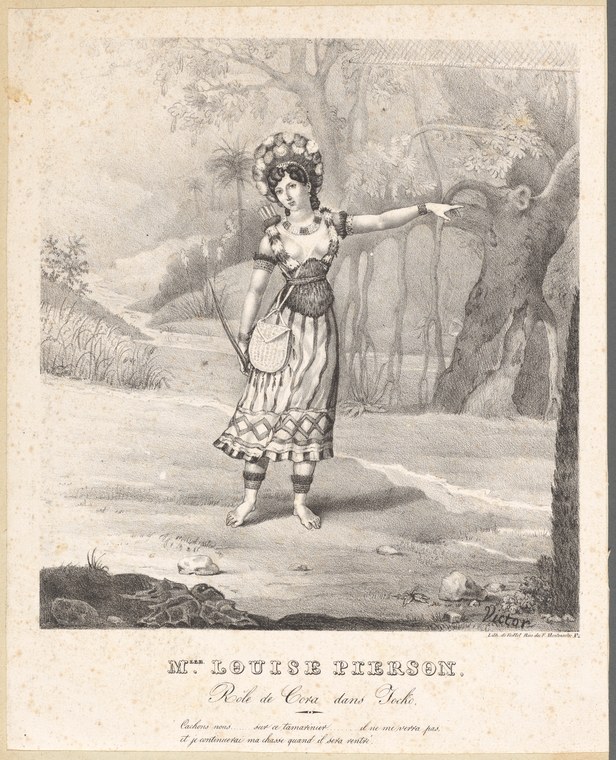
Mlle. Louise Pierson, rôle de Cora dans Jocko
Unknown artist
- Collection:
- Prints depicting dance
- Source:
- New York Public Library
- Rights:
- Public domain — free to use, share and adapt.
- Recorded as:
- Public Domain
This image documents the Romantic-era solo female role and the gestural, mime-based vocabulary that characterized theatrical dance of the 1850s—a crucial moment in ballet history when pantomime and narrative overtook pure technique as the primary means of expression. It also provides rare visual evidence of a named female performer in a specific role, allowing us to see how dancers of this era inhabited their characters and what audiences expected to witness on stage.
What you are looking at
A woman in classical theatrical dress stands alone in a wooded landscape, her body turned in contrapposto with one arm extended toward a large tree. She wears a white muslin dress with decorative hem, a jeweled headdress, and what appears to be a short classical tunic or overskirt. The setting is romantic and naturalistic—trees frame the composition, foliage suggests a forest or garden, and the ground is indicated with minimal detail. Her pose is arrestingly theatrical: weight shifted, one leg forward, the extended arm gesturing with palmed hand as if addressing or beckoning something beyond the frame. The engraving technique creates soft atmospheric depth through fine parallel lines, with darker tones in the trees giving way to lighter sky. The overall mood is one of classical reverie or dramatic soliloquy.
The dancing
A single figure stands in a refined contrapposto stance characteristic of neoclassical statuary and academic painting. Her upper body is turned to face left, with her right arm extended at roughly shoulder height, palm open, in a gesture of address or supplication. Her left arm hangs at her side. The weight appears shifted onto the back leg, creating an elegant S-curve through the body. Her head turns toward the extended arm, completing a unified directional impulse. There is no partnered action; the dance, if present, is one of solo expressivity and dramatic address to an imagined presence or audience.
The dance depicted
This is a theatrical dance from the Romantic era, most likely a solo from a pantomime-ballet of the mid-19th century. The role is identified as 'Cora' from *Jocko*, a pantomime-ballet (also known as *Jocko, ou Le Singe du Brésil*) that premiered in 1855 and became a popular vehicle for principal dancers. The costume and pose suggest a moment of dramatic declaration or address—characteristic of the expressive solo passages in Romantic-era theatrical dance, where emotion was communicated through arms, torso, and head rather than rapid footwork. The naturalistic woodland setting and classical costume align with Romantic ballet's fascination with exotic and nature-based narratives. The woman's solitary, gestural quality—extended arm, turned body, directed gaze—is typical of mid-19th-century theatrical mime combined with classical dance carriage.
How it was made
This is a steel or copper engraving, identifiable from the fine parallel line work (hatching and cross-hatching) used to build tone and shadow, particularly visible in the foliage and drapery. The technique allows precise reproduction and distribution of the image, suggesting this was a commercial print made for circulation—likely a theatrical souvenir or documentation of a celebrated dancer's role. Engravings of this type were affordable and popular, reaching a broad urban audience interested in theatrical celebrity and the latest ballet productions. The artist's signature appears in the lower right corner, though it is not fully legible in reproduction.
About this work
This engraving documents Mademoiselle Louise Pierson performing the role of Cora in *Jocko, ou Le Singe du Brésil*, a successful mid-19th-century pantomime-ballet. It captures a single moment of solo dramatic expression—a woman in classical dress, gesturing into a woodland landscape—representing the theatrical dance of the Romantic era. The work is both a record of a specific performer and role and a window into how theatrical narrative and emotion were conveyed through the body in Romantic ballet, emphasizing classical carriage, expressive gesture, and dramatic address rather than virtuosic technique. As a commercial engraving, it served as a souvenir and publicity document, circulating to audiences interested in theatrical performance and ballet celebrity.
How to look at it
Notice the pose: the dancer is not in motion, but in a moment of gestural utterance—this is mime and dramatic address, not footwork or leaps. The extended arm and turned body create a classical line that the engraver has clearly taken care to preserve and elegantly render. Observe how the artist has positioned the figure to fill the composition with her emotional intention rather than action; the woodland setting is atmospheric but secondary. The moment chosen is one of contemplation or address, inviting the viewer to imagine what the character is saying or feeling through her gesture.
The artist
The artist is not recorded in the catalogue. The signature, though present, is not clearly legible in available reproductions. The engraving appears to be a professional commercial work, likely made for theatrical distribution and sale to the public. Such engravings were typically commissioned by theatres or produced by print publishers who specialized in theatrical portraiture and scenes.
The period
This work dates to the mid-19th-century flowering of Romantic ballet. *Jocko* premiered at the Théâtre de la Porte-Saint-Martin in Paris in 1855 and became a popular vehicle for leading dancers, known for its exotic Brazilian setting, animal transformation sequences, and prominent mime-based roles. The 1850s saw the height of the star system in ballet, with celebrated ballerinas commanding substantial fees and roles written to showcase their particular gifts. Theatrical engravings and lithographs of celebrated dancers and scenes were major commercial products, feeding urban appetite for theatrical culture and allowing fans to collect images of their favorite performers.
Where it lives
The work is held in the New York Public Library's print collection dedicated to dance imagery. It is a commercial theatrical engraving, a form of mass-produced documentation and memorabilia common to the 19th-century theatrical industry.
Dance in this work
Questions about this work
What was *Jocko*?
*Jocko, ou Le Singe du Brésil* (Jocko, or the Monkey of Brazil) was a pantomime-ballet that premiered in Paris in 1855. It told the story of a shipwreck, a Brazilian setting, and a monkey's adventures and transformations. The narrative relied heavily on pantomime and dramatic gesture, making it a vehicle for actors and dancers skilled in mime as well as movement. It enjoyed considerable popularity and was performed by leading dancers of the era.
What does 'role di Cora' mean?
Cora is a character within the *Jocko* narrative. The phrase 'rôle de Cora dans Jocko' identifies the specific character being portrayed by Louise Pierson in this image—she is not simply a dancer, but an actress-dancer inhabiting a named dramatic part.
How was theatrical dance documented in the 1850s?
Before photography became widespread in theatrical use, engravings and lithographs were the primary visual records of performances and performers. Theatres commissioned or published prints of celebrated dancers in costume and in character, creating a merchandise and publicity function. These prints circulated among theatregoers as souvenirs and served as documentation of the era's most celebrated roles and performers.
What is the difference between engraving and lithography?
Engraving is an incised, intaglio process where an image is carved into a metal plate; lithography is a surface process based on the repulsion of oil and water. Engravings typically show fine parallel lines (hatching) and were often more expensive to produce but could yield more impressions. Both were common in theatrical documentation of this period.
More dance artwork





